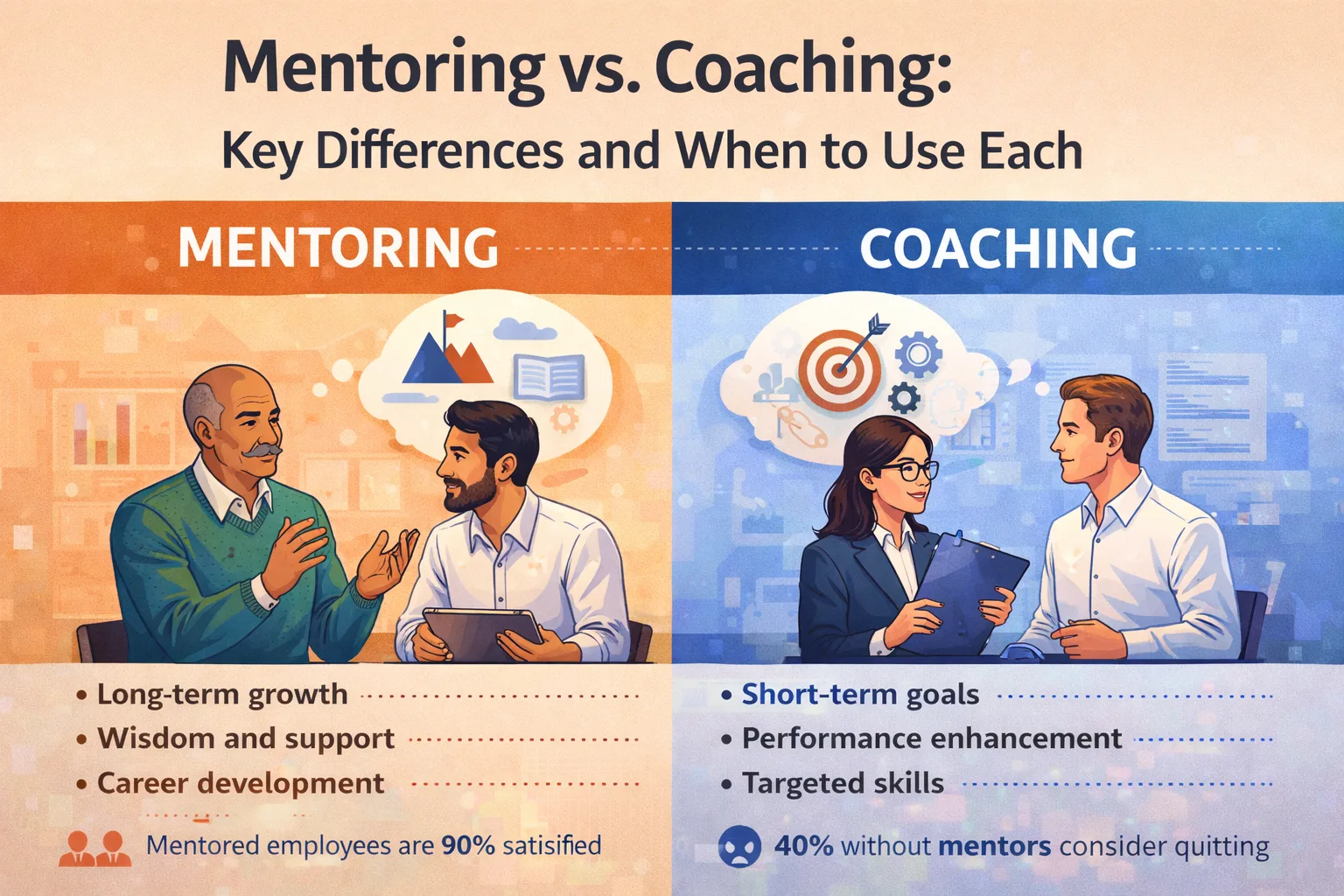
Statistics show that mentored employees are happier at work, with 90% reporting job satisfaction. The numbers paint a stark contrast – 40% of employees without mentors have thoughts about quitting. The difference between coaching and mentoring plays a more vital role than most realize.
Many people use coaching and mentoring as interchangeable terms. Understanding their unique roles can significantly affect professional development. A coach works on targeted performance enhancement through time-bound processes.
Mentoring takes a broader view and focuses on long-term personal and professional growth. Research backs these methods’ effectiveness – 70% of coached individuals see better work results, and 86% of businesses recover their coaching investment.
Coaching and mentoring serve distinct purposes at various career stages. A coach drives performance toward specific goals, while a mentor provides broader wisdom and ongoing support.
Let’s examine these development methods’ unique characteristics and ideal applications.
What is the difference between mentoring and coaching?
Coaching and mentoring, while often used interchangeably, serve fundamentally different purposes in professional development. The difference between these approaches helps organizations match the right support to specific growth needs.
Definition of coaching: structured, goal-oriented, short-term
Coaching is a structured process that improves specific skills or performance within a defined timeframe. The International Coaching Federation states that coaching involves “partnering with clients in a thought-provoking and creative process that inspires them to maximize their personal and professional potential.”
At its core, coaching is:
- Goal-oriented – Coaches help individuals set and achieve measurable objectives
- Performance-driven – Focused on enhancing specific skills or addressing performance issues
- Time-bound – Typically lasting from a few weeks to several months
- Structured – Following clear frameworks with regular check-ins
A coach doesn’t need firsthand experience in what they’re coaching. They use targeted questions and feedback to guide individuals toward finding their own solutions. The relationship stays formal, with clear agendas and measurable outcomes.
To cite an instance, see coaching as precision training. The coach observes your technique, gives immediate feedback, and helps you adjust until you become skilled at the task. A leadership coach might work with new managers over 3-6 months to develop specific communication skills needed for their role.
Definition of mentoring: relationship-based, long-term, all-encompassing approach
Mentoring creates a nurturing relationship where an experienced person (mentor) guides someone less experienced (mentee) through their professional experience. Unlike coaching’s targeted approach, mentoring offers detailed guidance across multiple aspects of career and personal growth.
Key characteristics of mentoring include:
- Relationship-centered – Built on trust and personal connection
- Development-focused – Aimed at overall career and personal growth
- Long-term – Relationships often last a year or longer
- Experience-based – Mentors share wisdom gained from their own experiences
A mentor’s role extends beyond skill development to include emotional support, career guidance, and network expansion. The mentoring relationship becomes more relaxed, with meetings guided by the mentee’s needs rather than strict schedules.
Rafael Nadal and his mentor Toni Nadal provide a perfect example. Beyond technical training, Toni instilled values like humility and resilience that shaped Rafael’s whole approach to tennis and life. This comprehensive influence exemplifies true mentoring.
Coach vs mentor: key conceptual differences
The differences between coaching and mentoring affect how each approach delivers value:
- Driving force: The coach typically drives the relationship with structured sessions and goal-setting. The mentee leads mentoring relationships by determining priorities and requesting guidance.
- Knowledge transfer: A coach guides you to find your own answers through thoughtful questions. One expert explains, “A coach does not give answers to a coachee, but they ask questions to help the coachee find the answers. Mentors directly share knowledge, experiences, and solutions.
- Feedback approach: Coaching provides evaluative feedback aimed at performance improvement, often tied to specific metrics or KPIs. Mentoring offers more supportive guidance focused on overall development rather than immediate performance.
- Expertise requirements: Coaches typically have specialized training in coaching methodologies, while mentors rely primarily on their personal and professional experiences. You don’t need certification to be an effective mentor, though formal training exists for both roles.
Both approaches add tremendous value, especially when paired with tools like MentorCity that can match individuals with the right type of support based on their specific needs.
Note that organizations benefit from offering both coaching and mentoring, addressing different developmental needs at different career stages.
Core differences between coaching and mentoring
Coaching and mentoring are different in five essential ways. Organizations need to know these differences to pick the right approach that matches their development needs.
Timeframe: short-term vs long-term
The length of the relationship shows a clear difference between coaching and mentoring. A coaching relationship usually runs from a few months to about a year. The focus stays on reaching specific goals within set timelines.
Mentoring creates a lasting bond. These relationships last at least six months but often go on for many years. This longer timeline lets mentees grow steadily and build stronger bonds with their mentors.
“Mentoring relationships are long-term because they focus more holistically on career development. The extended period helps address broader career goals that need ongoing guidance.
Focus: performance vs development
The core goals of coaching and mentoring set them apart. Coaching targets performance and aims to improve specific skills or tackle particular challenges. Coaches help employees boost their current abilities or fix performance issues.
Mentoring looks at the bigger picture and focuses on overall growth beyond just performance. The priority lies in long-term personal and professional development through guidance and strategic advice. This growth-focused approach helps mentees direct their career paths and get ready for future roles.
Structure: formal vs informal
These relationships follow different formats. Coaching uses a well-laid-out process with clear, measurable goals and scheduled meetings. Each session follows specific agendas and timelines.
Mentoring works in a more relaxed and flexible way. Regular meetings help, but mentees can ask for guidance whenever needed. This flexibility opens up natural conversations and addresses new concerns.
Here’s a quick comparison:
- Coaching structure: Clear goals, scheduled sessions, formal evaluations
- Mentoring structure: Flexible timing, adaptable agendas, relationship-based talks
Relationship: coach-led vs mentee-led
Leadership style marks a key difference between these approaches. Coaches or supervisors usually set the agenda in coaching. Since coaching links to performance, coaches often pick the priorities and topics.
Mentoring works the opposite way. Mentees take “the driver’s seat” and set their goals and topics. This approach gives people the ability to own their development while learning from experienced professionals.
This affects accountability, too. Both coach and employee share responsibility in coaching. In mentoring, mentors guide and support, but mentees stay mainly accountable.
Feedback style: evaluative vs supportive
Feedback works differently in each approach. Coaching gives constructive, evaluative feedback aimed at specific improvements. This often ties to measurable performance metrics and company goals.
Mentoring takes a more supportive approach. Mentors suggest possible actions, but mentees choose how to use that advice. This creates a safe space to discuss challenges without worrying about formal assessment.
One expert puts it this way: “Mentoring is non-evaluative, while coaching is based on measuring performance change, whether through company performance reviews or coaching tests.
When exploring mentoring vs. coaching, key differences and when to use each, tools like MentorCity can help match participants and track progress based on your development goals.
Both methods bring great value when used correctly. Success comes from understanding these basic differences and choosing what fits best.
Real-world examples of coaching vs mentoring
Ground applications show how coaching and mentoring serve different developmental purposes. These examples highlight distinct approaches and their measurable effects on professional growth.
Coaching example: leadership development for new managers
Leadership coaching helps new managers transition from individual contributors to skilled team leaders. Financial services firms identify promising team members and pair them with executive coaches to build leadership presence, delegation skills, and conflict management abilities. This focused approach helps new managers handle people management’s emotional intelligence requirements.
A look at Salesforce shows how senior developers coach junior staff on AI integration, which speeds up project completion by 40%.
The process stays well-laid-out and focused on goals:
- Coaches observe specific leadership behaviors
- They give immediate, applicable feedback
- Sessions target measurable growth in defined competencies
“Coaching prepares emerging leaders for future roles and ensures effective succession planning within the organization,” notes one leadership development expert. The results are clear, AT&T’s coaching program builds confidence in frontline employees who grow into supervisory positions.
The relationship remains brief but effective. One executive worked with a leadership coach to improve communication and conflict resolution skills. Through focused sessions, the coach helped identify leadership style, strengthen interpersonal relations, and create effective team management strategies. This goal-focused approach brought clear performance gains.
Mentoring example: career guidance for junior employees
Unlike coaching’s targeted focus, mentoring gives complete career guidance to junior staff. Mastercard’s mentoring breaks down silos by connecting employees who share ambitions across departments. Their system creates mentor pairings based on capabilities rather than just seniority.
The University of North Carolina’s pharmacy school shows this through their Bill and Karen Campbell Faculty Mentoring Program. This 7-year-old program supports junior faculty in pharmacy research’s changing world. Junior faculty members grew academically while mentors opened valuable networking doors.
Mentoring relationships grow naturally through:
- Regular guidance and emotional support
- Trust-building over time
- Complete career development across multiple skills
Cooley Law Firm recognized that complex legal work needs quick onboarding for new attorneys. Their Cooley Academy Mentoring Program (CAMP) links new employees with experienced attorneys and creates support systems that speed up competency.
Mentoring programs support employees in developing their careers by providing guidance and skill enhancement. This leads to increased employee engagement and productivity, directly benefiting the organization’s return on investment,” according to industry research.
Reverse mentoring: younger employees mentoring senior staff
Reverse mentoring changes the traditional model, in which junior employees mentor senior leaders. Jack Welch started this approach at General Electric in 1999, where younger staff taught executives about digital trends.
This practice now shows remarkable results across industries. Labcorp’s younger employees from diverse backgrounds mentor executives on inclusion, and 50% of these diversity mentors earned promotions since 2020. Siemens created a program where junior engineers taught senior executives about AI automation tools, which boosted efficiency by 20% in certain processes.
Lilly created a reverse mentoring program that matched LGBTQ+ employees with senior leaders to promote inclusion. PwC’s program made an even bigger difference: junior employees from underrepresented backgrounds mentored senior leaders, revealed unconscious biases, and sparked policy changes that improved diverse talent retention.
“In reverse mentoring, younger employees are more likely to be earlier adopters of new technological practices. This continuous learning format enables senior employees to sharpen their skills,” explains one organizational development expert.
The right approach, coaching, mentoring, or reverse mentoring, depends on specific development needs.
Conclusion
The difference between coaching and mentoring is nowhere near just academic wordplay.
Our exploration shows how these two development approaches complement each other while serving different purposes in professional growth.
Coaching delivers targeted, performance-driven interventions with clear timelines and well-laid-out processes. Mentoring takes a different path with relationship-centered guidance that grows naturally over time.
These approaches deliver powerful results. Coaching leads to measurable performance gains, closes skill gaps, and prepares leaders to handle challenging transitions.
More must-read stories from Enterprise League:
- Learn essential management fundamentals to guide your team effectively.
- Discover the truth about leadership in business and management.
- Understand how negative micromanagement effects destroy team productivity and morale.
- Build stronger connections through professional network development strategies that work.
- Recognize the warning signs of a bad boss before it’s too late.