
The debate over whether to build financial software internally or farm IT out to external vendors usually misses the point entirely. Most technical leaders treat this like a religious war. You are either a pure engineering culture that builds everything from scratch, or you are a business-first operation that delegates everything to third parties. Both extremes are massive liabilities in 2026. The financial technology sector is changing too quickly for rigid thinking.
Scaling a digital financial product today requires a completely different mindset. The old models of hiring armies of internal developers or tossing entire projects over a wall to an offshore agency are dead. Modern growth relies on finding a precise balance between protecting your intellectual property and using external speed. If you get this balance wrong, you will burn through your capital before you ever reach product-market fit.
The ego trap in engineering culture
Founders and technical leads often fall in love with their own code. There is a deep-seated belief that controlling every aspect of the technology stack creates a protective moat around the business. This was somewhat true ten years ago when off-the-shelf financial infrastructure was clunky and rigid. Today, building a proprietary payment gateway or a custom ledger from scratch is usually a poor allocation of capital.
IT takes months of careful planning and thousands of engineering hours to replicate what specialized vendors have already perfected. You burn through your runway paying premium salaries to solve problems that someone else solved five years ago. Furthermore, retaining top-tier engineering talent is increasingly difficult. When a senior internal developer leaves, their undocumented institutional knowledge often walks out the door with them, leaving the rest of the team scrambling to decipher legacy code.
Your engineering talent should focus entirely on what makes your product uniquely valuable to the user. Everything else is a distraction. Writing code for the sake of writing code is not a business strategy. IT is an ego trip that slows down product releases and bloats operational budgets.
The core versus context framework
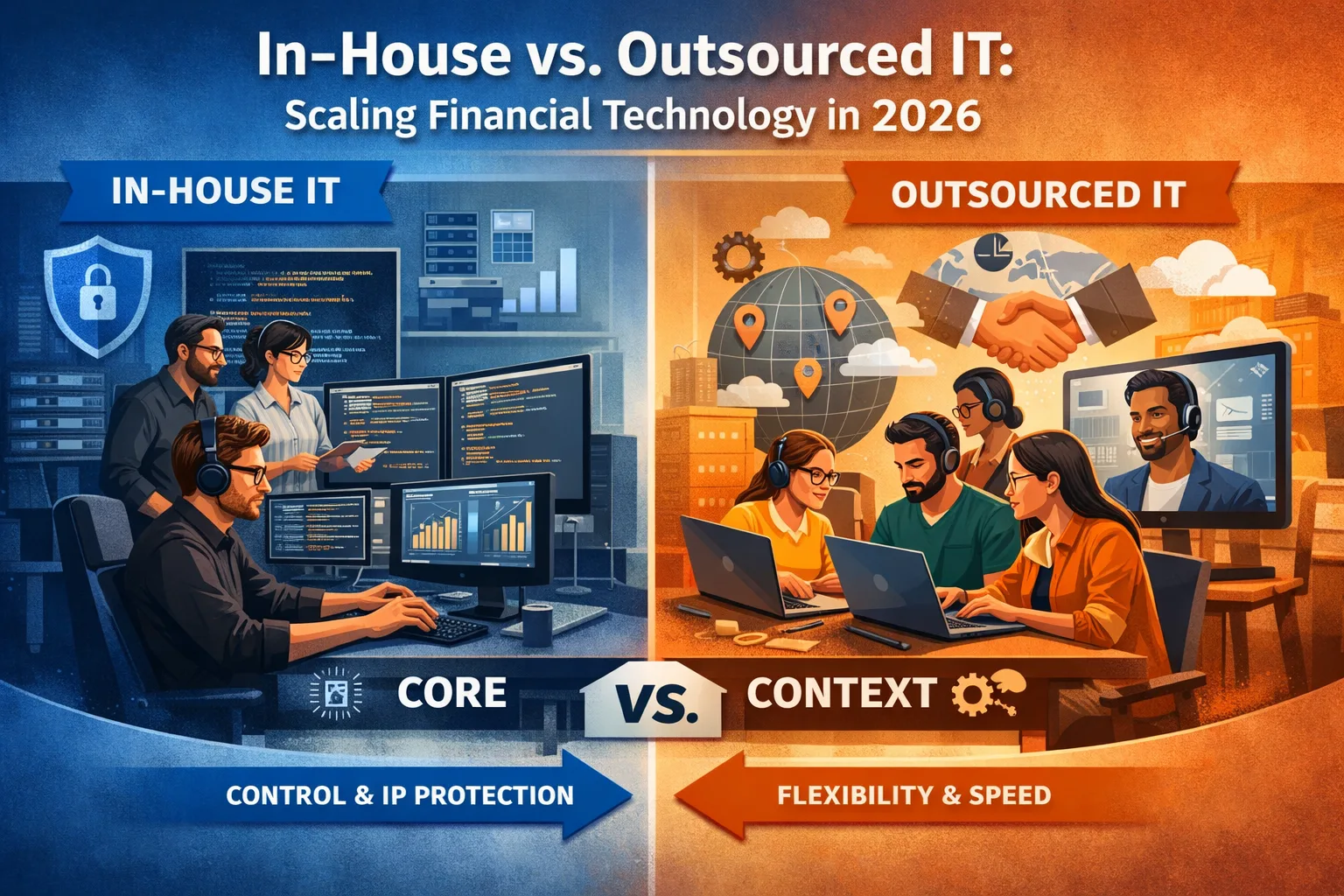
To make smart decisions about scaling technology, you need to ruthlessly separate your operations into two buckets. Core operations are the specific features and algorithms that directly generate revenue and differentiate your product from competitors. Context operations are all the necessary backend systems that keep the lights on but do not win you any new customers.
If you are building an algorithmic trading platform, your pricing models and execution logic are core. Your user authentication flow, basic ledger maintenance, and generic API integrations are context. Scaling effectively means hoarding your best internal talent for those core operations. You hand off the context to external experts who can execute faster and cheaper. This requires a level of organizational discipline that many startups simply lack.
Founders struggle with this because letting go feels like losing control. But control is an illusion if your team is moving too slowly to capture market share. By applying the core versus context framework, you force your company to prioritize innovation over basic infrastructure maintenance.
Strategic delegation in practice
Moving context operations outside the building does not mean throwing requirements over a wall and hoping for the best. The modern approach is deeply collaborative. You integrate external developers into your daily workflows so they function as a seamless extension of your own team. They join your standup meetings, communicate in your Slack channels, and follow your internal coding standards.
This model gives you the flexibility to ramp up resources during heavy development phases and scale down when the product stabilizes. Smart leaders know exactly when to bring in outside help. If your internal team lacks specific experience with regulatory compliance or complex payment routing, you do not wait six months to hire and train someone. You look outside. For instance, partnering with a dedicated fintech software development company can significantly cut down time-to-market while reducing operational overhead.
This approach keeps your internal roadmap completely unblocked. Your core engineers never have to pause work on a critical revenue-generating feature just to patch a secondary database or update a compliance reporting module. The machine keeps moving forward on all fronts simultaneously.
Managing hidden vendor risks
Working with external partners carries its own set of dangers. If you do not structure the relationship correctly, you can end up with code that your internal team does not understand or cannot maintain. The handoff process must be documented with extreme clarity from day one. You also have to guard against vendor lock-in by keeping your architecture as modular as possible.
The most successful companies treat their external partners as temporary accelerators rather than permanent crutches. They set up clear service level agreements and demand transparent testing protocols. If an external team builds a feature, they must also provide the automated testing suite to support IT. This lets you use external speed without sacrificing long-term stability or security.
You must also carefully evaluate the long-term financial implications. Many organizations underestimate the long-term maintenance costs of in-house infrastructure, pushing them toward specialized external partnerships to maintain lean operations. When done correctly, this shifts heavy capital expenditures into predictable operational expenses.
Building a hybrid architecture
The winning playbook for 2026 is a hybrid architecture. Your internal team acts as the brain of the operation. They design the system architecture, write the core intellectual property, and manage the product vision. External teams act as the muscle. They execute the heavy lifting on third-party integrations, compliance reporting dashboards, and user interface development.
This separation of duties creates a highly resilient organization. When market conditions change quickly, you can pivot your internal strategy without getting bogged down in backend refactoring. Your external partners absorb the shock of sudden scaling requirements, letting your core team stay focused on the horizon.
This hybrid approach also changes how you hire. Instead of recruiting dozens of mid-level developers to churn out basic features, you hire a handful of elite senior architects. Their primary job becomes orchestrating the work of your external partners and reviewing pull requests to keep the code quality impeccably high.
Optimizing your build-or-partner matrix
There is no perfect formula for how much to build versus how much to buy. The ratios will shift constantly as your company matures and market dynamics change. What matters is building a culture that values speed and efficiency over engineering vanity. Every line of code you write internally is a liability you have to maintain forever. You want to keep those liabilities as low as possible.
Look at your current product roadmap and ask yourself hard questions about where your team is actually creating unique value. If you are spending weeks building tools that already exist in the market, you are moving too slowly. The companies that dominate the next phase of financial technology will be the ones that master the art of strategic delegation.
Stop trying to reinvent the wheel. Focus your capital on the engine, the steering, and the destination. Let specialized partners handle the rest. This is how you outpace competitors who are still trapped in the legacy mindset of owning every single line of code.
FAQ about in-house vs. outsourced IT: scaling financial technology in 2026
Why is building everything in-house no longer recommended for financial startups?
Building everything internally burns capital on non-differentiating features. IT forces companies to spend months replicating systems that specialized vendors have already solved, slowing down the time to market and wasting expensive engineering resources.
How do you determine what parts of a financial application to outsource?
You should outsource context features that do not directly generate revenue or differentiate your product from competitors. Keep your internal engineering talent focused strictly on the core logic and unique user value.
Does outsourcing technology increase security risks?
Not if handled correctly. External teams specializing in financial software often have deeper expertise in strict compliance protocols and data security standards than an early-stage internal team.
What is the biggest mistake companies make when working with external developers?
Many companies fail to integrate external teams into their daily workflows. Treating partners as a separate entity rather than an extension of the internal team leads to misaligned expectations and poor code quality.
How can a hybrid team structure improve scalability?
A hybrid structure allows internal teams to focus on strategy and proprietary features while external partners handle heavy technical execution. This allows the business to scale operations up or down quickly without complex hiring processes.
More must-read stories from Enterprise League:
- Discover why companies are choosing managed IT services over internal teams.
- Learn essential financial management strategies for scaling technology businesses effectively.
- Explore how automation tools can streamline your technology operations today.
- Understand the real costs when outsourcing app development to external teams.
- See how investing in cybersecurity protects your growing financial technology infrastructure.