
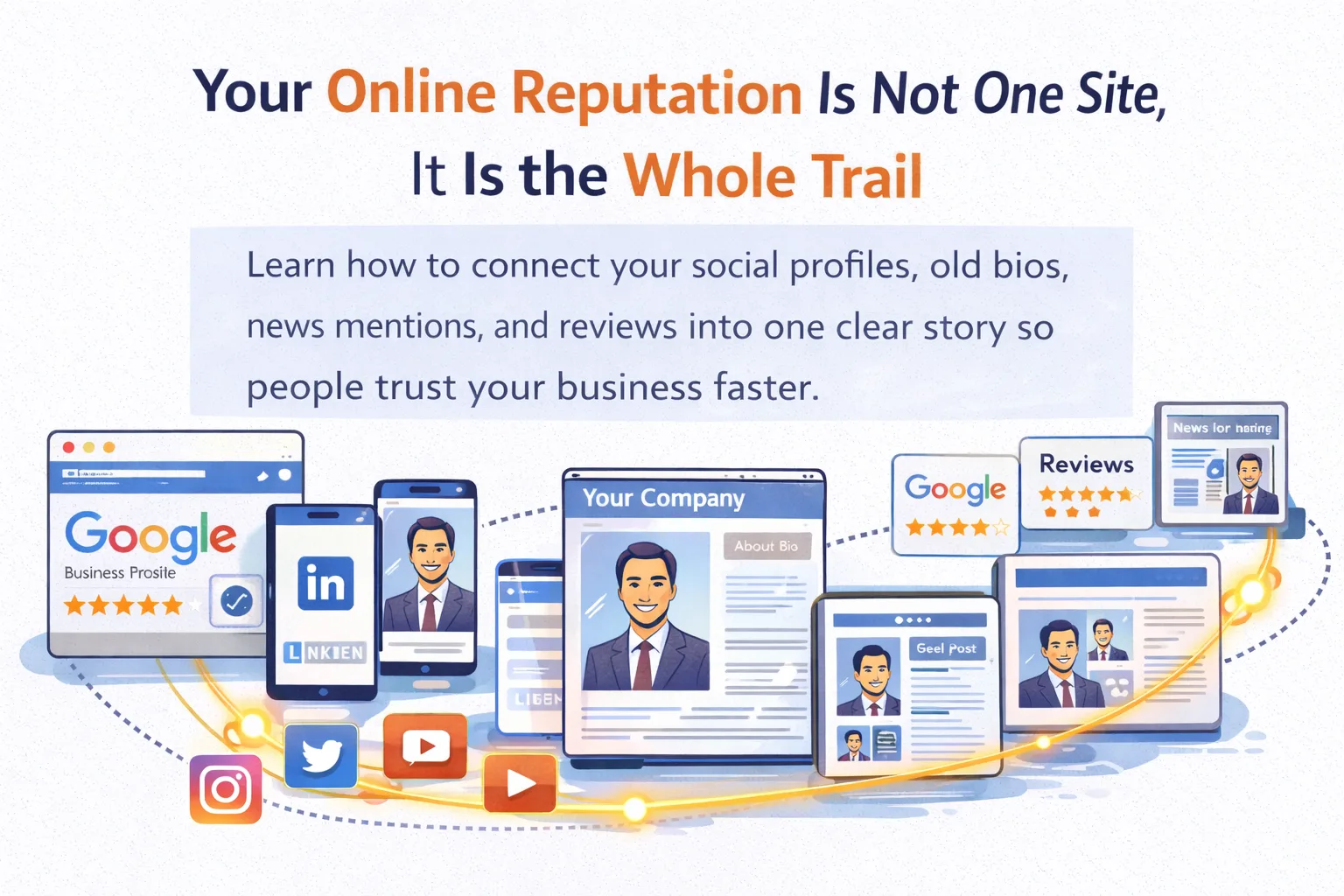
Learn how to connect your social profiles, old bios, news mentions, and reviews into one clear story so people trust your business faster.
Most founders think their reputation lives in one place, like a Google Business Profile, a LinkedIn page, or a single article. In reality, people rarely stop at just one result.
They click a few links, skim your About page, scan your reviews, and then build a quick “mental profile” of you and your business. If those touchpoints match, you look established. If they contradict each other, you look risky, even when you are not.
This guide explains how the trail works, where it usually breaks, and how to keep your story consistent without turning your life into a full-time cleanup project.
What is the “reputation trail”?
Your reputation trail is the collection of public signals that show up when someone searches your name, your company, or both. It includes owned assets (things you control) and third-party assets (things you do not control).
Most trails include:
- Your website and About page
- Social profiles (LinkedIn, X, Instagram, YouTube, TikTok, GitHub, Medium, etc.)
- Old bios on partner sites, podcasts, conference pages, and guest posts
- Reviews (Google, Yelp, G2, Trustpilot, industry directories)
- News mentions, press releases, and industry features
- Business listings and data broker profiles
- Images, snippets, and “People also ask” results
Key Takeaway: People do not judge you from one page. They judge you from patterns across multiple pages.
Why consistency matters more than “perfection”
A mismatched trail creates doubt. Doubt kills deals, partnerships, and hires.
Here is what “mismatch” looks like in the real world:
- Your LinkedIn says you are a founder, but your website shows you as a consultant
- An old conference bio lists a company you left years ago
- Your Google reviews mention a service you no longer offer
- A news article describes your company in a way that does not match your current positioning
- Your brand name appears in listings with the wrong phone number or address
Even small inconsistencies can feel like “something is off.” And because trust in business is not unlimited, you do not want to give people extra reasons to hesitate.
How the trail connects behind the scenes
Most founders underestimate how connected the web is. Here is why one old bio can keep showing up for years:
Search engines reward confirmation
When multiple sources repeat the same details (name, title, company, niche, location), Google gets more confident. That confidence can help those pages rank.
Scrapers copy everything
Directories, “profile” sites, and aggregator blogs often pull content from each other. One outdated page can get cloned into ten more.
Knowledge panels and snippets are built from many sources
Those little info boxes are not just “from Google.” They are built from sources Google trusts and can connect.
Did You Know? Review behavior trends show many consumers still check more than one site before deciding, which means your trail is often compared across platforms, not viewed in isolation.
What do reputation management efforts actually do?
If you want a consistent trail, you need a repeatable system. The goal is not to “control the internet.” The goal is to reduce confusion and strengthen credibility.
Here are the core activities that usually move the needle:
- Asset alignment: Make sure your website, social profiles, and listings match the same positioning, services, and proof points.
- Content hygiene: Update old bios, speaker pages, directory profiles, and any “about the founder” pages you control.
- Review visibility and response: Build a steady habit of earning, monitoring, and responding to reviews in a way that matches your brand voice.
- Search-result triage: Identify what ranks on page one and page two for brand and founder searches, then prioritize fixes.
- Suppression planning: If harmful or irrelevant results rank highly, build stronger, more relevant assets that can outrank them over time.
Benefits of managing your trail as one story
Treating your online presence as a connected system gives you practical benefits:
- Faster trust in sales calls because prospects see the same story everywhere
- Fewer awkward questions from partners and investors (“why does this bio say…?”)
- Less hiring friction when candidates research leadership
- Better conversion from branded search (people searching your company name)
- Reduced risk when something negative appears, because your page-one footprint is stronger
Key Takeaway: Consistency reduces “trust tax.” You spend less time proving you are real.
The most common trail problems founders run into
1) Old bios that outrank your current story
This happens when you spoke at an event, did a podcast, joined an accelerator, or got featured years ago. Those pages often have high authority and can rank for your name.
2) Too many “almost-right” profiles
Different usernames, different headshots, slightly different titles, different company descriptions. None of these are major issues on their own, but together they look messy.
3) Reviews that do not match your current business
Maybe you pivoted. Maybe you changed pricing. Maybe you shifted industries. People still use reviews as a quick proxy for what it is like to work with you.
4) Listings with wrong contact info
This can create real operational damage, not just reputation damage. Missed calls and misdirected leads add up.
5) One negative result that anchors the whole search
When page one contains a harsh forum thread, a complaint post, or a bad press mention, people may assume it is the “real story,” even if it is outdated or one-sided.
How much does it cost to keep the trail clean?
There is no single price because the work depends on how complex your footprint is. But most founders fall into one of these buckets:
- DIY maintenance (low cost): A monthly routine and a simple tracker. Best if you have a small footprint and no major negative results.
- Hybrid (moderate cost): You handle updates and reviews, but bring in help for removals, suppression strategy, or high-stakes issues.
- Full support (higher cost): Best if you have frequent press, a growing team, investor visibility, or recurring reputation attacks.
Cost drivers usually include:
- How many profiles and listings you need to update
- Whether negative content requires removal, deindexing requests, or suppression
- How many locations your business has
- How regulated your industry is (health, finance, legal, etc.)
- How fast you need results
Tip: Even if you hire help, keep a simple “source of truth” doc with your official bio, positioning statement, logo files, and brand description. That one doc prevents future drift.
How to keep your story consistent
Use this as a practical checklist. Most founders can do steps 1 to 3 in one afternoon, then turn it into a monthly habit.
1) Map your trail like a customer would
Search these variations in an incognito window:
- Your full name
- Your name + company
- Your company name
- Your company name + reviews
- Your company name + scam (yes, check it)
- Your company name + complaints
Create a short list of what shows up on page one and page two.
2) Choose your “story spine”
Your story spine is a short set of facts that should match everywhere:
- What you do
- Who you do it for
- What makes you different
- Proof points (results, clients, credentials, coverage)
- How to contact you
Write a 60 to 90 word version and a 150 to 200 word version. These become your standard bios.
3) Align your owned assets first
Start with what you control:
- Website homepage and About page
- Founder bio page (if you have one)
- LinkedIn headline and About section
- Pinned posts or featured sections
- Brand messaging on your top social platforms
If your owned assets are unclear, everything else will feel unclear too.
4) Update your “high authority” third-party pages
Look for pages that rank well and are easy to fix:
- Speaker profiles
- Podcast guest pages
- Accelerator or alumni pages
- Guest author bios
- Company directory listings you can claim
These often have strong domain authority and can shape search results quickly once updated.
5) Build a monthly maintenance habit
Put this on your calendar:
- Check brand search results once per month
- Respond to new reviews weekly or biweekly
- Add one new proof point per month (case study, short post, interview, customer story)
Tip: Take screenshots when you find a problem. It helps you track changes and creates a record if you need to request edits later.
When to bring in professional help
If your issue is time-sensitive, legally complex, or spreading fast, it is worth talking to specialists. In those cases, online reputation management support can help you coordinate removals, suppression, and monitoring as one plan instead of a set of random tasks.
How to find a trustworthy provider (and avoid red flags)
Some services are helpful. Others are risky. Here are warning signs to watch for:
- “Guaranteed” ranking promises: No one controls Google’s algorithm, and anyone claiming certainty is overselling.
- No process transparency: You should understand what tactics are used, where content will be published, and what you will own.
- Pressure to sign long contracts immediately: It is reasonable to have terms, but you should have clear milestones and exit clauses.
- Shady review tactics: Buying fake reviews or incentivizing dishonest reviews can backfire and violate platform policies.
- One-size-fits-all packages: Your footprint is specific, so the plan should be specific too.
Key Takeaway: Trustworthy providers explain options, limits, and tradeoffs in plain English.
Online reputation trail FAQs
How long does it take to see improvements?
Small fixes (bios, listings, profile alignment) can help within weeks, especially if those pages already rank. Bigger changes (suppression, content strategy, review volume growth) usually take months, not days.
Can I DIY this without tools?
Yes, if your footprint is small and the issue is mostly “messy,” not “harmful.” A spreadsheet tracker and a monthly check-in goes a long way. Tools help when you need monitoring, alerts, or consistent reporting.
What causes old content to keep resurfacing?
Scraping, reposting, and high-authority sites. Once an old bio is copied and republished, it can become a long-term search result unless you update the original or build stronger assets that outrank it.
What if the information is true but outdated?
That is common. Start by updating what you control, then request updates from site owners where possible. If you cannot change it, the next best option is to publish newer, more relevant content that becomes the “main story” in search.
Conclusion
Your online reputation is not a single profile or a single review site. It is the full trail people follow when they decide whether to trust you.
If you treat that trail like a system, you will spend less time reacting and more time building. Start with the basics: map what shows up, define your story spine, align your owned assets, and build a simple monthly routine.
Over time, consistency compounds. And when something negative happens, you will have a stronger page-one foundation that helps your real story win.
More must-read stories from Enterprise League:
- Build trust by developing a customer-focused strategy that prioritizes their needs.
- Learn how bad branding can destroy your company’s reputation overnight.
- Discover why word of mouth remains the most powerful marketing tool.
- Protect your business from the hidden dangers of doing business on the internet.
- Master customer retention strategies to keep clients coming back.