
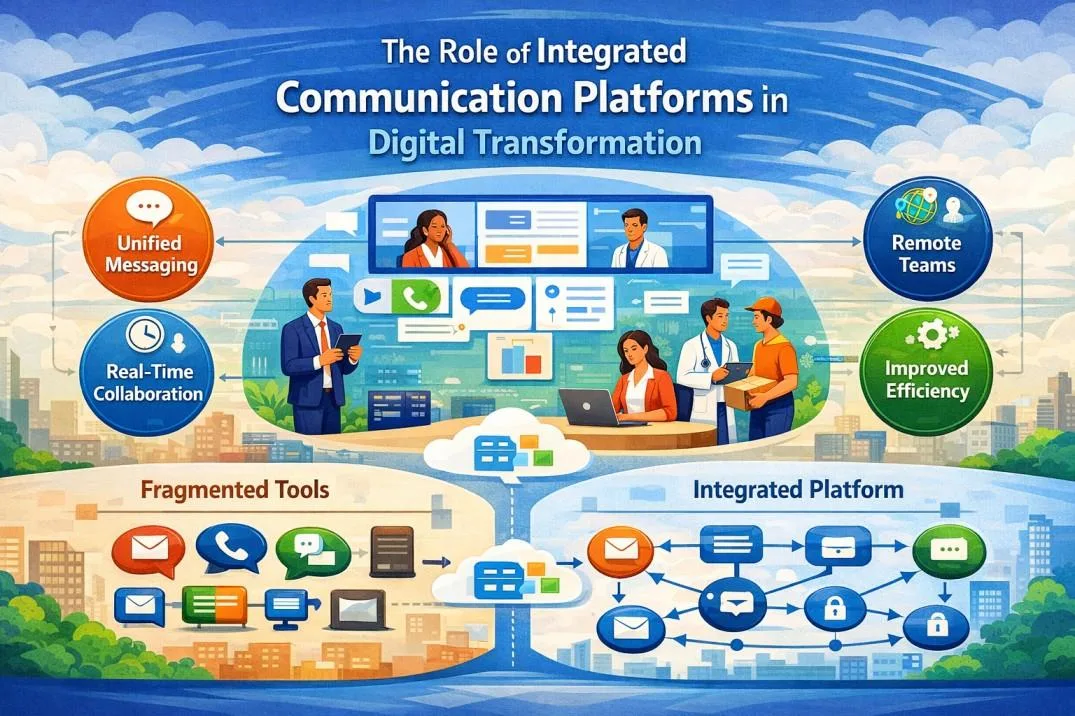
Digital transformation is something that people talk about a lot. They usually mention things like automation and making systems more modern. Companies spend money on technology to make their work easier, to be more efficient, and to provide better services. There is one very important thing that they often forget: how people communicate with each other in the company.
When companies get bigger, communication becomes more complicated. Teams work in different places using different systems and are in different time zones. Employees use different tools to stay informed, work together, and respond to changes. If there is no plan for communication, this can cause problems like information not being consistent, being late, or hard to find.
This is a problem in industries like banking, healthcare, government, and logistics where communication is very important for the work they do and for following rules. In these places, communication is not just about sharing information. It helps people make decisions, provide services, and manage risks.
Communication as part of digital infrastructure
In the past, communication was not considered a part of a company’s systems. Email, messaging tools, and internal websites were used to share information. They were not seen as essential. Things are changing now.
As companies go through transformation, communication is being seen as a fundamental part of their systems. It connects parts of the company, its processes, and its people. Without communication, even the best systems will not work as well as they should.
For example, if a company automates a process but does not make sure that the right people are informed in time, it can cause delays. Similarly, if a company introduces systems without making sure that communication is good across teams, it can lead to inconsistent use of those systems.
Integrated communication platforms solve this problem by allowing companies to make communication a part of their workflows. Instead of being separate tools, communication becomes part of how systems interact with each other.
This is part of a change in how communication technology is developing. A communication platform as a service lets companies add messaging capabilities to their existing applications, making their workflows better without replacing them.
The challenge of fragmentation
In companies, it is common for communication to be fragmented.
Different departments use tools that they like, and over time this creates a patchwork of systems that do not communicate well with each other. Employees have to switch between platforms to get information, and it is hard to see how communication flows across the company. This fragmentation causes problems.
First, it reduces consistency. Messages sent through one channel may not be the same as those sent through another, causing confusion. Second, it affects how quickly information is shared. Important updates may be delayed if they rely on processes or specific tools. Third, it limits accountability. Without a system, it is hard to track whether messages have been received or acted upon.
In industries that are heavily regulated, these problems are even bigger. Companies must show that communication has been delivered, understood, and in some cases acknowledged. Fragmented systems make this hard to do.
From multi-channel to integrated communication
Most companies already use different communication channels. They use email, SMS, mobile apps, and websites to communicate. However, just having many channels does not solve the problem.
The problem is not how many channels are used, but how they are managed.
An integrated approach brings all these channels together into one system. Instead of managing each channel separately, companies can coordinate communication across all channels from one place. This makes messaging more consistent and reduces the complexity of managing many tools.
It also reflects how people communicate in their lives. Individuals switch between channels depending on the situation without expecting the conversation to be disconnected. Companies are expected to provide that level of continuity.
Supporting consistency and reach
One of the benefits of integrated communication platforms is that they improve consistency.
When communication is managed from one place, companies can ensure that messages are the same across all channels. This reduces the risk of conflicting information and helps maintain clarity across teams.
At the same time, integrated platforms improve how far communication reaches. In a workforce that is spread out, employees may not all use the same systems. Some may rely on mobile devices while others work mainly on desktop platforms. By delivering messages across channels, companies can increase the chances that information reaches the right people.
This is particularly important for workers on the frontline, who may not have access to traditional communication tools. Making sure they get updates is essential for maintaining operational continuity.
Enabling targeted communication
As companies move away from one-size-fits-all systems, there is also a shift towards more targeted communication.
In the past, communication was often broad and sent to everyone. Messages were sent to entire teams or departments regardless of whether they were relevant. Over time, this approach has been shown to be ineffective as it leads to information overload and reduced engagement.
Integrated platforms enable companies to segment their audiences and deliver messages based on role, location, or function. This makes communication more relevant and increases the chances that it will be acted upon.
For example, operational alerts can be sent to specific teams while compliance updates are shared only with relevant departments. Leadership messages can be tailored to regions, ensuring that communication remains consistent while addressing local needs.
This level of targeting supports effective decision-making and helps companies manage complexity more efficiently.
Security and compliance considerations
In regulated industries, communication must meet strict security and compliance requirements. Financial institutions, healthcare providers, and government organisations handle sensitive information that must be protected. Communication systems must therefore ensure that messages are delivered securely and that access is controlled.
Integrated communication platforms are designed with these requirements in mind. They support encrypted messaging, access controls, and audit trails, enabling companies to maintain visibility over communication activities.
This is not only important for protecting information but also for demonstrating compliance. In regulated environments, companies must be able to provide evidence of communication, including delivery and engagement. By centralising communication, integrated platforms make it easier to meet these requirements and reduce the risks associated with fragmented systems.
Linking communication to operational outcomes
The impact of communication goes beyond internal processes. When communication is good, companies are better able to respond to changes, coordinate teams, and deliver services effectively. When it breaks down, the effects are often visible to customers and stakeholders.
For example, delays in communication within a logistics network can affect delivery schedules. In healthcare, miscommunication can disrupt patient care. In financial services, inconsistent messaging can undermine customer trust.
As a result, communication is being seen as part of a company’s operational performance. It is not just about sharing information but about making sure that information supports how the company operates.
The future of communication in digital transformation
As digital transformation continues, communication systems are changing.
There is a growing focus on making communication more integrated, adaptive, and responsive. Automation is being used to trigger messages based on specific events, reducing the need for manual intervention. Analytics are providing insights into how communication performs across channels.
At the same time, companies are trying to reduce complexity by consolidating tools and creating more unified systems. This reflects a change in how communication is understood. It is no longer seen as a support function but as part of the infrastructure that supports digital operations.
Conclusion
Integrated communication platforms play an important role in enabling digital transformation. By reducing fragmentation, improving consistency, and supporting targeted communication, they help companies operate more effectively in complex environments. They also support security and compliance requirements, which are essential in regulated industries.
As companies continue to change, the ability to manage communication as part of a unified system will become more and more important. It is not just about improving efficiency but about making sure that information flows in a way that supports how the company works.
In this context, communication is no longer just a tool. It is a core capability that underpins enterprise operations. Integrated communication platforms are essential for successful transformation, and companies that use them will be better equipped to succeed in a changing business environment.
More must-read stories from Enterprise League:
- Master remote team communication to enhance your digital workplace collaboration.
- Discover how marketing automation streamlines your business processes effectively.
- Learn why advantages of business process automation drive organizational efficiency.
- Explore essential software that small business owners need for growth.
- Understand how managed cloud services transform modern business operations.