If you’re still using raw, static screen recordings to promote your app, you’re losing money. It’s that simple.
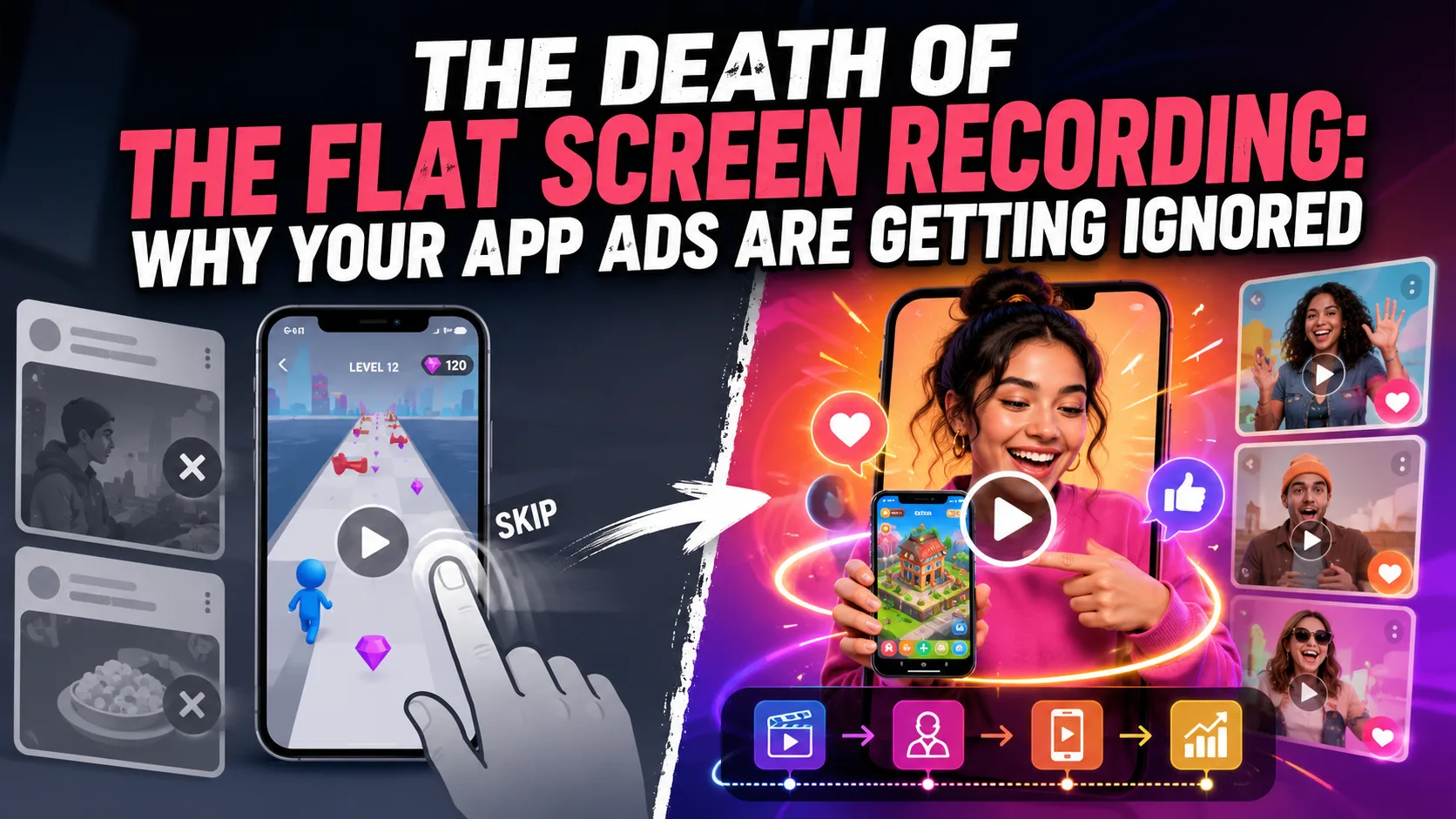
Five years ago, a flat screen recording of your app’s interface was enough to get a user to click. It was functional, clear, and informative. But today, it’s arguably the fastest way to get your ad skipped. The problem isn’t just that these recordings look outdated; they fundamentally misunderstand how users consume content on social platforms.
The modern user acquisition world on TikTok, Meta, and Reels runs on content, not commercials. Users have developed a sixth sense for “ad content.” The moment they see a flat, unedited screen recording, their brains categorize it as a corporate promotion and trigger the scroll. You aren’t just competing with other apps anymore; you’re competing with a never-ending feed of high-energy, relatable, and human-centric content. Your raw recording feels like a speed bump in that flow.
Why “native” is the only currency
The shift away from flat screen recording isn’t just about aesthetics; it’s about social proof and psychological connection. The traditional screen recording is cold. It lacks context. When a user sees it, they see an interface, not a solution to their problem.
Think about the last time you downloaded an app based solely on seeing its interface. You probably can’t remember, because that’s not how purchasing decisions work anymore. Users want to see themselves in your content. They want to understand not just what your app does, but how it fits into their daily routine, solves their specific pain points, and makes their life better.
To break through the noise, high-performing ads today rely on two critical elements: the human element and motion context. These aren’t just nice-to-have features; they’re essential components of modern app marketing.
When you introduce a digital human narrator or a dynamic presentation style, you fundamentally change the relationship between viewer and content. You aren’t showing a user an app interface anymore; you’re showing them a person experiencing the app. This creates an immediate layer of trust and relatability. It mimics the “UGC-style” content that users actually engage with on their feeds, effectively lowering the barrier for them to click through to your app store page.
The psychology behind this is straightforward. Humans are wired to pay attention to other humans. When we see a face, hear a voice, or watch someone interact with something, our mirror neurons fire up. We unconsciously imagine ourselves in that person’s position. A flat screen recording doesn’t trigger this response. It remains an abstract, corporate entity that users have trained themselves to ignore.
The production bottleneck
The pushback I hear from most teams is simple: “I don’t have time to produce high-end video.” And honestly, this used to be a valid concern.
Historically, creating dynamic, human-led creative required significant resources. You needed a video editor who understood motion graphics, a scriptwriter who could craft compelling narratives, and hours of painstaking work to produce even a single ad variation. For teams trying to test multiple creative concepts weekly, this approach was unsustainable.
But that was before we realized that every edit shouldn’t be manual. The game has changed, and if you’re still approaching video production the same way you did three years ago, you’re already behind.
If you are a growth team, you need to stop thinking like a production studio and start thinking like a software pipeline. You don’t need a custom edit for every variation. You need a system that can produce consistent, high-quality creative at scale.
Building a scalable creative system
We’ve shifted our workflow to automated tools like apptovid.com to bypass the manual design phase entirely. Instead of hiring an editor to cut screen recordings, we feed the store URL into an engine that generates these high-converting, dynamic formats with storytelling elements, digital avatars, and plot hooks automatically.
This approach solves multiple problems at once. First, it dramatically reduces production time from days to minutes. Second, it ensures consistency across your creative variations while still allowing for rapid testing. Third, it frees up your team to focus on strategy and optimization rather than getting bogged down in production details.
The beauty of this system is that it doesn’t require you to abandon your existing assets. Your flat screen recording can still serve as raw material. The difference is that now it becomes one component of a larger, more engaging narrative rather than the entire ad itself.
Consider what this means for your testing velocity. Instead of producing three ads per week, you can produce thirty. Instead of waiting days for feedback on whether a creative concept works, you can know within hours. This acceleration in testing speed directly translates to faster learning and better performance.
Why this shift matters
The goal isn’t to stop using your product footage entirely. Your app’s interface is still important, and users need to see what they’re downloading. The key is contextualizing that footage within a broader narrative framework.
When you wrap your app footage in a high-energy animated hook or a narrative-driven walkthrough, you provide the context that a raw recording lacks. You transform a functional screen grab into a visual story that resonates with viewers on an emotional level.
The data confirms the effectiveness of this shift. Teams that move away from raw recordings toward dynamic, “content-native” assets consistently see significant improvements in click-through rates. More importantly, they see improvements in conversion rates, because users who click through already understand the value proposition of the app.
The audience doesn’t want to be “sold” a screen recording anymore. They want to see how your app fits into their world, solves their problems, and improves their daily experience. A flat screen recording can’t communicate any of this. It shows features, not benefits. It displays functionality, not transformation.
The future of app advertising
The death of the flat screen recording isn’t just a temporary trend; it represents a fundamental shift in how users expect to discover new apps. As social platforms continue to prioritize engaging, authentic content over obvious advertisements, the gap between traditional app ads and successful app ads will only widen.
Smart teams are already adapting. They’re building creative production systems that can keep pace with the demands of modern social platforms. They’re investing in tools and processes that allow them to test dozens of creative variations without burning out their design teams. Most importantly, they’re recognizing that the flat screen recording, while once a staple of app marketing, has become a liability in the current environment.
Conclusion
If your ad library is still just a collection of flat screen grabs, you’re manually capping your growth potential. The modern user has been trained by years of social media consumption to ignore obvious advertisements, and nothing screams “advertisement” louder than a raw, unedited flat screen recording of your app.
The solution isn’t complicated, but it does require a shift in mindset. Stop thinking of your app footage as the ad itself. Start thinking of it as raw material that needs to be packaged, contextualized, and presented in a way that feels native to the platform where it appears.
Audit your creative stack today. Look at your current ads and ask yourself honestly: do they look like content that someone would voluntarily watch, or do they look like interruptions? If it doesn’t look like content, it’s not going to convert. The era of the flat screen recording is over. The question isn’t whether you’ll adapt, but how quickly you can make the transition before your competitors leave you behind.
More must-read stories from Enterprise League:
- Master customer retention strategies to keep users engaged with your app.
- Learn why video marketing for small businesses beats static content every time.
- Discover how marketing automation can personalize your advertising at scale.
- Understand why bad branding kills even the best app campaigns.
- Boost conversions with proven customer acquisition techniques that actually work.