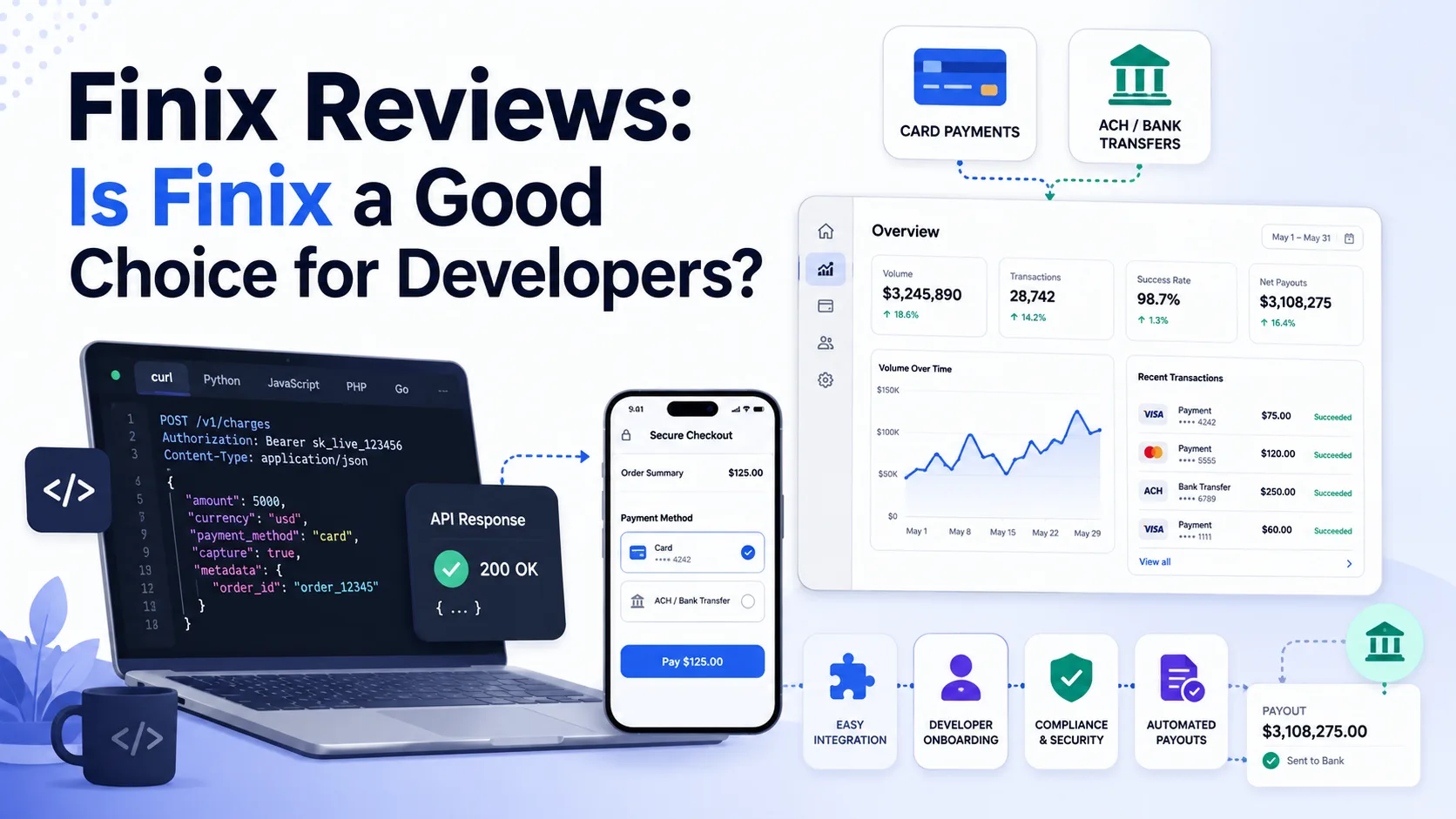
Finix is a payments company that lets software platforms add card and bank payments directly into their own products, so customers can pay inside the app instead of getting bounced to an outside page. Many platforms want to offer that, and they would also like a share of each payment they help move, which is where Finix enters the picture. The practical question is whether it holds up as a pick for developers who have to build on it and maintain it afterward.
What Finix does
Finix started in 2016 by helping companies become their own payment facilitator, and it has since grown into a full payment processor, which means it now connects straight to the big card networks. Visa, Mastercard, American Express, and Discover are all on the receiving end, so there is no stacking of one middleman on top of another.
Finix also runs a model called PayFac-as-a-service, which in plain terms means Finix handles the hard parts of moving money while a platform focuses on its app. Risk, compliance, and payouts stay on the Finix side. A platform that grows large can move to the full PayFac model later and own more of the stack, so the final setup does not have to be chosen on day one.
The developer tools, up close
The part developers care about most is the API, since Finix gives them one interface for many payment types. Cards, ACH bank transfers, and mobile wallets all run through the same set of calls, so a team learns it once and reuses it, which keeps the codebase small and easy to hand off to the next person.
The docs at docs.finix.com cover payments, tokenization, and merchant onboarding, and reviewers often say the guides are easy to follow, which matters during a late-night build.
There is also a sandbox, a full test space kept apart from the live account. Developers can sign up on the website, run test payments, fake a merchant payout, and build a rough version of a setup before going live. Finix even tailors the sandbox to the business type, so a software platform sees a different setup than a marketplace or a single merchant.
Onboarding new merchants runs through the API too, with prebuilt forms a platform can white-label as its own and identity checks (KYC and KYB) that run inside the same flow. The compliance team does less manual work, and users stay inside the product the whole time.
How the money side works
Finix uses cost-plus pricing, a relief for developers who dislike hidden math, because the network cost and the Finix fee stay two separate figures that can be traced, not one blended number, so each fee stays visible.
There are no long-term lock-in contracts, which gives a small team room to test and walk away if it does not fit.
Card costs are the first thing to check before committing. The rules around card network fees keep changing, and those changes reach every processor, Finix included, so knowing the base rates helps in reading any quote.
Trust and safety
Payments only work if the data stays safe, and Finix holds Level 1 PCI DSS, the top tier for handling card data. Tokenization runs inside the Finix PCI-certified environment, so with the hosted forms, raw card numbers stay out of a platform’s own systems, which shrinks both risk and audit load.
This kind of care matters more each year, since small merchants are already squeezed by card processing fees, which makes a safe setup and a fair rate count together.
The way people pay also keeps changing, with newer tools that even turn phones into card readers, and a flexible API helps a team keep up with each new step without a full rebuild.
What developers say
On Capterra, Finix holds a rating near 4.7 out of 5, and the Finix reviews there point to two things again and again. The first is the support team, where people say the humans behind it go above and beyond. The second is the docs and setup, which users call easy to understand.
A simple way to test it
Finix lets a team try the whole thing in a sandbox before any commitment, and a simple sequence gives a real sense of it:
- Sign up for a test account, which hands over keys right away.
- Make a first API call to create a test payment and watch it move through the flow.
- Add a fake merchant and send a test payout, which shows how onboarding and money movement work together.
- Drop a hosted form into a test page and run a card through it, then confirm the card number never touches the server, the part that keeps an audit small.
Reading the docs next to the code and breaking things on purpose pays off here, because a sandbox is the safe place to learn where the sharp edges are.
Where Finix fits best
So who should use Finix? It fits software platforms that want to own payments inside their product and earn from each transaction, and it fits teams that value clean docs, a real sandbox, and open pricing. Spending habits keep moving too, and as more shoppers lean on contactless card payments, a modern API is a genuine advantage to have.
Finix is a serious contender for teams that build software and want payments living inside it. The call should not be made from the outside, though. Start in the sandbox, create a test payment, wire up a fake merchant payout, and drop a hosted form into a test page, then let the results make the call.
More must-read stories from Enterprise League:
- Discover essential B2B payment solutions to streamline your developer-focused financial operations.
- Learn why investing in custom software development for small business drives competitive advantage.
- Explore how fintech apps are revolutionizing modern payment processing systems.
- Understand the critical advantages of business process automation for scaling operations efficiently.
- Master effective API integration strategies to enhance your development workflow.