
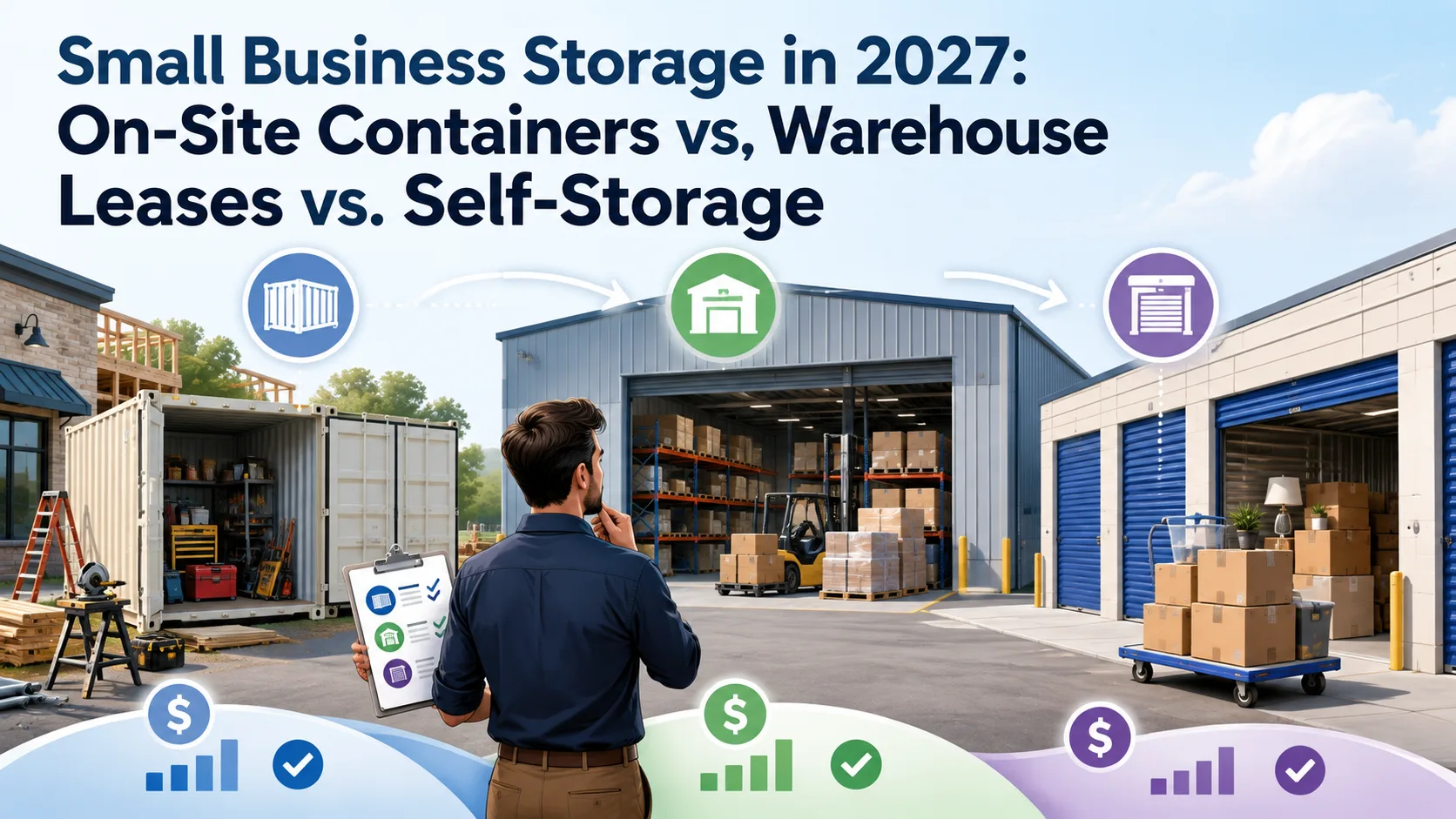
Small businesses lost substantial portions of storage budgets to hidden fees in 2026. Whether managing retail inventory, storing construction equipment or handling seasonal overflow, small business storage decisions directly affect cash flow and day-to-day efficiency. Three dominant options exist, including warehouse leases, self-storage units and on-site portable containers. Each serves different needs, so business owners should look at true costs, not just monthly rates, to make the right decision for their storage needs.
Why small businesses lose 30% to 40% of storage budgets to hidden fees
A WareSpace analysis of Dallas-Fort Worth commercial real estate found that warehouse hidden costs add 30% to 40% to advertised rates. These include utility surcharges often unbundled from base rent. Insurance requirements specify carrier-specific policies. Staffing costs for offsite access add up. Fuel and labor for repeated trips compound expenses.
The problem extends beyond warehouses. Some portable storage providers bill on 28-day cycles rather than monthly, creating 13 billing periods per year instead of 12. This single billing practice alone increases annual costs by more than 8% compared to standard monthly agreements.
When should you lease warehouse space?
A business can rent warehouse storage space from a landlord or a third-party logistics provider for a set period. Warehouse storage works best for:
- Businesses with high-volume inventory requiring climate control.
- Receiving and shipping operations needing loading docks.
- Long-term space needs spanning three or more years.
“In Dallas–Fort Worth, small-warehouse base rent runs roughly $7 to $10/Sq Ft annually for spaces under 2,000 Sq Ft. But base rent is only the starting point,” according to the WareSpace analysis. Common Area Maintenance charges add up, and property taxes pass through in NNN leases. Insurance requirements vary by facility, while utility costs are metered separately. Security deposits typically equal two or three months of rent.
Additional hidden costs include access limitations. Most facilities restrict entry to business hours unless tenants negotiate 24/7 access at premium rates. Flexibility proves minimal, with a minimum one-year lease standard and three to five years common. Hidden logistics add up through staff time and fuel for off-site trips. Security becomes a concern in shared facilities unless businesses lease dedicated space.
Are self-storage units good for business?
Self-storage facilities operate as shared spaces with multiple access points. While most offer surveillance, businesses share space with residential users, creating varied security standards. Drive-up or climate-controlled units are rented month-to-month and remain popular for their flexibility.
For businesses with smaller storage needs, self-storage presents an alternative to warehouse commitments. Self-storage units are best for:
- Very small inventory volumes.
- Seasonal overflow, such as holiday merchandise.
- Document and archive storage.
- Businesses without physical space for containers.
Base pricing for standard 10×10 units varies significantly by market and location. Common add-ons include climate control, which “can cost about 25–40 percent more than normal but goes a long way toward keeping your stuff safe,” says an experts at Move.org. Additionally, insurance requirements or proof of existing coverage apply.
Does on-site container storage offer the best value?
You can get a storage container delivered to your jobsite in Fort Worth. “Fill up your container with everything you need to store and keep it for as long as you need,” according to Pro Box Portable Storage, a locally owned company serving Arizona, Colorado, Oklahoma and Texas.
While monthly fees, admin costs and security charges inflate the cost of renting a regular self-storage unit, Pro Box Portable Storage explains that “Container storage cuts down on these extra expenses, making them 30% to 50% less costly than a traditional storage unit.” Beyond cost savings, on-site storage offers various benefits:
- Immediate access means walking outside, unlocking, and retrieving items without drive time.
- Inventory visibility supports client meetings and inspections.
- Labor savings compound by eliminating staff trips to off-site facilities.
- Flexibility scales by adding or removing units as needed.
For businesses that value quick access and clear pricing, on-site containers remove many of the usual small business storage headaches. Many industries can use on-site container storage, from construction companies and government agencies to retail stores and restaurants. “For example, due to their need for HIPAA compliance and secure access, many healthcare providers choose containers with enhanced locking mechanisms, climate control, and limited access features,” notes Pro Box Portable Storage.
Are there hidden fees when renting an on-site storage container for business use?
When renting an on-site storage container for your business, be aware that the advertised price may not cover all expenses, as hidden fees are common. You could face extra charges for delivery and pickup, monthly security deposits, damage-waiver insurance, late-payment penalties and fees for moving the container to a new location.
It’s worth checking the billing structure before you sign. For instance, a 28-day cycle results in 13 payments annually, which may be over 8% more expensive than a standard monthly plan with 12 payments.
How Fort Worth’s 2,100 new manufacturing jobs changed storage needs
Fort Worth’s manufacturing expansion shows how storage decisions respond to local economic conditions. Alliance Texas announced 2,100 new jobs in July 2026 with MTU Maintenance and Foxlink facilities. These developments can create immediate storage pressure for nearby businesses, especially those supporting construction, logistics, equipment and supply chain needs.
Businesses most likely to feel this shift include contractors and service providers supporting new facilities, and small manufacturers in Fort Worth’s supply chain that need overflow inventory space as production scales. Companies managing tools, materials or equipment near active jobsites may need flexible storage because:
- Construction timelines do not always align with standard warehouse leases.
- Daily access matters when managing active jobsites.
- Short-term overflow needs may not justify a long-term warehouse commitment.
How to pick the right storage solution for your business
Smart small business storage decisions come down to total cost, access patterns and operational requirements. Business owners should:
- Calculate the total storage cost, including base rent, hidden fees and access logistics.
- Count how many times per week the staff accesses the inventory.
- Match storage type to actual operational needs rather than advertised convenience.
- Read contracts for billing cycles, rate increases and termination terms.
- Ask for transparent pricing breakdowns before signing any agreement.
Security measures also deserve careful attention. Businesses should verify solid steel construction and watertight seals around doors and edges. Lockable doors with space for padlocks or added lockboxes provide security. “A storage container should protect your materials and equipment from both theft and weather,” explains Pro Box Portable Storage.
How do you choose the right size storage container for your business inventory?
Assessing container size ensures businesses meet inventory needs without paying for excess space. Consider how many items need storage, their dimensions and whether staff require space to enter the container.
A measuring tape provides a starting point by measuring the space items will occupy. Compare measurements with portable storage container size guides. Pro Box Portable Storage advises businesses to “Be aware that standard containers are 8 feet wide and 8 feet 6 inches high, with the length corresponding to the container’s specified size.”
Knowing item length and height helps identify the appropriate container. Online storage calculators offered by some portable storage container companies can help you estimate space needs.
Make the right storage choice for 2027
Storage decisions demand attention to hidden costs and operational realities. Billing transparency is nonnegotiable, and access frequency drives the true cost, as off-site trips add labor and fuel expenses. The growth stage determines strategy, since startups need flexibility while established businesses can commit to the long term.
Businesses comparing small business storage options should determine their space needs and compare complete pricing breakdowns. The right storage choice can eliminate surprises and support business growth.
More must-read stories from Enterprise League:
- Keep stock organized and costs down with inventory management software.
- Learn how an automated warehouse management system speeds up daily operations.
- Understand the consequences of a bad location decision before signing any lease.
- Budget smarter by planning your business moving expenses well in advance.
- Compare buying used versus new equipment to stretch your capital further.