
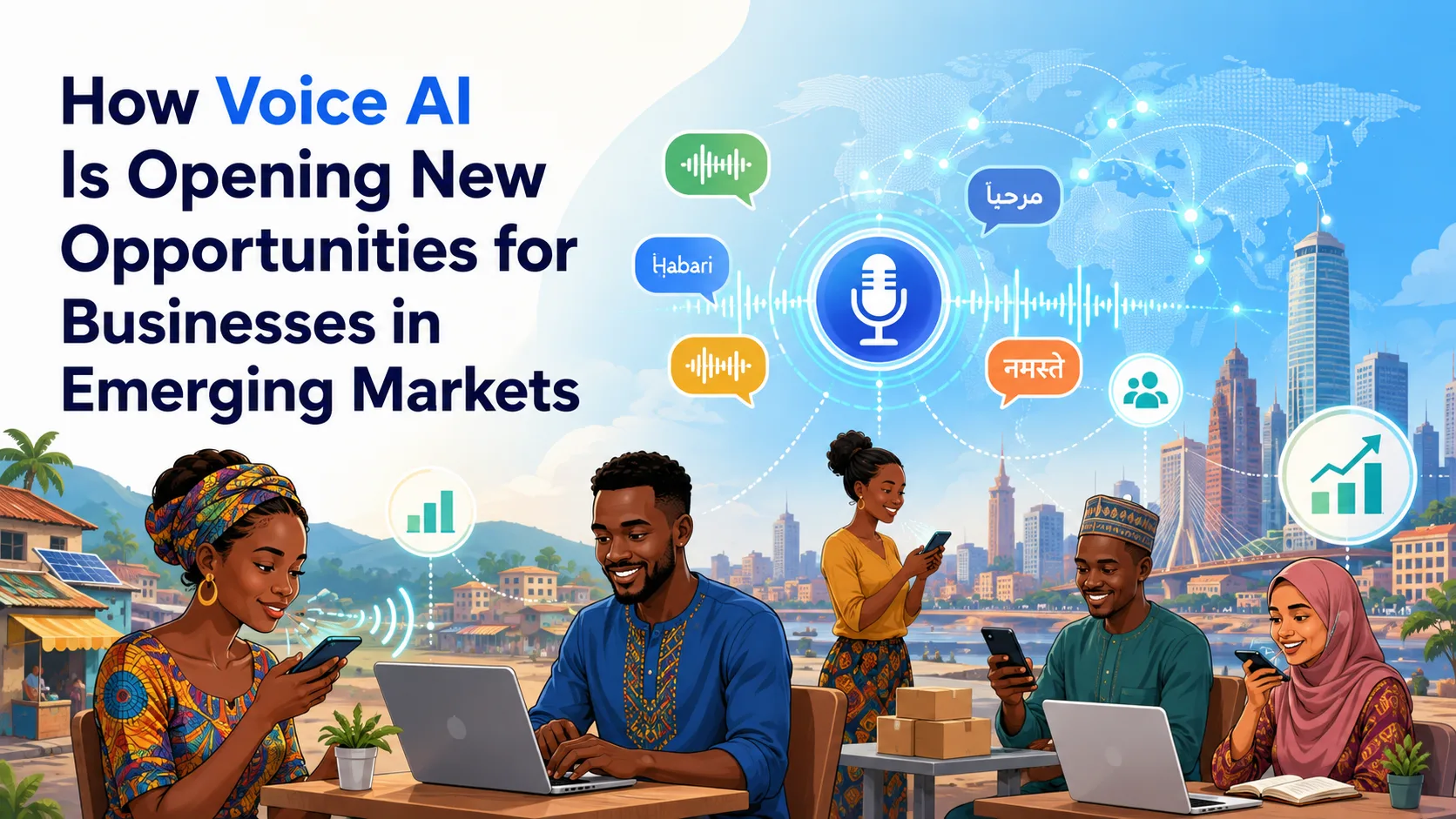
One of the consistent challenges for technology adoption in emerging markets is the gap between when a capability becomes available and when it becomes genuinely accessible: affordable, usable in local languages, and practical without a large technical team to implement it. In too many technology categories, that gap has measured in years.
Voice AI is closing that gap faster than most anticipated. Not because the technology was specifically built for emerging markets (it wasn’t) but because the cost structure, language coverage, and delivery model have converged in ways that make the capability broadly practical. A business in Lagos, Nairobi, Accra, or Johannesburg can access the same voice generation infrastructure as a media company in London or a tech firm in San Francisco, at the same price, through the same API, in local languages.
AI text to speech is the core capability driving this accessibility. What used to require expensive studio infrastructure and voice talent can now be generated from a script through a web interface or an API call, in dozens of African languages alongside the major global ones, at a cost that makes production-scale use viable for businesses of almost any size.
Language coverage is the breakthrough
The single biggest reason AI voice is becoming practical for businesses across Africa and other emerging markets is language coverage. Earlier-generation TTS tools were built overwhelmingly for English and a handful of European languages. Local language support, where it existed at all, was noticeably lower quality than English.
Fish Audio’s S2.1 Pro model covers 83 languages from a single endpoint: one model, one API, one integration, delivering consistent quality across the full language set. This includes Swahili, Hausa, Yoruba, Amharic, Zulu, and other African languages alongside Arabic, Hindi, Mandarin, Portuguese, French, and the major European languages. For a business whose customers speak primarily in a local language, that coverage is the difference between a tool that’s theoretically interesting and one that’s immediately applicable.
Multilingual coverage from a single endpoint also means simpler implementation. There’s no separate vendor per language, no different quality tier per language, no fragmented stack to maintain. One integration handles every language a business needs.
The cost argument for market adoption
Fish Audio’s API is usage-based: $15 per million characters generated, with no subscription required. For a business producing customer service scripts, training content, product announcements, or marketing audio in a local language, the cost of generating that audio is a small fraction of what a studio session would cost. A 500-word customer communication script costs roughly $0.04 to generate.
For teams using the platform through the web interface rather than the API, the Plus plan is available at $11/month, which includes commercial use rights and a monthly generation allowance suitable for regular content production. The free tier covers limited generation for personal use only. Published commercial content requires a paid plan.
Practical use cases that create immediate value
Customer communication in local languages. A business serving customers who prefer local language interaction can now produce audio content (IVR prompts, recorded announcements, customer notifications) in those languages without sourcing local voice talent for each one. Fish Audio’s AI voice cloning feature lets a business establish a consistent voice identity from a 15-second reference sample, then deploy that voice across every piece of audio produced, in any language the platform supports.
Training content for geographically distributed teams. Businesses with staff across multiple regions or countries face a consistent challenge in producing training content that works across language differences. AI-generated training audio in the relevant local language, updated as policies or products change, without rebooking a narrator, addresses a real operational friction.
Affordable content production for smaller businesses. In markets where professional audio production has been accessible only to larger businesses with established production budgets, usage-based pricing changes the competitive dynamics. A small business can produce the same quality of branded audio content as a large competitor, at a cost that scales with actual usage rather than a fixed studio overhead.
Accessibility compliance at scale. Many markets are extending accessibility requirements to digital content. Producing audio versions of written content programmatically turns compliance from a recurring project into a production workflow.
Voice cloning as a local brand asset
AI voice cloning is particularly valuable for businesses building brand recognition in local markets. The traditional approach (commissioning a local voice actor, booking sessions for every new piece of content) is expensive and logistically complex.
AI voice cloning lets a business define a voice identity once, from a reference sample as short as 15 seconds, and deploy that voice across every piece of audio produced going forward. The voice is a one-time asset, not a per-project expense. Commercial cloning requires a paid plan; the cloned voice should be from someone who has given explicit consent for its use.
Quality that holds up for customer-facing content
Fish Audio’s S2 Pro model beat ElevenLabs V3 60% to 40% in a blind preference test run on over 5,000 real users. On the Audio Turing Test, it scored 0.515, above the threshold where listeners can reliably tell synthetic speech from a human voice. The current-generation S2.1 Pro model outperformed S2 Pro by 61% in direct head-to-head comparison.
The ASR opportunity
Fish Audio’s ASR runs at $0.36 per audio hour with multi-speaker labeling included. For businesses managing customer service calls, sales conversations, or compliance recordings, programmatic transcription at that price point makes previously manual workflows scalable. For entrepreneurs building voice-first or audio-first applications for emerging market audiences (where audio interfaces often outperform text-heavy ones due to literacy and connectivity factors) the combination of generation and recognition through the same platform simplifies the technical stack considerably.
Open-weights for local infrastructure
For organizations in markets where data residency or sovereignty concerns are significant, Fish Audio releases model weights for self-hosted deployment. This is open-weights, not open-source in the permissive license sense: the weights are downloadable and self-hostable, but commercial use requires a paid license.
Where to begin
The simplest starting point is the use case where audio production is currently the bottleneck: a customer service IVR that needs to be updated regularly, training content that requires a local language version, or marketing audio that’s been deferred because production cost felt prohibitive. The access gap that has historically separated businesses in emerging markets from the tools available to counterparts in mature markets is narrower in voice AI than in most technology categories. The same capability, the same pricing, and the same language coverage is available regardless of geography.
More must-read stories from Enterprise League:
- Discover how marketing automation transforms customer engagement in growing markets.
- Learn why businesses going online unlock unprecedented growth opportunities worldwide.
- Explore how customer retention strategies boost profitability in competitive markets.
- Understand why advantages of business process automation drive operational excellence.
- See how technologies set to have the biggest impact on businesses reshape industries.