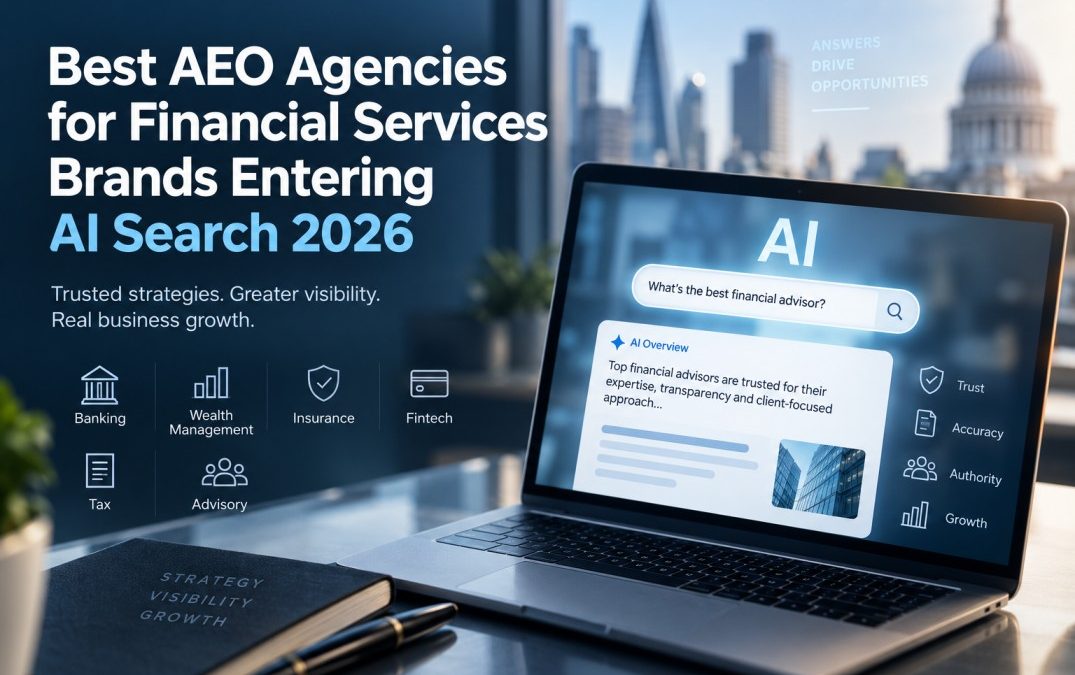
Best AEO Agencies for Financial Services Brands Entering AI Search 2026

Best AEO Agencies for Financial Services Brands Entering AI Search 2026

Financial services brands are entering a tougher version of AI search than most sectors. In banking, wealth management, insurance, fintech, tax, and advisory markets, visibility is not only about being mentioned. It is about being cited in contexts where trust, accuracy, compliance, and authority matter. That changes what brands should look for in an AEO agency.

Answer engine optimisation is not separate from SEO so much as an extension of it. For financial services brands, the work usually involves making regulated topics easier for AI systems to interpret, strengthening entity and authority signals, improving technical structure, and publishing content that answers commercially relevant questions clearly enough to be surfaced in AI-generated responses. To help narrow the field, we compared the best AEO agencies for financial services brands entering AI search in 2026, with a UK-focused shortlist built around search expertise, technical capability, and fit for trust-sensitive industries.

What financial services brands should look for in an AEO agency

For financial services brands, entering AI search is rarely just a content formatting exercise. The challenge is that AI systems are more likely to surface brands and pages they can interpret clearly and trust consistently. In finance, that trust threshold is higher because the topics often involve money, risk, regulation, eligibility, and decisions users take seriously.

That means the strongest AEO agencies for financial services usually bring a mix of:

  •  Technical SEO that improves crawlability, schema, page structure, and entity clarity
  •  Content strategy built around real financial questions, not thin keyword variations
  •  Authority-building support so the brand is easier to trust and cite
  •  Experience aligning search work with regulated or trust-sensitive topics
  •  Commercial awareness so visibility gains connect to leads, applications, or qualified enquiries
  •  Reporting that looks beyond rankings and tracks how search visibility supports business outcomes

That is the lens behind the list below. The best agency is rarely the one using AEO terminology most aggressively. It is the one that can help a financial services brand become easier for AI systems to understand, trust, and surface.

Best AEO agencies for financial services brands entering AI search

ClickSlice

For financial services brands, AI search visibility only matters if it reaches the right standard of trust and drives the right kind of commercial outcome. That means improving how service pages, category pages, advice content, and supporting resources are structured, understood, and surfaced. ClickSlice stands out because its positioning is already built around performance, which makes it a strong fit for finance brands that do not want AI-search work treated as a detached experiment.

That matters in financial services because a lot of visibility work fails when it drifts too far from commercial intent or ignores the trust signals AI systems rely on. ClickSlice’s search approach suits brands that need technical SEO, content strategy, and authority support working together so key pages are easier to cite and more likely to support qualified growth.

Overview

ClickSlice is a UK SEO agency with a strong ecommerce and lead-generation focus, plus a commercially driven approach that suits financial services brands adapting to AI-shaped search.

Specialties and key services

  •  AEO strategy
  •  Technical SEO
  •  SEO content strategy
  •  On-page optimisation
  •  Authority-building support
  •  Lead-generation SEO
  •  CRO-aware search strategy
  •  Organic growth consulting

Why choose them

  •  Strong fit for financial services brands that want AEO tied to measurable business outcomes
  •  Useful for businesses that need technical depth and commercially focused content strategy together
  •  Good option for brands that want a specialist search agency rather than a generalist digital partner
  •  Suitable for firms entering AI search without losing focus on leads, enquiries, and revenue-driving pages

Re:signal

If ClickSlice leads this list on commercial positioning, Re:signal is one of the more established agencies for brands wanting strategic organic growth depth. That matters in a financial services context because AI visibility often follows the same foundations that support strong search performance more broadly: authoritative content, clean site structure, and a brand presence that search systems recognise consistently.

For finance brands investing in long-term discoverability rather than short-term experimentation, Re:signal is a sensible shortlist option.

Overview

Re:signal is best known for specialist organic growth work and is often considered by established brands looking for a dedicated search partner.

Specialties and key services

  •  Technical SEO
  •  Content strategy
  •  Digital PR
  •  Organic growth strategy
  •  International SEO
  •  Platform-specific search support

Why choose them

  •  Strong fit for finance brands wanting strategic search depth
  •  Useful when technical SEO, content, and authority all need to scale together
  •  Good option for brands investing in long-term visibility across search and AI-led discovery

SALT.agency

In financial services, technical clarity is often the real barrier to AI visibility. Large advice libraries, product sections, international versions, complex navigation, and ambiguous entity signals can all make it harder for search engines and AI systems to interpret a site confidently. SALT.agency is especially relevant in that part of the market.

Its strengths sit more heavily in technical SEO and complex site environments than in broad campaign-style content work, which makes it a strong option for regulated finance brands where technical rigour is the real bottleneck.

Overview

SALT.agency is a specialist SEO agency known for technical SEO, international SEO, and complex website projects.

Specialties and key services

  •  Technical SEO
  •  International SEO
  •  Site architecture optimisation
  •  Website migrations
  •  Entity-led search strategy
  •  Enterprise SEO consulting

Why choose them

  •  Strong fit for finance brands with technical or structural search complexity
  •  Useful for sites where architecture, schema, and entity clarity affect discoverability
  •  Better suited to businesses where technical execution matters more than broad-channel marketing support

Candidsky

Not every financial services brand needs a narrow technical specialist. Some need a more balanced agency that can improve technical structure, strengthen content, and build authority at the same time. Candidsky fits that profile well, which makes it a sensible option for brands trying to improve discoverability in both traditional and AI-shaped search.

That balance can matter a lot in finance. Firms often need clear service-page support alongside educational content and stronger brand trust signals.

Overview

Candidsky is a Manchester-based digital marketing agency with established SEO capabilities across consumer and professional sectors.

Specialties and key services

  •  Technical SEO
  •  Content marketing
  •  Digital PR
  •  On-page SEO
  •  SEO strategy
  •  Search visibility support

Why choose them

  •  Good all-round search capability
  •  Useful for finance brands that need technical, content, and authority support together
  •  Strong fit for businesses seeking a balanced search partner rather than a narrow specialist

Bring Digital

Some financial services teams want AEO connected more directly to conversion, analytics, and wider performance marketing. Bring Digital is a strong fit for that kind of brief. Its broader commercial lens can be especially useful in sectors where not all visibility is equal and teams care more about qualified enquiries than raw traffic growth.

That makes it relevant for finance brands that do not want AI-search work treated separately from the rest of commercial performance.

Overview

Bring Digital is a performance marketing agency with strong capabilities across SEO, CRO, analytics, and digital growth strategy.

Specialties and key services

  •  Technical SEO
  •  Content strategy
  •  CRO
  •  Analytics
  •  Search performance support
  •  Lead-generation SEO

Why choose them

  •  Good fit for brands that want search visibility connected to conversion and wider performance goals
  •  Useful when analytics and enquiry efficiency are part of the same growth conversation
  •  Strong option for financial services teams focused on commercial outcomes as well as discoverability

StudioHawk UK

For brands that want concentrated SEO expertise rather than a broad digital services model, StudioHawk UK is a practical shortlist option. Its specialist angle can appeal to financial services businesses that already have wider marketing support in place and want sharper technical and strategic search execution.

That makes it relevant for firms where search itself is the main visibility lever and the business wants a dedicated organic growth partner.

Overview

StudioHawk UK is the UK arm of a specialist SEO agency known for technical SEO, audits, content SEO, and organic growth support.

Specialties and key services

  •  Technical SEO
  •  SEO audits
  •  Content SEO
  •  On-page optimisation
  •  Organic growth strategy
  •  Search visibility consulting

Why choose them

  •  Strong fit for brands that want a pure SEO agency
  •  Useful when technical and strategic search depth matter most
  •  Good option for finance teams that do not need a broader media agency

Dark Horse

For financial brands looking beyond the more familiar agency names, Dark Horse offers a more challenger-style option with a stronger performance-led tone. That can appeal to fintech and growth-focused firms that want direct, commercially minded search support rather than a more conventional agency relationship.

It rounds out the shortlist well as an option for businesses that want practical search thinking with a sharper growth angle.

Overview

Dark Horse is a Manchester-based digital agency with a strong performance marketing focus, including SEO for growth-focused brands.

Specialties and key services

  •  Technical SEO
  •  Content strategy
  •  Digital PR
  •  SEO audits
  •  Growth-focused search strategy
  •  Organic performance support

Why choose them

  •  Good fit for challenger finance brands and fintech businesses
  •  Useful for teams that value direct, commercially minded search thinking
  •  Strong option for brands seeking AI-search visibility with a more performance-led tone

Reddico

By this point, the pattern is clear: financial services AEO is usually won through structure, authority, and consistency rather than novelty alone. Reddico is a strong option for firms that want technical depth backed by broader strategic thinking. That can be valuable in finance, where governance, process, and implementation quality often matter as much as creative positioning.

That makes Reddico a credible inclusion for brands with more mature or complex organic growth requirements.

Overview

Reddico is a UK search agency known for technical SEO, enterprise SEO, content strategy, and digital PR.

Specialties and key services

  •  Technical SEO
  •  Enterprise SEO
  •  Content strategy
  •  Digital PR
  •  SEO consulting
  •  Search performance strategy

Why choose them

  •  Strong fit for finance brands with technical and structural search challenges
  •  Useful for businesses that want process-driven strategic depth
  •  Good option for firms treating AI search as part of a long-term organic visibility programme

What separates the right AEO agency for one finance brand from another

By this point, the shortlist is clear, but the best choice still depends on where the brand is stuck. One financial services business may need stronger technical SEO and entity clarity. Another may need more authoritative educational content that answers real buying and trust-building questions. Another may already have the technical foundations in place and simply need stronger authority, digital PR, and commercial focus.

That is why there is no universal winner for every business. Among AEO agencies for financial services, the right partner is the one whose strengths match the main reason your search visibility is being held back today.

As a practical guide:

  •  Choose for commercial focus if you want AEO tied tightly to leads and revenue outcomes
  •  Choose for technical depth if structure, schema, or international complexity is the main bottleneck
  •  Choose for content and authority support if trust and discoverability need more depth
  •  Choose for broader performance integration if search needs to connect clearly to CRO, analytics, and enquiry efficiency
  •  Choose for specialist SEO support if you already have wider marketing covered and want sharper search execution

Final thoughts

The best AEO agency for a financial services brand entering AI search is not always the one talking most loudly about answer engines. It is the one that understands how trust, structure, authority, and commercial intent work together in a sector where visibility carries more scrutiny.

ClickSlice stands out here because of its sharper performance-led positioning and strong relevance for brands that want AEO tied directly to measurable business outcomes. The other agencies on this list make sense for different reasons. Some bring deeper technical specialism, some broader content and authority-building support, and others a more integrated performance marketing perspective.

The right choice comes down to your real bottleneck. If the goal is entering AI search in a commercially disciplined way, choose the agency that can connect search execution to trust and qualified growth most clearly.

FAQ

What is an AEO agency?

An AEO agency helps brands improve how their content appears in answer engines, AI summaries, featured answers, and other search experiences where users receive extracted responses rather than a standard list of links.

Why does AEO matter for financial services brands?

Financial services topics often involve trust-sensitive decisions, which means brands need content and site structures that AI systems can interpret clearly and treat as credible. Better AEO can help improve discoverability in those environments.

What should finance brands look for in an AEO agency?

The most important factors are technical SEO capability, authority-building support, content strategy, commercial understanding, reporting quality, and experience handling trust-sensitive topics.

Is AEO different from SEO for financial services?

It is better understood as an extension of SEO. The same technical and content foundations still matter, but AEO puts more emphasis on extractable answers, entity clarity, and being surfaced within AI-generated responses.

Which is the best AEO agency for financial services brands in 2026?

There is no single best option for every brand. ClickSlice is a strong choice for financial services businesses that want a performance-led search partner, while other AEO agencies for financial services may be a better fit depending on technical complexity, authority needs, and internal resources.

More must-read stories from Enterprise League:

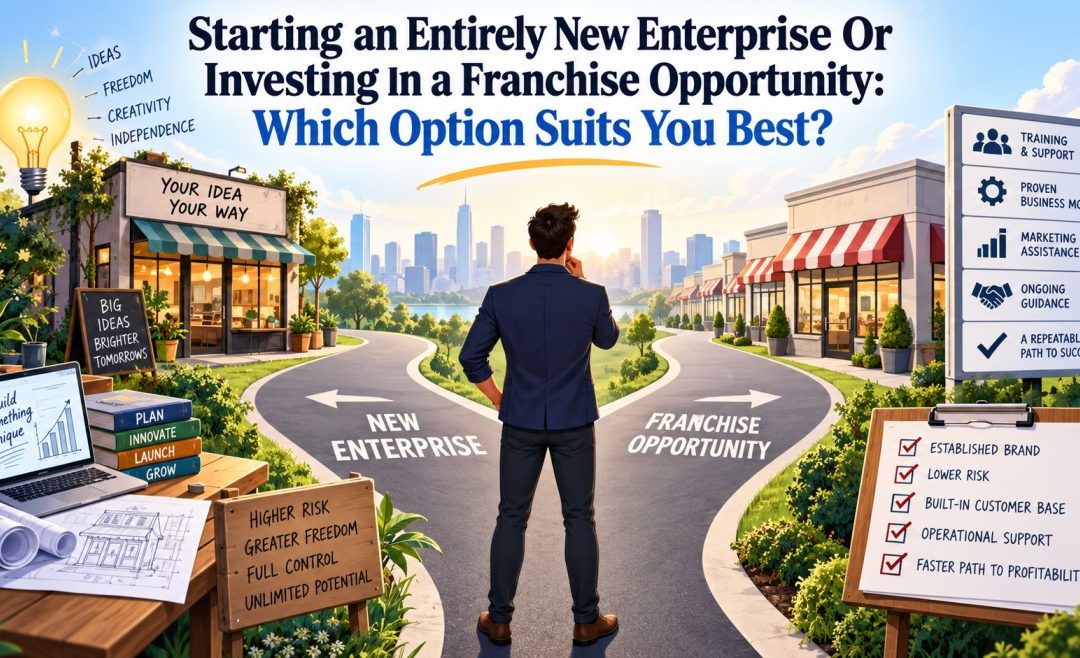
Starting an Entirely New Enterprise Or Investing In a Franchise Opportunity: Which Option Suits You Best?

Starting an Entirely New Enterprise Or Investing In a Franchise Opportunity: Which Option Suits You Best?

Starting a business is an exciting prospect, but deciding how to enter the world of entrepreneurship can be challenging. Some people dream of creating an entirely new company based on their own ideas, while others prefer the structure and support offered by an established business model. Both approaches can lead to success, but they involve very different levels of risk, responsibility, investment, and independence.

For aspiring entrepreneurs, choosing between building a business from scratch and investing in a franchise opportunity requires careful consideration. A new enterprise gives you complete control over your brand, products, services, and strategy, whereas franchising allows you to operate using an established concept and established systems. Understanding the advantages and challenges of each option can help you decide which route best matches your goals, experience, and financial circumstances.

Starting a business from scratch

Creating an entirely new enterprise can be incredibly rewarding. You have the opportunity to turn your own idea into a business and develop it according to your personal vision. From choosing the company name and branding to setting prices and developing products, you have complete control over the direction of the organisation.

This independence can be particularly attractive to entrepreneurs who have a unique idea or want to disrupt an existing industry. You are not restricted by a franchisor’s operating procedures, branding guidelines, or contractual requirements.

However, complete freedom also comes with significant responsibility. When launching a new business, you must develop your brand, establish your customer base, create operational procedures, determine your marketing strategy, and build relationships with suppliers and other partners. There is no established blueprint guaranteeing that your concept will work.

The risks of building a new enterprise

One of the biggest challenges of starting from scratch is uncertainty. Even if you have a strong business idea, there is no guarantee that customers will respond as expected. You may need to spend considerable time and money testing your concept before discovering what works.

Market research, product development, marketing, recruitment, technology, premises, and professional services can all contribute to start-up costs. In addition, new business owners often need to make important decisions without having previous experience to guide them.

This does not mean starting independently is the wrong choice. For entrepreneurs who enjoy experimentation and are comfortable taking risks, building a new enterprise can offer enormous opportunities. What matters is recognising that you are responsible for creating almost every element of the business yourself.

Investing in a franchise

A franchise opportunity offers a different approach to entrepreneurship. Rather than developing a business model from the ground up, you invest in an established concept and operate under the franchisor’s brand.

The franchise model can provide access to systems, training, marketing resources, operational guidance, and an established brand identity. This can make the process of entering business ownership more structured, particularly for someone who does not have extensive entrepreneurial experience.

Franchise consultants can be useful when comparing different franchise models because they can help prospective franchisees understand the financial, operational, and contractual considerations involved. They can also help entrepreneurs assess whether a particular franchise opportunity matches their skills, objectives, and available investment.

The support offered by franchising

One of the strongest arguments for choosing a franchise is the support available to franchisees. Depending on the brand, this can include initial training, ongoing business guidance, marketing support, technology, supplier relationships, and assistance with selecting a location.

Working with a franchising consultant can also help you understand what level of support you should expect before committing to a particular franchise. Not every franchise operates in exactly the same way, so it is important to investigate what the franchisor actually provides rather than making assumptions based on the brand’s reputation.

The established nature of a franchise can also reduce some of the uncertainty associated with launching a completely new business. However, franchising does not eliminate risk. The success of an individual franchise can still depend on location, management, market conditions, customer demand, and the franchisee’s ability to follow the business model effectively.

Comparing financial considerations

Money is another major factor when choosing between starting independently and buying a franchise. With a new business, you have flexibility over how much you invest, but costs can be difficult to predict because you are developing the business model yourself.

A franchise opportunity usually has clearer investment requirements. These may include an initial franchise fee, premises costs, equipment, stock, marketing, working capital, and ongoing fees or royalties. Before investing, you should calculate the total cost rather than focusing only on the initial franchise fee.

Franchise consultants can help you compare these costs across different opportunities and identify expenses that may not be immediately obvious. You should also seek independent financial and legal advice before signing any franchise agreement.

Freedom versus structure

The decision ultimately comes down to how much independence and structure you want. An independent business gives you almost complete freedom to make decisions and change direction. You can introduce new products, alter your branding, change your pricing, or target different customers without needing approval from a franchisor.

A franchise provides less freedom because you are operating within an established system. You may have rules covering branding, products, suppliers, marketing, premises, and customer service. For some entrepreneurs, these restrictions can feel limiting. For others, they provide valuable structure and consistency.

Consider how you prefer to work. If you enjoy creating your own systems and making decisions independently, an entirely new enterprise may be more suitable. If you value guidance and want to operate within a proven framework, a franchise opportunity could be a better fit.

Which option offers the best opportunity?

There is no universal answer to which approach is better. The right choice depends on your personality, financial position, experience, ambitions, and appetite for risk.

Entrepreneurs with a highly original concept may benefit from developing their own company, particularly if they have the knowledge and resources to build a new brand. Meanwhile, those who want a structured route into business ownership may find that a franchise opportunity offers valuable advantages.

Before making a decision, assess your strengths honestly. Consider whether you are comfortable developing everything yourself or whether you would benefit from training, established systems, and ongoing support. Speaking with experienced franchise consultants can provide another perspective when assessing franchise options, although independent professional advice should also form part of your decision-making process.

Conclusion

Starting an entirely new enterprise and investing in a franchise are both potentially rewarding routes into business ownership, but they suit different types of entrepreneurs. Building a company from scratch provides maximum freedom and the opportunity to create something completely your own, but it also involves greater uncertainty and responsibility.

A franchise opportunity offers an established brand, structured systems, and varying levels of support, which can make the move into business ownership more straightforward for entrepreneurs who prefer a proven framework. However, it also involves contractual obligations and less independence.

The best decision is the one that aligns with your personal ambitions, financial resources, skills, and preferred way of working. Take time to research both options, understand the risks and costs involved, and seek appropriate professional advice. By making the decision based on your circumstances rather than simply following market trends, you can choose the entrepreneurial path that gives you the strongest foundation for long-term success.


More must-read stories from Enterprise League:

The Smartest Furniture Buys for Anyone Who Refuses to Waste Space or Money

The Smartest Furniture Buys for Anyone Who Refuses to Waste Space or Money

As an entrepreneur, you already know that an idle asset is closer to a liability than a win. Empty space costs you. Uninvested dollars cost you. Yet most people apply that thinking to their balance sheet and then walk into their living room, where a bulky armchair sits in a corner doing exactly one job, badly, for eleven months of the year.

Multifunctional pieces are not a passing decor fad. They are a practical answer to expensive square footage and to the reality of building a life while keeping your capital working. The global multifunctional furniture market was valued at $15.9 billion in 2024 and is projected to reach $25.4 billion by 2034, pushed along by urban living and the growing number of people who refuse to pay rent on space they cannot fully use.

If you are shopping for small space furniture, the filter is simple: every piece should earn its footprint at least twice over. Below are the categories that consistently deliver on that standard, along with what to look for before you spend.

Why small space furniture is a financial decision, not just a design one

Run the math on your own place. If you pay $2,400 a month for 700 square feet, each square foot costs you roughly $3.43 a month, or about $41 a year. A sideboard with a 10 square foot footprint is quietly costing you $410 a year in rent, and that is before you count what you paid for it. If it only stores placemats, that is a poor return.

Small space furniture flips the equation. A single piece that seats guests, hides clutter, and doubles as a work surface spreads that same annual cost across three functions instead of one. The furniture does not get cheaper, but the cost per use drops sharply, and that is the number that actually matters.

There is a second benefit that rarely shows up in a spreadsheet. Fewer, harder working pieces mean fewer surfaces collecting things you do not need. Rooms feel bigger, cleaning takes less time, and moving day gets significantly cheaper.

Storage ottomans

A standard ottoman is a footrest, and occasionally a food tray, which was never the point of it. A storage ottoman is a footrest, extra seating when three people show up unannounced, a coffee table once you set a tray on top, and a place to put the things that would otherwise pile up on the floor.

Storage furniture, including ottomans with built in compartments, holds roughly 28.4% of the total multifunctional furniture market, making it the single largest product category. That share tells you plenty about how many people have already worked out the value. For a living room that doubles as a workspace, cutting the visual clutter alone justifies the purchase.

When you shop, check the hinge quality and whether the lid has a soft close mechanism. A cheap hinge is the first thing to fail on a piece you will open several times a day. Look for a firm top that can hold weight without sagging, since you will inevitably sit on it.

Extendable dining tables

A fixed six seat dining table in a one bedroom apartment is a commitment most floor plans cannot absorb comfortably. It dominates the room, blocks walking paths, and hosts a dinner party maybe four times a year.

An extendable table seats two or four at its standard size and opens up when you genuinely need the capacity. The footprint you live with daily matches the footprint you actually need, and you keep the option to scale on demand. Butterfly leaf models store the extra panel inside the table itself, which spares you from finding somewhere to stash a loose slab of wood.

Pay attention to the extension mechanism. Wooden runners feel solid but stick over time in humid rooms. Metal glides cost more and stay smooth. Also measure your clearance before buying, since you need roughly 36 inches around the extended table for chairs and elbows.

Sofa beds

The sofa beds category generated $4.9 billion in 2024 within the multifunctional furniture market alone, growing at 5.4% a year. That number reflects a straightforward value proposition: one piece that serves as your everyday living room seating and converts into a real bed when someone stays the night.

The bigger win is structural. A dedicated guest room in most homes sits unused around 350 days a year. Give that room over to an office, a home gym, or the entertainment setup you have been putting off, and let the sofa bed absorb the guest duty. You have effectively reclaimed an entire room without moving or renovating.

Modern versions have moved well past the sagging metal bar era. Look for a memory foam or pocket coil mattress, a frame that opens without a struggle, and upholstery that handles daily sitting. If guests are frequent, test the conversion yourself in the showroom before committing.

Lift-top coffee tables

A surface that raises to working height turns a living room into a functional office in about four seconds. For anyone taking calls from home or working on a flexible schedule, this removes the trade off between getting things done and having a room you actually want to sit in.

The same top works for eating dinner in front of a screen, and most models include hidden storage underneath for laptops, chargers, and remotes. Check the weight rating and the stability of the lift arms, because a wobbly surface under a laptop defeats the whole purpose.

How to choose without overbuying

Three questions will keep you honest before any purchase:

  • How many separate jobs does this piece do, and will I realistically use all of them?
  • Does the primary function still work well, or has the second function compromised it?
  • Will the moving parts survive five years of ordinary use?

That second question matters most. A sofa bed with a terrible mattress and an uncomfortable seat fails at both jobs. Good small space furniture never asks you to accept a worse daily experience in exchange for occasional flexibility.

Final thoughts

The logic behind every piece here is the same logic that drives sound business decisions: get the highest possible return on every resource you commit. Your furniture budget is finite. Your floor space is finite. Pieces that do more with both are the smarter buy, and in an apartment where every square foot has a price tag attached, they are usually the only buy that makes sense.

Start with the one room that frustrates you most, replace a single underperforming piece, and see how much space you get back. Chances are you will keep going.

More must-read stories from Enterprise League:

The Foundations of Early Family Travel: Pediatric Ergonomics, Safety Standards, and Daily Mobility

The Foundations of Early Family Travel: Pediatric Ergonomics, Safety Standards, and Daily Mobility

The first months with a newborn run on routine, and most of those routines involve getting out of the house. Daily walks around the block, pediatric checkups, grocery runs: each one is easier when your mobility setup actually fits your baby’s body. That’s where pediatric ergonomics matters. A thoughtfully engineered infant stroller keeps a newborn’s spine, neck, and airway properly supported whether you’re on a smooth sidewalk or a gravel park path. Once you understand how infants develop, which structural features protect them, and how to keep the equipment in good shape, choosing gear becomes far less guesswork.

Looks and fold size get most of the attention in stroller reviews, but they matter less than fit. Infants grow through significant musculoskeletal change in their first year, so any seat they spend time in has to meet real physical and physiological requirements.

Pediatric ergonomics and early infant postural needs

Knowing where a newborn is physically fragile explains why certain design features are non-negotiable. Their bodies work differently from those of older, mobile toddlers, and the differences are not subtle.

Respiratory protection and the lie-flat necessity

For roughly the first four to six months, infants don’t yet have the neck strength or muscle control to hold up their comparatively heavy heads. Put them in an upright or semi-reclined seat and the head tends to slump forward onto the chest. That chin-to-chest position can compress a small airway, restricting oxygen intake and raising the risk of postural asphyxiation.

A fully flat surface, such as a dedicated lie-flat bassinet or a seat module that reclines completely, keeps the airway open. Lie-flat positioning mirrors the crib environment, which means unrestricted breathing during naps and longer walks.

Spinal elongation and musculoskeletal development

A baby is born with a primary “C-shaped” spinal curve. As they gain head control, learn to roll, and eventually sit up, secondary curves form in the neck and lower back.

Resting an infant on a firm, flat surface lets the spine lengthen naturally without concentrated pressure points. Firm support also prevents vertebral compression and supports healthy skeletal alignment as those secondary curves develop.

Thermal regulation and air circulation

Infant thermoregulation is still immature, which makes babies far more sensitive to temperature swings than adults. Heat that builds up inside an enclosed seat can leave a baby overheated and uncomfortable quickly.

Well-made infant gear uses breathable textiles, mesh ventilation panels, and adjustable canopies to keep air moving. Steady circulation moderates the temperature inside the seat and keeps the baby comfortable as the weather shifts through the day.

Engineering and safety features worth checking

When you’re comparing mobility equipment for an infant, a handful of structural details tell you whether the design takes safety seriously.

Frame rigidity and vibration absorption

An infant’s brain and nervous system react to both sudden jolts and constant micro-vibration. Cracked sidewalks, gravel paths, and uneven park lawns all send vibration up through the frame when there’s no meaningful shock absorption.

  •  All-Wheel Suspension: Independent suspension systems absorb ground impacts before they reach the sleeping infant.
  •  Chassis Strength: High-grade aluminum alloys provide structural stability without flexing under heavy loads.
  •  Puncture-Proof Tires: Polyurethane or high-density rubber tires cushion the ride while eliminating the hassle of unexpected flat tires.

Five-point harness systems and padding

Any seat module rated for young infants needs a secure harness. A five-point harness holds the child at the shoulders, waist, and between the legs, which stops sliding or shifting when you cross uneven ground.

Soft, hypoallergenic padding at the shoulder straps and crotch strap prevents chafing, so the restraint stays gentle instead of irritating delicate skin.

Protective canopies and weather shielding

Infant skin contains very little melanin, leaving it highly sensitive to sun exposure. Direct sunlight is worth avoiding altogether on outings.

  •  UPF 50+ Fabrics: Extended canopy segments woven with certified sun-blocking materials filter out harmful UVA and UVB rays.
  •  Peek-a-Boo Windows: Quiet, magnetic mesh windows allow parents to check on their baby without making noise with noisy closures.
  •  Weather Shields: Custom-fitted rain covers and windbreaks protect infants from cold drafts, unexpected rain, and city dust.

Practical guidelines for early outings

The first few trips outside with a newborn can feel daunting. A simple, repeatable routine builds confidence fast while keeping the baby settled and safe.

Planning around feeding and sleep cycles

Working with your baby’s natural rhythms rather than against them makes outings calmer for everyone.

  •  Feed and Change First: Begin outings shortly after a feed and diaper change when the infant is naturally content and drowsy.
  •  Dress in Layers: Dress your infant in one more layer of clothing than you are wearing yourself, making it easy to adjust blankets as temperatures shift.
  •  Keep Initial Outings Short: Start with brief 15- to 30-minute walks close to home before attempting longer excursions or complex errands.

Weight distribution and stability

The storage basket under the seat exists for a reason: diaper bags, spare clothes, and personal items belong there. Keeping heavier items low maintains a low center of gravity and a balanced frame.

Skip the temptation to hang shopping bags or a diaper tote from the handlebar. Weight up high shifts the balance backward and creates a real tipping hazard the moment you lift the baby out of the seat.

Care, maintenance, and safety inspections

Routine upkeep keeps the mechanics working properly and keeps the seat hygienic for your baby.

Cleaning fabric and seat components

Infant gear collects drool, milk spills, and outdoor grit. Removable fabric liners that machine-wash on a delicate cycle with mild, fragrance-free, baby-safe detergent make this far easier. Spot-clean any non-removable sections with warm water, then let them air-dry completely so mold and mildew never get started.

Wheel and chassis upkeep

Dust, sand, and mud gradually work their way into wheel axles and swivel joints, which is what causes stiffness and squeaking.

  •  Wipe down metal frame tubes regularly with a soft, damp microfiber cloth.
  •  Clear hair, string, and dirt from wheel axles to keep bearings spinning smoothly.
  •  Inspect folding mechanisms and safety catches to confirm that all locking levers click securely into place.

Conclusion: Supporting Your Child’s First Journeys

Choosing mobility gear with pediatric ergonomics in mind is one of the more practical things you can do for a newborn’s comfort and development. Prioritize lie-flat support, genuine shock absorption, a dependable five-point harness, and a maintenance habit you’ll actually keep, and daily outings stop feeling like a production. Well-engineered, ergonomically sound equipment turns an ordinary walk into restful time outside for your baby and a calmer hour for you.

More must-read stories from Enterprise League:

5 Keynote Speakers Every Business Owner Needs to Know

5 Keynote Speakers Every Business Owner Needs to Know

Leading an organization today means managing constant change, faster technology cycles, rising expectations and steady pressure to perform. The right keynote speaker does more than deliver a memorable presentation. They challenge how leaders think, introduce practical frameworks and share ideas that influence how organizations communicate, lead and perform.

Whether you’re planning an executive meeting, sales kickoff, leadership conference or company-wide event, the right voice can shift perspective and create momentum well beyond the stage. These five keynote speakers bring distinct expertise, proven credibility and insights designed to help leaders work through complexity, strengthen performance and stay ahead in a fast-moving business environment.

1. Paul Bramson

Paul Bramson is a world-class global keynote speaker and elite trainer who helps leaders and organizations turn human connection into a real business advantage in the age of AI. With more than 25 years of experience, his work spans leadership, communication, influence, sales and the underlying motivators that drive human behavior and performance.

Having engaged more than 500,000 professionals worldwide, Bramson is known for translating complex human dynamics into strategies people can immediately put to work. Through his signature Connecting Like A PRO® talk and proprietary Underlying Motivators® framework, he equips organizations to strengthen trust, elevate influence and build the human capabilities technology cannot replace. His commanding stage presence and provocative insights challenge conventional thinking, shift how leaders show up and create impact long after the keynote ends.

2. Carmine Gallo

Carmine Gallo is a communications expert and bestselling author who turns leaders into extraordinary storytellers. His books, including “Talk Like TED” and “The Bezos Blueprint,” have been translated into over 30 languages.

What sets Carmine apart is his background as an award-winning journalist, which he uses to study a company before delivering highly customized keynotes. This approach ensures every presentation speaks to the specific challenges and opportunities your organization faces, making his insights immediately actionable.

3. Marcus Sheridan

Marcus Sheridan is a world-renowned communication expert and author who helps brands build trust and deeper human connections. With 23 years as an entrepreneur and 13 years of speaking experience, he authored the bestselling book “They Ask, You Answer,” which serves as a toolkit for rethinking how organizations engage with audiences.

His expertise spans a wide range of subjects, including sales, leadership, marketing, AI, personal development and trust. Marcus’s practical frameworks help you change the way your business communicates with customers and prospects.

4. Brad Cleveland

Brad Cleveland is a leading expert in customer experience and service innovation. He has worked with top brands like Apple and American Express, delivering insights in over 60 countries. As the author of “Leading the Customer Experience,” Brad’s books and courses are widely used by CX professionals, and he is an instructor for LinkedIn Learning.

Recognized for his pioneering work in customer service and contact center management, Brad continues to shape the future of customer experience with strategies that help organizations create memorable, loyalty-building interactions. He also discusses how AI is affecting customer experiences and helping business owners plan strategically.

5. Kate Ancketill

Kate Ancketill is a business futurist and tech optimist who helps leaders make sense of complex societal shifts and new technologies. As the CEO of GDR, she has been an innovation partner to major brands, such as Google and Sephora, for 25 years.

Kate has delivered the keynote trends presentation at the world’s largest retail tech show, the NRF Big Show, for 10 years running. Her forward-thinking insights give business leaders the knowledge they need to stay ahead of industry disruption and act on new opportunities.

The impact of keynote speakers on business growth

Hiring keynote speakers is a strategic investment in leadership, engagement and organizational performance. The right speaker can elevate an event well beyond the stage by increasing perceived value, strengthening credibility and sharing ideas that continue to influence attendees long after the presentation ends. For high-profile meetings, leadership conferences and company-wide events, a compelling keynote can play a meaningful role in driving registration, engagement and overall event ROI .

The impact can be just as significant inside the organization. Leadership teams increasingly recognize the connection between engagement, motivation and performance. In fact, 78% of businesses focus on hiring keynote speakers for employee engagement. This investment makes sense when you consider that motivated employees are more productive than those who are disengaged. When employees leave an experience with renewed energy and practical strategies they can apply right away, the value extends well beyond the event itself and into the way the organization performs.

Elevate your next event with the right speaker

The right investment in a keynote speaker can turn an event from a date on the calendar into a catalyst for meaningful change. By challenging assumptions, shifting perspective and introducing practical frameworks leaders can apply right away, the right speaker can influence how teams communicate, make decisions and perform long after the event ends. Whether you’re planning an executive meeting, leadership conference, sales kickoff or company-wide event, choosing a speaker with the right expertise, presence and message can elevate the entire experience and create momentum that lasts.

More must-read stories from Enterprise League: