
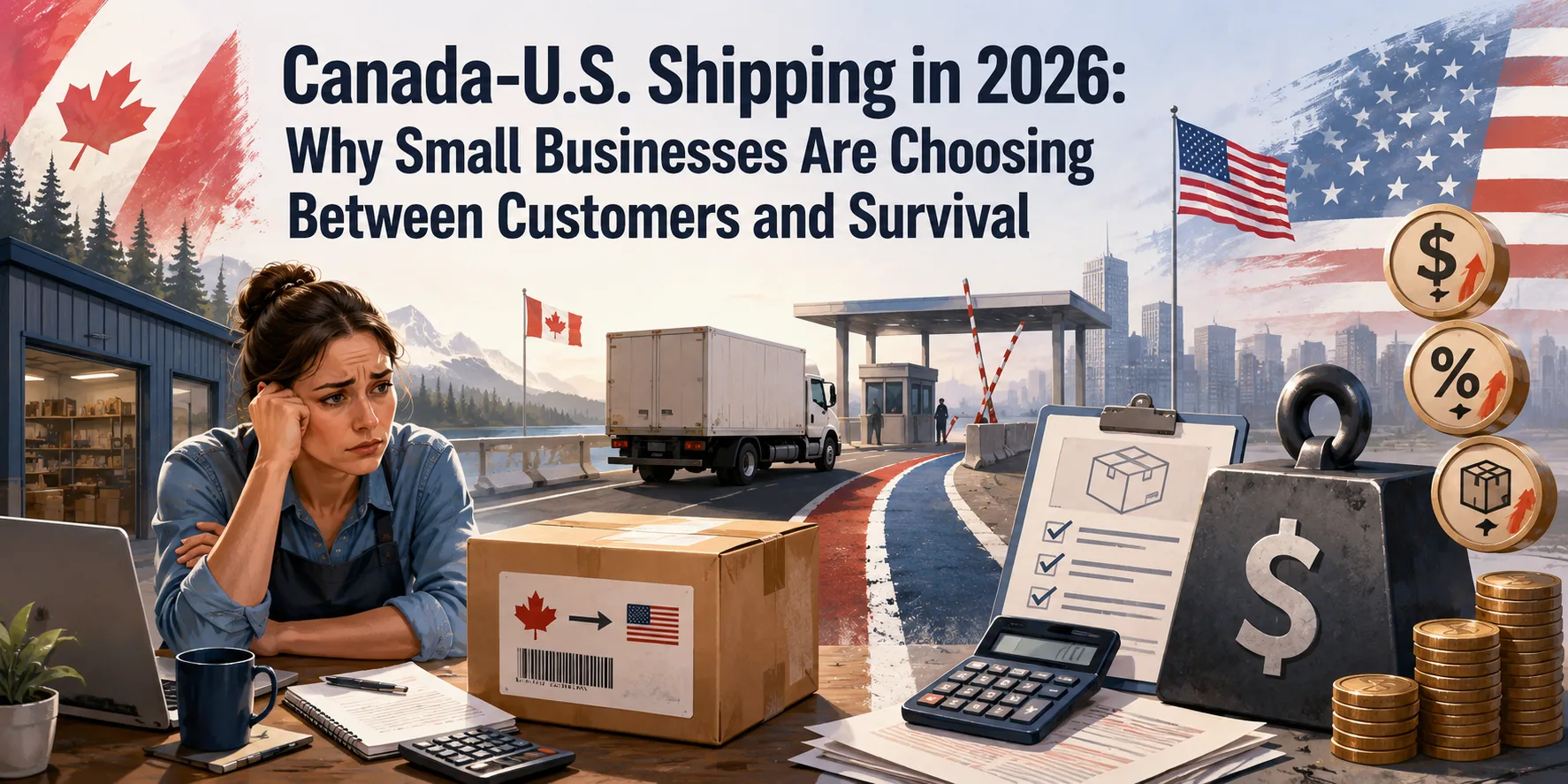
The cross-border trade relationship between Canada and the United States has undergone a fundamental transformation. What once functioned as a relatively straightforward process for small businesses has become a complex web of regulations, fees, and administrative requirements that threaten the viability of countless enterprises on both sides of the border.
The elimination of the de minimis exception has forced Canadian businesses into an impossible position: continue serving American customers at a loss, pass along prohibitive costs that drive those customers away, or abandon the U.S. market entirely. Meanwhile, American businesses attempting to sell into Canada face their own set of challenges, including stringent import processes and frequent customs rejections. This new reality of Canada-U.S. shipping has created a crisis for small businesses that built their success on cross-border commerce.
How the de minimis shift changed everything for Canadian businesses
For years, the de minimis rule served as the foundation of cross-border e-commerce between Canada and the United States. This provision allowed nonregulated goods valued under $800 to enter the United States without duties or taxes, requiring only minimal documentation. Small businesses across Canada structured their entire operations around this framework, building customer bases and revenue streams that depended on affordable cross-border shipping.
The elimination of this threshold has fundamentally altered the economics of Canada-U.S. shipping. Now, every single shipment requires formal customs clearance, regardless of its value. A handmade bookmark worth $10 faces the same bureaucratic requirements as industrial equipment worth thousands. This change affects not just the paperwork involved but the entire cost structure of cross-border sales.
Consider a small pottery studio in British Columbia that previously shipped ceramic mugs to customers in Seattle and Portland. Under the old system, a $25 mug could be sent across the border with minimal friction. Today, that same mug incurs customs brokerage fees that often exceed the product’s value. Add in the administrative time required for proper documentation, potential delays at the border, and the risk of rejection due to paperwork errors, and what was once a profitable sale becomes a guaranteed loss.
The impact extends beyond individual transactions. Canada-U.S. tariffs, combined with customs brokerage fees and administrative costs, have made entire business models unviable. Companies that specialized in low-value, high-volume items find themselves particularly affected. A jewelry maker who built their business selling $30 earrings to American customers now faces fixed costs that can reach $50 or more per shipment. The mathematics simply don’t work anymore.
The impossible choice facing Canadian exporters
The consequences of these changes extend far beyond inconvenience or reduced profits. According to data from the Canadian Federation of Independent Business collected in August 2025, 19% of Canadian small businesses estimated they could not survive for more than six months under the new system. This statistic represents thousands of businesses and tens of thousands of jobs at risk.
Business owners find themselves confronting three equally problematic options, each with serious drawbacks. The first option involves absorbing the new costs internally. For businesses operating on margins of 10-20%, adding $30-50 in fees per shipment quickly eliminates any profit. Many small businesses simply cannot sustain this approach for long without depleting their cash reserves or taking on unsustainable debt.
The second option requires passing these costs to customers. A Canadian artisan who previously sold handcrafted scarves for $60 to American customers might need to charge $110 or more to maintain the same profit margin. At these price points, Canadian products become uncompetitive compared to domestic American alternatives that face no such additional costs. Customer acquisition becomes nearly impossible when your products cost 50-80% more than similar items from U.S.-based competitors.
The third option means abandoning the American market entirely. For many Canadian small businesses, U.S. customers represent 30-50% of their revenue. Walking away from this market means not just reduced growth but potentially closing their doors entirely. Years of relationship building, brand development, and customer loyalty disappear overnight.
However, a fourth path has begun to emerge. Forward-thinking businesses are discovering that strategic partnerships with shipping companies and customs experts can help minimize the impact of Canada-U.S. tariffs. While this approach cannot eliminate all additional costs, it can make the difference between sustainable operations and business failure.
How a Canada customs broker can help businesses adapt
Working with a Canada customs broker has become essential for businesses determined to maintain their cross-border operations. These partnerships provide value not just for Canadian companies shipping south, but equally for U.S. businesses attempting to manage Canadian import fees, country of origin regulations, and the complexities of customs clearance in Canada.
According to Purolator, Canada’s leading integrated freight and parcel provider, customs optimization can maximize efficiency while ensuring businesses take advantage of all available incentives and strategies. The company notes that many businesses unknowingly miss opportunities to reduce their costs through existing trade agreements and programs.
“A U.S. business may find that its Canada-bound shipments qualify for duty-free status under the United States-Mexico-Canada Agreement (USMCA). A Canadian business may discover that ground shipments originating in Mexico can move through the United States as in-bond shipments, thereby avoiding a stop at U.S. customs. Or, a business may be eligible for duty drawback, which refunds import duties paid on products that are subsequently exported,” Purolator explains.
A qualified shipping partner provides several tangible advantages that can make Canada-U.S. shipping more manageable:
- Paperwork management: Documentation handling for customs clearance in Canada and the United States reduces costly errors and delays.
- Compliance assurance: Expert knowledge of constantly changing regulations protects businesses from costly penalties and rejected shipments.
- Cost optimization: Strategic bundling of shipments and identification of USMCA duty exemptions can significantly reduce per-package expenses.
The value of this expertise became even clearer following recent regulatory developments. After a February 2026 Supreme Court challenge regarding other tariffs raised hopes that the situation might improve, an executive order confirmed that the de minimis exception would remain suspended. This confirmation makes expert assistance invaluable for anyone involved in Canada-U.S. shipping.
Building resilience in a changed market
The current environment demands strategic thinking and operational excellence from businesses engaged in cross-border trade. While profit margins may never return to pre-2025 levels for small shipments, smart business decisions can help companies adapt to the new reality. Success now depends on understanding every available option for reducing costs and improving efficiency.
Companies that invest in understanding USMCA provisions often discover unexpected opportunities. A clothing manufacturer might find that certain materials qualify for preferential treatment, reducing overall duty rates. A food producer could identify ways to consolidate shipments that dramatically lower per-unit shipping costs. These discoveries require expertise and attention to detail, but they can mean the difference between profitability and loss.
Working with a Canada customs broker who specializes in cross-border trade provides access to knowledge that most small businesses cannot develop internally. These professionals understand the nuances of customs clearance in Canada and the United States, stay current with regulatory changes, and maintain relationships with customs officials that can expedite problem resolution. Their expertise helps businesses avoid common pitfalls that lead to delays, rejections, and penalties.
Conclusion
The transformation of Canada-U.S. shipping has created unprecedented challenges for small businesses on both sides of the border. The elimination of the de minimis exception has forced companies to make difficult choices about their future, with many facing the prospect of abandoning markets they’ve spent years developing. Yet within this crisis, opportunities exist for businesses willing to adapt their approaches and seek expert assistance.
The path forward requires acknowledging that cross-border trade has permanently changed. Success in this new environment depends on strategic partnerships, operational efficiency, and a deep understanding of available tools and exemptions. While the days of simple, low-cost Canada-U.S. shipping may be over, businesses that invest in the right expertise and systems can still maintain profitable cross-border operations. The choice facing small businesses is no longer just between customers and survival, but between adaptation and obsolescence.
More must-read stories from Enterprise League:
- Learn essential customer retention strategies to keep your buyers loyal during tough times.
- Discover why business location decisions can make or break your company’s success.
- Master the art of finding buyers for your product in competitive markets.
- Understand the critical consequences of bad location decisions before it’s too late.
- Build stronger connections through effective buyer-seller relationship management strategies.