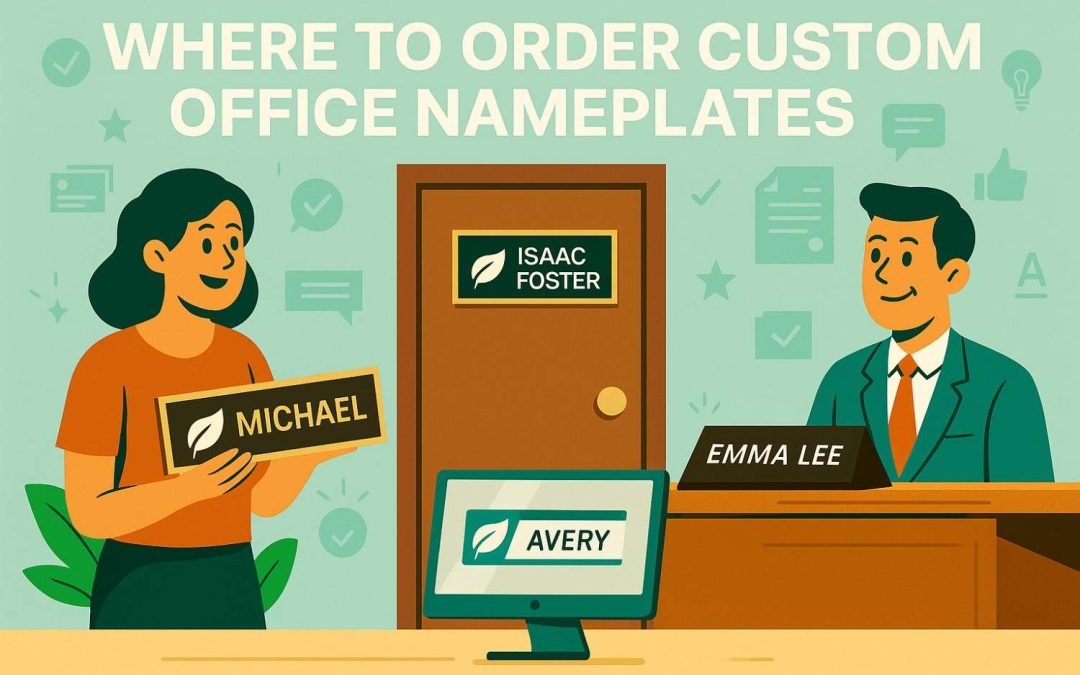

Where to Order Custom Office Nameplates

Where to Order Custom Office Nameplates

Custom office nameplates play an important role in any workplace. They help create a sense of pride, make positive first impressions, strengthen brand identity and encourage open communication. Desk nameplates also make onboarding smoother by helping new employees learn team members’ names. They assist facilities staff with monitoring office occupancy and support compliance with safety and security protocols.

Different manufacturers take unique approaches to nameplate customization. Some focus on perfecting the basics, while others use advanced technology for premium designs. Here are four top companies that create custom office nameplates with company logos.

Top nameplate manufacturers

  •  Providence Engraving

Providence Engraving offers extensive customization options. Standard nameplates range from 1×1 inch to 10×12 inches, with over 22 color combinations available. Their flexible templates let you select your preferred dimensions, match your office decor, add branding elements and include up to 48 characters in various fonts. Their online design tool makes it simple to create and preview custom pieces.

Their nameplates come with rectangular or rounded corners and can be wall-mounted or displayed in desk holders. The piano finish wedge designs add an executive touch, with optional card holder attachments.

The company uses precise CO2 laser engraving for detailed marks on acrylic or brass materials. This allows for quick 1-2 day turnaround times across the US and Canada. As an American manufacturer, they can expedite orders when needed.

Providence Engraving maintains clear pricing and provides custom design quotes by phone. Their team offers consultations to help bring your nameplate ideas to life.

  •  VistaPrint

VistaPrint creates laser-engraved nameplates in durable plastic with black or white text. They offer 2×8 inch and 2×10 inch desk signs in black, brushed silver and brushed gold finishes. Their aluminum and plastic holders are interchangeable, except for the solid walnut holder which has an attached nameplate.

Ordering is straightforward through their nameplate design tool. The interface works like a photo editor, with clear text fields and formatting options. Guidelines show safe printing areas, and you can preview designs instantly before adding to cart.

VistaPrint provides professional design services with 24-hour turnaround. You can review designs independently or schedule a video call with a designer, with up to three rounds of revisions included.

  •  Name Tag, Inc.

Name Tag, Inc. produces office desk signs using laser engraving, hot stamping and digital printing methods. They specialize in UV color printing for vivid logos, using quick-drying ink for crisp details. By working with various materials and inscription techniques, they give customers flexibility in design options.

The company offers many color combinations for plastic and metal signs, plus multiple font choices. Desk signs can include up to four text lines. They provide digital proofs so you can preview how size, color, fasteners and add-ons work together before production begins.

Their one-year guarantee covers manufacturing defects. They even offer discounted reprints if you’re not satisfied, regardless of whether specifications were met.

Name Tag, Inc. ships globally and provides volume discounts for identical layouts. No minimum quantities apply to repeat orders.

  •  PlaqueMaker

PlaqueMaker makes customizable desk, cubicle, table, tent, wall and door nameplates with logos for indoor settings. They work with 13 materials including bamboo, bronze, glass, granite, laser metal, leatherette and titanium. Each style has unique features with optional upgrades available.

Text engraving is included at no extra cost, with no character limits. They send proofs within one business day and allow three free revision rounds after initial review.

Free shipping is available within the contiguous US and to APO/FPO addresses with minimum orders. Their 90-day guarantee allows returns and refunds for unsatisfactory items.

Comparing custom office desk sign manufacturers

Consider these factors when evaluating nameplate makers.

  •  Material: Know whether a vendor uses plastic, metal, wood or all three to gauge how aesthetically pleasing and wear-resistant its desk designs are.
  •  Inscription techniques: Find out if a company prints, engraves, etches, stamps or hand-carves nameplate details. The inscription method influences sign appearance, durability and price.
  •  Visual elements: Explore the limits of a nameplate manufacturer’s customization capabilities to receive your custom desk nameplates with logos as envisioned.
  •  Configuration: Check the sign’s mounting mechanism and whether it can serve purposes other than labeling, like holding pens or dispensing business cards.
  •  Add-ons: Determine the extra features you can add to desk signs to elevate their appearance and expand their functionality.
  •  Sustainability: Assess how green a vendor’s products are to partner with a maker that supports your environmental, social and governance goals.
  •  Service area: Note a vendor’s location, and see if it ships locally, regionally, nationally or internationally.
  •  Turnaround time: Learn how fast a custom nameplate manufacturer typically delivers orders and what shipping options are available.
  •  Pricing: Analyze a company’s pricing structure to know how customization options affect the final bill and spot hidden fees.

Finding the right nameplate manufacturer

Each company brings unique strengths to nameplate customization. Take time to research their specific offerings and capabilities to find the best match for your organization’s needs.

More must-read stories from Enterprise League:

What Are the Top-Rated Automotive Glove Companies

What Are the Top-Rated Automotive Glove Companies


When you think about automotive work, images of grease, sharp tools and harsh chemicals probably come to mind. Whether you’re swapping out tires, detailing a classic car, repairing windshields or towing vehicles on a rainy night, your hands are constantly taking the brunt of the job. That’s why gloves are essential gear, not just accessories.

Automotive professionals need gloves that provide the right mix of durability, dexterity and comfort. Each task requires specific protection. Several companies stand out by offering innovative products, meeting safety standards and providing excellent customer service. Understanding what makes quality auto protection, how to select the right manufacturer and which top automotive glove companies deserve consideration is crucial for making informed choices.

Why gloves matter in the automotive industry

Automotive work without proper protection puts workers at risk. According to the Occupational Safety and Health Administration (OSHA), employers are required to provide suitable hand protection for the tasks assigned to their employees. Hand injuries are among the most common workplace incidents across the mechanical and repair industries, with 238,900 reported at workplaces from 2021 to 2022. Gloves help reduce these injuries by protecting against cuts, burns and chemical exposure.

Protection improves your grip when handling oily or slippery tools, which prevents accidents and saves time. They stop harsh cleaning chemicals from damaging auto detailers’ skin. Even tow truck drivers benefit from durable gloves that protect against rope burns and abrasions. Simply put, they are a nonnegotiable part of every automotive worker’s toolkit.

What makes for the perfect auto glove

The ideal glove varies by job, but certain standards remain constant across the automotive industry. When they meet these four criteria, mechanics and technicians can work more efficiently and safely.

  •  Protection first: Gloves should shield hands from cuts, punctures, oils, solvents and hot surfaces. Nitrile, leather and cut-resistant fibers all have their place.
  •  Dexterity and grip: Automotive tasks often involve small parts or precision tools. A glove that’s too thick can be as dangerous as wearing none at all.
  •  Durability: Disposable gloves need puncture-resistance, while reusable ones should stand up to repeated use without losing structure.
  •  Comfort and fit: Gloves worn for long shifts must feel natural, with good ventilation and flexibility to reduce hand fatigue.

How to choose the best automotive glove manufacturers

Quality varies significantly between safety companies. Some focus on disposable examination types, while others specialize in heavy-duty cut resistance. The best manufacturers offer a wide range to satisfy different task requirements within the automotive world. Consider these points to find reliable suppliers that consistently deliver high-quality products.

Factors to look for include:

  •  Certifications: Medical grade, examination grade or American National Standards Institute (ANSI) cut ratings help you know that PPE has been tested for safety and performance.
  •  Materials: Nitrile is a staple for mechanics, but depending on where and how you use it, you may also need coated textiles, leather or hybrid options.
  •  Industry focus: The company’s proven success in automotive and industrial sectors shows it understands your specific needs.
  •  Logistics: Fast shipping, transparent pricing and customer support are critical for small workshops and large operations.
  •  Innovation: Companies that invest in research create gloves with better grip coatings, chemical resistance or ergonomic designs.

What are the top-rated automotive glove companies?

Automotive protection manufacturers differ in specialties, certifications and industry focus. Some excel in sustainable materials, while others stand out for advanced cut protection or bulk supply. Consider this overview as a side-by-side comparison of the leading companies in terms of their key strengths and markets.

6 top-rated automotive glove companies

Quality, safety and reliability distinguish the best manufacturers. Each supplier brings unique advantages to the automotive industry, from high-performance disposables to heavy-duty protective gear designed for long-term use.

1. Glove America

Glove America combines high-quality protective gear with responsive service. The company manufactures its own products, maintaining strict quality control across lines designed for automotive, food processing and medical industries. For automotive work specifically, its range of nitrile and cut-resistant products helps mechanics and technicians stay safe while maintaining dexterity.

The company supplies other protective products, such as corded and banded earplugs. Selecting the protective gear you need is easy on the site, where you can shop by category, size, color, cut rating, palm material and thickness, with extended cuffs available. Most gloves are available in single pairs, boxes of 100 or bulk cases of 1,000 pairs.

The materials available also influence the types of automotive-focused gear you can order, including goatskin, synthetic leather, dipped material and 100% leather gloves.

Key features:

  •  SureCare brand with nitrile grip palm for smooth, tacky strength
  •  ANSI cut ratings 1, 4 and 5, meeting OSHA recommendations when handling metal
  •  Ships within one to five business days across the U.S. and Canada
  •  Price guarantee and qualifying free shipping for bulk orders

2. American Nitrile

American Nitrile stands out by manufacturing products in the United States. The company makes gloves that withstand contact with oil and brake fluid without tearing. Nitrile offers more strength than vinyl or latex and enhances functionality in disposables. The fit and tacky grip lets mechanics handle wrenches and small fasteners with precision.

Local manufacturing reduces import delays. Automotive workshops appreciate the durability and reliable availability, allowing them to order as needed rather than months in advance, while getting hand protection that holds up to greasy, solvent-heavy jobs.

Key features:

  •  Massive production reach at 120 million gloves per month for six lines, reducing backorders and skipping delays
  •  U.S.-made nitrile PPE for consistent quality control
  •  Ideal for protection against chemicals while maintaining comfort

3. Showa Group

SHOWA Group creates industrial-quality safety equipment. It serves industries where reliable hand protection is essential, and its lineup meets busy autoshop needs. Mechanics benefit from SHOWA’s puncture-resistant nitrile gloves, which protect them from sharp edges while resisting grease, oil and solvents.

Autodetailers rely on the brand’s lightweight coated protection, which combines dexterity with sure grip when working with wet surfaces or polishing compounds. For shops that use high volumes, SHOWA’s biodegradable gloves with eco-best technology help reduce landfill waste. The company prioritizes durability and comfort, making its products reliable for long shifts at the bench or under the hood.

Key features:

  •  Full range of reusable and disposable work gloves, including nitrile, polyurethane, heavy-duty Kevlar and cut-resistant options
  •  Order samples before ordering bulk
  •  Website’s comparison feature stacks different gloves side-by-side

4. Carolina Glove & Safety Co.

Carolina Glove & Safety Co. offers various gloves for automotive tasks, from light workshop work to heavy repairs. Cotton and jersey products work well for general shop handling, while the leather lines offer the abrasion resistance needed for towing, welding and handling sharp metal.

The company creates various coating styles to improve grip when working with oily tools and wet car parts. One advantage is flexibility. Smaller workshops can order off-the-shelf products while larger brands can opt for custom runs featuring private labeling.

Carolina Glove & Safety Co.’s 70-year history, American-based manufacturing, and additional imports ensure consistent quality and supply. The brand is ISO-certified, meeting industry standards. Complete your workshop safety kit with earplugs, eyewear and head protection from the brand’s extensive industrial range.

Key features:

  •  Family-owned company with detailed customer service
  •  Dynamic range of materials, including coated, flannel, leather, jersey, Kevlar and specialty types
  •  Custom design for unique requirements

5. MCR Safety

MCR Safety has earned respect in industrial safety. Its protection lines suit the daily needs of mechanics and autoshops. The Ninja® work gloves excel for jobs involving greasy tools and frequent solvent exposure. These make work easier while promoting comfort thanks to their strong grip, and they offer 47% higher abrasion protection than most.

The company provides products with higher cut ratings for cutting and grinding tasks, offering increased protection without limiting movement. The brand’s range includes impact-resistant options for heavy-duty work like tire changes, towing and handling large components like engine blocks. The variety of specialized protective gear makes MCR Safety valuable for automotive businesses needing protection across all workshop tasks.

Key features:

  •  Large range of protective gear, including cut-, impact- and chemical-resistant types
  •  Multiple ANSI cut ratings to match tasks, from light assembly to heavy metal work
  •  Complete range of arm and hand, eye and face, and body protective gear

6. Magid Glove & Safety Manufacturing Co.

Magid Glove & Safety Manufacturing Co. provides reliable options for automotive shops needing variety and volume. Mechanics use the brand’s nitrile disposable gloves for quick jobs involving grease and fluids, while coated and cut-resistant types and sleeves protect during heavier repair work.

The company offers lightweight options that keep hands comfortable during repetitive work like cleaning and polishing at detailer shops. The brand works well for both smaller garages buying custom starter packs and larger operations preferring bulk purchases with tailored safety programs.

With decades serving industrial markets, the manufacturer creates gloves balancing cost-efficiency with durability, suited for long days repairing vehicles.

Key features:

  •  Extensive catalog covering various styles, materials and finishes
  •  Bulk supply options
  •  ANSI ratings up to level A6 for high-intensity work demands

Assembling the top automotive glove manufacturers

This list of top-rated automotive glove companies considers both objective and practical factors. Safety standards, certifications and compliance with regulations by institutions like OSHA were essential. Product range, durability and customer satisfaction also influenced rankings.

Industry experience was another important factor. Companies with proven success in automotive, detailing and mechanical work ranked higher. Additionally, useful features like specialized coatings and chemical-resistant materials set some apart from basic offerings.

Gloves to buy or avoid

Not every glove is worth your money. Here’s a quick breakdown of hardworking types you may need:

  •  Nitrile disposables for chemical and oil resistance
  •  Cut-resistant gloves rated ANSI 5 and above for metal work
  •  Hand protection with specialty coatings for grip and abrasion resistance

Investing in the right pair pays off in fewer injuries, better performance and less wasted money. Gloves to avoid are:

  •  Low-quality vinyl that tears easily
  •  Makes without safety ratings or certifications
  •  Poorly fitted ones that compromise dexterity and safety

FAQ

Q: What gloves are best for mechanics?

A: Nitrile gloves are a go-to for disposable use, while cut-resistant textile types are best for heavy mechanical tasks.

Q: Are nitrile gloves better than latex for automotive work?

A: Yes. Nitrile is more resistant to oils and solvents, making it a safer choice in automotive environments. Keep latex gloves in the first-aid kit for treating injuries.

Q: What does the ANSI cut rating mean?

A: It’s a standardized test that measures a glove’s resistance to cuts. ANSI 5 offers strong protection against sharp edges.

Q: How do I choose the right glove size?

A: Measure your palm circumference and consult the manufacturer’s sizing chart. A snug fit improves safety and comfort. Oversized ones reduce grip integrity and can cause injuries, while a too-tight fit reduces range of motion.

Q: How do I order bulk gloves?

A: Once you’ve decided on a supplier, you’ll need to find the average hand size for the team in your workshop. If there’s little variation, you can order bulk at reduced cost, but if the team has small, medium, large and extra large hands, you may be better off ordering individual units as needed.

The best fit automotive glove companies

Hand protection is fundamental to safety in the automotive industry. The right manufacturer provides more than basic protection by offering innovative features, quality assurance and reliable service. These companies represent the industry’s best options, from nitrile disposables to heavy-duty cut-resistant choices.

If you’re looking to improve your hand protection, consider starting with a trusted name like Glove America, which combines quality products with competitive pricing and dependable customer support.

More must-read stories from Enterprise League:

Planning Your Advisory Exit: A Human-Centered Roadmap for a Profitable and Purposeful Transition

Planning Your Advisory Exit: A Human-Centered Roadmap for a Profitable and Purposeful Transition

If you’re a financial advisor who has dedicated years to nurturing client relationships, managing markets, and building a reputable practice, it’s only natural to wonder: what happens when it’s time for me to step away? Whether you’re approaching retirement or considering a new chapter, planning your advisory exit is one of the most significant business decisions you’ll ever make.

In this comprehensive guide, we’ll help you design an exit strategy that not only maximizes the value of your practice but also preserves your legacy, supports your team, and honors your clients.

Why you need an exit strategy now, not later

Many advisors put off exit planning until it becomes urgent. The consequences? Rushed negotiations, confused clients, and diminished valuations.

By contrast, planning your exit early can:

  •  Protect and enhance your firm’s market value
  •  Offer continuity and confidence for clients
  •  Allow for a smooth operational transition
  •  Give you peace of mind about your future

Most importantly, a well-timed exit strategy ensures you’re in control of how and when you transition instead of being forced to react to health issues, market changes, or unexpected life events.

The 6 pillars of an effective advisory exit strategy

1. Valuation: Understand what your practice is worth

Buyers and successors care about more than just revenue numbers. Key factors influencing valuation include:

  •  Recurring, fee-based income
  •  Client demographics and retention rates
  •  Revenue trends over the past 3–5 years
  •  Operational systems and technology adoption

Pro tip: Hire a valuation expert at least 3 years in advance. This gives you time to address weak spots and position your firm for a higher multiple.

2. Financial optimization: Clean up and streamline

Think of your practice like a home you’re preparing to sell. Before listing, you paint the walls, fix leaky faucets, and declutter. The same applies here:

  •  Eliminate unnecessary expenses
  •  Pay off outstanding debts
  •  Simplify organizational workflows
  •  Review vendor agreements and tech stacks

A lean, organized business not only looks good to buyers but also simplifies due diligence.

3. Succession planning: Choose the right fit

Selecting a successor is a deeply personal and strategic decision. Your options include:

  •  Internal successor: An employee or junior advisor already familiar with your clients and culture.
  •  External buyer: A larger firm or independent buyer that aligns with your values.
  •  Family member: Keeps the business in-house but requires training and mentorship.
  •  Merger/acquisition: Offers scale and resources while phasing out your direct involvement.

Cultural compatibility and client trust should outweigh purely financial incentives.

4. Legal & compliance preparation: Avoid regulatory pitfalls

Retirement doesn’t exempt you from legal obligations. Poor planning can lead to compliance issues long after you’ve stepped away.

Action steps:

  •  Update ownership agreements and operating documents
  •  Handle SEC/state filings well in advance
  •  Put your succession plan in legally binding form
  •  Work with a legal advisor to avoid oversight

5. Client communication: Maintain trust through transparency

One of the biggest risks in any exit is client attrition. Address this by keeping clients informed and engaged.

Best practices:

  •  Announce your plan early
  •  Personally introduce your successor
  •  Reiterate service continuity and shared values
  •  Offer transition meetings with both parties present

Clients don’t just trust your advice they trust you. Showing them that you trust your successor goes a long way.

6. Timeline: Start planning 3–5 years in advance

Why this window?

  •  You have time to boost key performance metrics
  •  You can mentor and train your successor
  •  You avoid last-minute tax planning mistakes
  •  You maintain leverage in negotiations

Rushing an exit often leads to lost revenue, unfavorable terms, and unnecessary stress.

Common exit paths and their pros & cons

Choosing the right path depends on your personal goals, client mix, and financial targets.

Don’t ignore the emotional side of exiting

Selling or leaving your advisory firm isn’t just a financial transaction it’s an emotional milestone.

Advisors often report:

  •  Loss of identity after exiting
  •  Anxiety about “what’s next”
  •  Emotional responses from clients

Plan for your post-exit life with as much clarity as your business transition. Whether it’s traveling, teaching, consulting, or launching something new know your next chapter.

Final thoughts: Exit on purpose, not by default

You’ve spent a career helping others prepare for their future. Now it’s time to do the same for yourself.

By planning your advisory exit with intention, you can:

  •  Maximize the value of your business
  •  Protect your legacy
  •  Support your clients and staff
  •  Move confidently into your next phase

For a deeper look at the financial and legal steps to selling your advisory firm, visit Advisor Legacy’s guide.


More must-read stories from Enterprise League:

Who Has the Best Service for Fire Protection Extinguishers and Restaurant Suppression

Who Has the Best Service for Fire Protection Extinguishers and Restaurant Suppression


Running a restaurant requires following safety standards. One requirement is installing fire protection equipment like fire extinguishers and suppression systems. These help protect your employees, customers and assets in case of an emergency.

Learn which companies provide excellent service for fire protection extinguishers and restaurant suppression systems, and understand what factors matter most when selecting equipment.

National fire supply

National Fire Supply stands out for fire protection extinguishers and restaurant suppression systems. The company excels in comprehensive solutions, quick response times, and reliable compliance support for commercial kitchens and restaurants. This National Association of Fire Equipment Distributors (NAFED)-certified supplier makes it simple to purchase equipment online with direct delivery to your facility. They stock major brands including Amerex, Pyro Chem, Range Guard, Badger and Kidde.

Their suppression systems are specifically built for commercial kitchens, providing dependable protection against grease fires. Their extinguishers effectively control various types of fire. Beyond these essential safety items, National Fire Supply offers quality fire alarms, detectors, hoses, emergency lighting and signage. Check out their website, browse the catalog, get same-day shipping and join their newsletter for special discounts.

Key features

  •  Competitive pricing: The staff works tirelessly to provide cost-effective fire safety solutions, ensuring restaurant owners have top-tier equipment.
  •  Bulk discounts: National Fire Supply offers special discounts for larger establishments or multiple locations. This is ideal if you manage multiple restaurant chains.
  •  Integrated solutions: See a full range of extinguishers, suppression systems and related safety equipment.
  •  Expert guidance: Experts provide guidance to help you determine the right products for your needs, ensuring you make smart investment decisions for long-term success.


Koorsen

Family-owned Koorsen has provided excellent service for fire protection extinguishers and restaurant suppression since 1946. They offer comprehensive safety solutions for restaurants including facilities management, construction, combustible dust consultation and environmental services. Their clients include Culver’s, Ivy Tech Community College, Honda and Indianapolis Airport Authority.

Their certified technicians and engineers install and maintain fire extinguishers and suppression systems for restaurants. They stay current with National Fire Protection Association (NFPA), local and national fire safety standards. Additional services include emergency lighting, fire alarm systems, sprinklers, security tools and mass communication systems. Visit their website to learn more.

Key features

  •  Customized solutions: Koorsen offers tailored suppression systems for restaurants of all sizes, including industrial and commercial kitchens.
  •  24/7 emergency response: Expect immediate response for system activations or failures.
  •  Comprehensive services and maintenance: It is your one-stop shop for all your fire and security requirements, helping you save time. Get regular inspections, testing and maintenance programs.


Cintas

Cintas delivers high-quality fire protection services, including extinguishers, inspections, and restaurant suppression system installation and maintenance. As a full-service provider, they assess your facility’s needs to provide appropriate fire protection equipment and train your staff in proper usage. Their team monitors your facility 24/7 and tests emergency lights.

The fire extinguisher service covers testing, inspection and maintenance of equipment, detailed documentation, and round-the-clock support. Experts provide hands-on training about common fire hazards and evacuation routes. They also handle kitchen and hazard suppression services to ensure your restaurant meets local and insurance requirements. Contact a service representative through their website.

Key features

  •  Nationwide coverage: Cintas caters to over 1 million customers in the U.S. and Canada and operates in 12 distribution centers.
  •  Bundled safety services: Aside from fire protection services, it provides other safety assistance in terms of first aid, restroom and hygiene, flame-resistant clothing, and workwear.
  •  Certified technicians: Trained fire experts will give you detailed documentation and training to help you meet safety standards.


Ansul

ANSUL is respected in fire prevention. They supply portable fire extinguishers and spill control products. Their premium lines include SENTRY, REDLINE and restaurant-specific options, with choices like wet chemical and portable CO₂ equipment.

Their restaurant fire suppression systems are designed specifically for commercial kitchens. The PIRANHA dual agent system combines two effective extinguishing agents the quick flame knockdown ability of wet chemical with water’s cooling power. ANSUL-certified technicians help select appropriate equipment for your needs. Reach out to customer service for specific recommendations.

Key features

  •  Industry-leading equipment: ANSUL provides advanced suppression systems designed for high-risk environments.
  •  Comprehensive product range: Get extinguishers, suppression systems, detection devices and more from a single supplier.
  •  Training services: ANSUL-certified professionals can provide fire protection training and on-the-job performance support aids.


Fireline

Fireline serves the Mid-Atlantic region with excellent fire extinguisher and restaurant suppression services. They pioneered the use of ABC multipurpose dry chemical fire extinguishers in Maryland. Their experts inspect, maintain and train your staff for safe kitchen operations.

The Fireline team installs automatic suppression systems that prevent fire reflash. These systems automatically cut off electricity or fuel to cooking appliances. Fireline also provides fire alarm monitoring without requiring phone lines or third-party providers.

Key features

  •  Restaurant-focused services: Fireline has 75 years of industry experience and is a well-known expert in kitchen suppression and compliance.
  •  Top-notch customer service: The staff are friendly and responsive, ready to assist you with your fire protection and safety needs.
  •  Certified technicians: Experts are well-versed in the restaurant industry and can perform regular, thorough inspections, and maintenance.


CFS Fire Protection, Inc.

CFS Fire Protection, Inc. provides quality fire extinguisher and suppression system services for restaurants and commercial kitchens in Northern California, with strong compliance and customer service. Their services meet NFPA and NAFED standards. They supply fire extinguishers, suppression systems and inspection tags that verify proper equipment checks.

Their team conducts on-site live demonstrations of fire extinguisher use, giving staff practical experience. Trained technicians handle installation, repairs and maintenance of automatic suppression systems to keep your business running smoothly. Visit their website for more details.

Key features

  •  Certified inspections: NFPA-compliant inspections and testing, which ensure your business is safe for your staff and customers.
  •  Great customer service: Many reviews noted the team’s responsiveness, kindness and patience in answering queries.
  •  Emergency repairs: Certified technicians provide fast response for system or equipment malfunctions.


Impact Fire

Impact Fire offers complete fire protection services, including extinguishers and restaurant suppression systems. They help businesses prepare for emergencies with a free emergency readiness checklist on their website. They use thorough risk assessment, detailed emergency response procedures, training guidelines, effective communication protocols and coordination with local emergency services.

Impact Fire serves multiple U.S. regions as a leading fire safety provider. They supply accessible extinguishers and install them according to NFPA codes and local standards. Their team services, inspects, and certifies fire suppression systems through semiannual maintenance programs and 24/7 emergency support. Visit their website to learn more.

Key features

  •  Thorough inspections: Impact Fire performs a systematic process to identify potentially detrimental equipment and site conditions and act on them immediately.
  •  24/7 emergency response: Whether you have faulty equipment or need an upgrade, contact the team and they’ll respond immediately.
  •  Comprehensive services: The brand also provides security systems, backflow devices, fire alarms, fire sprinklers and special hazards.


Jorgensen Co.

Jorgensen Co. has provided trusted fire safety services since 1932. This California-based company handles equipment, employee training, installation, design, routine maintenance and quick response services. They follow all local, state, and federal codes and regulations. As members of NAFED and the California Association of Life Safety and Fire Equipment, their technicians stay updated on protection requirements.

Teams install and maintain fully functional portable extinguishers. Their training uses an eco-friendly fire simulator for hands-on fire extinguishing practice. Jorgensen Co. services, repairs and upgrades most brands of automatic suppression systems. Check their website for more information.

Key features

  •  Restaurant expertise: Jorgensen Co. has a deep knowledge of kitchen fire risks and solutions.
  •  Custom installations: Experts can provide custom restaurant suppression systems to suit your kitchen layout.
  •  Robust staff training: The company’s fire safety education includes theoretical and practical phases.


FireServ

FireServ specializes in quality fire protection extinguishers and restaurant suppression services. They serve clients nationwide to create safe, functional facilities. Customer reviews highlight their affordable options, professionalism and reliable maintenance schedules. Their licensed technicians bring years of experience in customized solutions.

FireServ provides fire extinguishers and suppression systems that meet NFPA regulations. They conduct monthly or quarterly visual inspections to verify proper function. Visit their website to connect with a representative.

Key features

  •  24/7 rapid response: Many testimonials highlighted FireServ’s immediate response and efficient resolutions in emergency situations.
  •  Routine inspections: Technicians perform regular inspections to ensure compliance and safety.
  •  Various types of fire extinguishers: The company has a range of options suited for fires from different sources.

Best service for fire protection extinguishers and restaurant suppression

Here’s a quick rundown of the enterprises that offer fire protection products and services.

How to choose the right provider for your restaurant

According to the NFPA, 61% of fires in eating and drinking establishments involve cooking equipment. Working with a qualified fire protection company helps ensure restaurant safety and continuity. Consider these factors when selecting a provider.

1. Verify certifications and compliance

Ensure the business and its technicians are certified by recognized authorities like NFPA, NICET, and other relevant certifications. Ensure the fire extinguishers and protection systems have been approved by reputable third-party testing organizations.

2. Assess the services

Find a provider offering comprehensive safety solutions. Consider additional options like fire sprinklers, cabinets, hoses and service verification collars. Confirm they work with suppression systems suited to your restaurant’s needs, such as wet chemical or water mist systems.

3. Evaluate response time and support

Select a supplier with 24/7 customer support. Ask about typical response times and emergency request procedures. Poor support can cause operational problems or safety risks if issues aren’t addressed promptly.

4. Read reviews

Look at customer feedback to gauge service quality. Check reviews on the company website and platforms like Google, Yelp, and Reddit. Notice how they handle both positive and negative feedback.

5. Compare pricing and value

Many companies provide free quotes and site inspections. Get detailed quotes showing all costs including parts, warranty and labor. Consider package deals for better value.

While price matters, it shouldn’t be the only factor. Lower-quality fire protection equipment often costs more long-term through repairs and compliance issues.

Ask key questions

Important questions to ask potential providers:

  •  How long have you been in business?
  •  Do your technicians have relevant certifications, such as NICET?
  •  Do you have experience in providing services for restaurants?
  •  Can you provide references from other restaurants you serve?

Invest in the best service for fire protection, extinguishers and restaurant suppression

The ideal supplier matches your specific requirements rather than just being well-known. Evaluate their certifications, technical expertise and ongoing service commitment.

Choose a long-term partner dedicated to maintaining your fire extinguishers and systems in compliance and ready for action when needed.

More must-read stories from Enterprise League:

Can I buy warehouse automation equipment in Virginia?

Automating warehouse operations can significantly improve a business’s quarterly performance. Team members get valuable support, and customers enjoy better order experiences.

Business owners in any industry can find warehouse automation equipment in Virginia to enhance their companies’ operations.

Top factors to consider

The best warehouse automation equipment varies by team. Employees working on conveyor lines and moving supplies across large storage spaces use different tools. The most effective automation upgrades match their daily responsibilities and simplify tasks with job-specific equipment.

Warehouse management teams should also consider scalability and affordability. Investing in automation is only worthwhile if the machinery lasts. The tools should handle increasing consumer demand and expanding teams without straining business finances after purchase.

Automated warehouse equipment providers

Companies interested in warehouse automation can explore these trusted providers based in or serving the Virginia area. They offer solutions for every warehouse operational need.

1. Eastern lift truck co.

Eastern Lift Truck Co. has helped companies handle materials for over 50 years. The business assists warehouse teams with designing and managing their projects. Clients who choose Eastern Lift Truck Co.’s automation solutions gain tools to accomplish more, collect accurate data, and improve employee safety.

Warehousing professionals can contact the company to discuss the best solution for their specific workflows.

2. ATI industrial automation

Companies interested in robotics should consider ATI Industrial Automation. The company provides parts for automated robots and robotic arms. Customers find diverse selections of end-effectors to improve automated operations. They also receive excellent customer service, thanks to the company’s established history.

3. Southeast industrial equipment, inc.

Southeast Industrial Equipment, Inc. operates throughout the East Coast. The company makes warehouse automation equipment for global brands in Virginia, North Carolina, Georgia and South Carolina. Warehousing teams can arrange financing programs to fit their budget, making automation benefits accessible. Whether teams need help with storage systems or guided vehicles, Southeast Industrial Equipment, Inc. provides quality machinery.

4. Honeywell

Warehouse automation professionals trust Honeywell for modern fulfillment needs. The manufacturer produces equipment that addresses daily labor challenges and consumer demand. Machinery handling outbound orders, conveyor processes and other manufacturing operations can boost productivity while supporting company growth with adaptable technology.

5. Numina group

Numina Group created an execution and control software platform that manages the company’s Tier 1 warehouse systems. Clients get single-point access to monitor production and maintain high productivity.

When teams order automated equipment from Numina Group, the in-house design team creates a custom plan for that company’s warehouse. Turnkey implementation and assisted integration ensure warehouse employees experience minimal downtime during configuration.

6. TE connectivity

TE Connectivity has global locations, including the southeastern U.S. Professionals can purchase warehouse automation equipment from this established company for large conveyor systems or smaller sub-application parts.

TE Connectivity’s engineered solutions and connectivity give manufacturing teams modern technologies that streamline workflows. Clients also receive ongoing learning materials to train their team or improve their technical skills after implementation.

7. Carolina handling

The experts at Carolina Handling are near Virginia and serve companies nationwide. Every product comes from experienced professionals who optimize for peak productivity and simple usage.

If company leaders want to evaluate whether automation suits their team, Carolina Handling offers operational assessments to determine if their products would benefit the business.

8. Dematic

Dematic works with supply chain professionals to automate teams throughout manufacturing, warehousing and distribution facilities. The available equipment simplifies everything from case and piece picking to conveyor work.

After clients integrate their purchases, Dematic professionals maintain contact for long-term support. They ensure their products reduce costs and drive efficiency years after installation.

Benefits of using automated warehouse machinery

Investing in new equipment and upgrading warehouse machinery are significant steps. Business owners can consider these advantages that motivate many to invest in automation.

1. Improved operational efficiency

Manual labor can become more efficient over time, but automated systems maximize work performance immediately. New machinery can move and process goods without human errors, like dropping products off conveyor belts. Fewer operational bottlenecks help teams accomplish more work each quarter without overtime.

2. Extended production hours

Team members need breaks and sustainable work schedules. New machinery can operate continuously when employees are resting or off work. After investing in warehouse automation equipment, employees no longer need stressful schedules. Production hours can increase without straining workers.

3. Local regulatory incentives

The Virginia Jobs Investment Program (VJIP) rewards companies that expand their operations with technological upgrades. Buying warehouse automation equipment could qualify a company for VJIP cash grants when training employees on new technology. Business owners should contact the VJIP office to discuss eligibility and grant processes through meetings with VJIP business managers.

4. Reduced payroll costs

During peak demand, automated equipment continues workflows while employees are off the clock. Overtime pay decreases, often resulting in less stressed teams with more balanced schedules. Companies don’t need temporary staff during busy seasons. Leadership teams save money on payroll by combining automation with existing teams.

5. Better inventory accuracy

Automation improvements in inventory tracking can save businesses money. It ensures order fulfillment has minimal mistakes and reduces human error. Teams can track machinery during the day, checking current inventory levels without spreadsheets or checklists. Employees also improve restocking accuracy using current inventory information from automated devices.

6. Enhanced workplace well-being

Warehouse operations affect employee health. Lifting cases weighing over 35 pounds daily can cause musculoskeletal or ergonomic disorders. Long-term stress from intense schedules impacts mental health. Automation removes repetitive or dangerous tasks that increase safety concerns.

Robotics can lift heavy materials, handle hazardous substances and sort supplies to reduce physical strain. Some automation equipment features ergonomic designs to support employee health.

7. New data for decision-making

Warehouse equipment with automated technologies collects real-time data. Management teams can use recent information to understand team performance or operational efficiency. Ongoing decisions become more accurate with data-based choices.

Potential challenges after installation

Industry leaders researching warehouse automation equipment in Virginia should plan for potential challenges. Problem-solving before complications arise makes integration easier.

1. Integrating existing systems

Current warehouse management systems might not work with new automation technologies. Teams should research potential merging processes with enterprise resource planning systems or other software platforms helping with daily operations.

If integrations are possible, leadership teams must review data migration processes. Errors could cause lost records. Planning steps before integration ensures smooth implementation.

2. Employee job concerns

People often worry when automation upgrades happen. Workplace leaders benefit from reassuring staff that job displacement isn’t planned. The automation supports valued team members, helping the company succeed rather than replacing workers. Information about retraining opportunities can improve morale.

3. Missing technical training

Some automation manufacturers provide training materials. If equipment doesn’t include ongoing learning modules, review the team’s existing IT skills. Leadership teams might need extra time for technical training.

The business could consider outsourced IT teams for help with secure data migration and ongoing technical support. Some manufacturers offer 24/7 support, while others don’t. IT experts can answer questions about management software or bug fixes.

Tips for integrating new equipment

Teams minimize potential downtime with detailed integration plans. Company leaders should outline how they’ll add automation equipment, which manufacturers may help coordinate. Plans might include:

1. Define success metrics

Leadership should define automation purchase goals and long-term objectives. What problems will the equipment solve? Which metrics indicate success or failure? These details provide concrete ways to assess investment value during operations reviews.

2. Schedule phased implementation

Phased implementation helps warehouse teams succeed. They can practice with new technologies in small facility sections, fixing training or operations issues before expanding. Employees get time to adjust to machinery, reducing human error risks that cause production or revenue loss.

3. Migrate data carefully

Automated tools that store or track team data usually need existing information from spreadsheets or older programs. Business leaders must plan careful data migration. They should verify required information amounts and check digital security infrastructure to protect data.

4. Create training materials

All employees need access to comprehensive training materials before, during and after automation implementation. Some manufacturers provide this, others don’t. Managers might need time to create learning modules.

5. Listen to employee concerns

Managers may meet nervous team members as automated tools change responsibilities. Regular meetings to hear concerns help ease minds. Managers can explain how machinery helps employees rather than replacing jobs. Listening, getting feedback and reinforcing worker value improves team morale during transition.

Adding new machinery to warehouse workflows is a major project. Breaking it into steps, planning for challenges and getting manufacturer integration help makes the process smoother for everyone involved.

Find the best warehouse automation equipment in Virginia

Warehouse companies can upgrade their machinery with automated solutions to improve productivity, efficiency and more. Comparing products from different providers helps leadership teams choose optimal options. Once they identify the right products within budget, integration can begin.

More must-read stories from Enterprise League: