


How Individual Cyber Mistakes Can Turn into Business Risks

How Individual Cyber Mistakes Can Turn into Business Risks

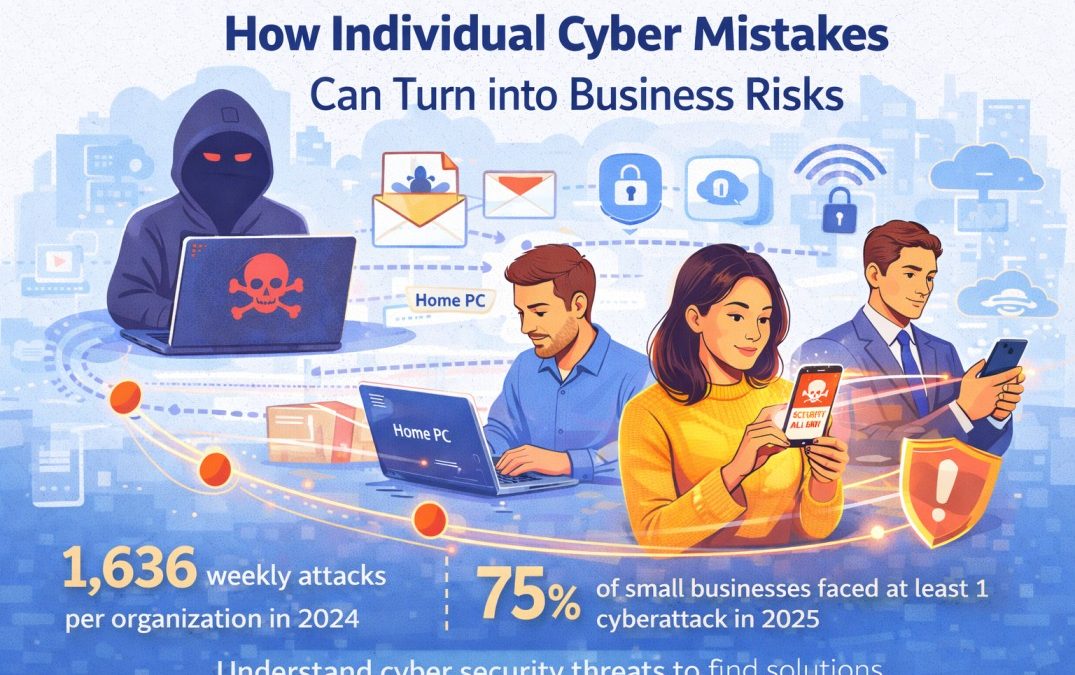
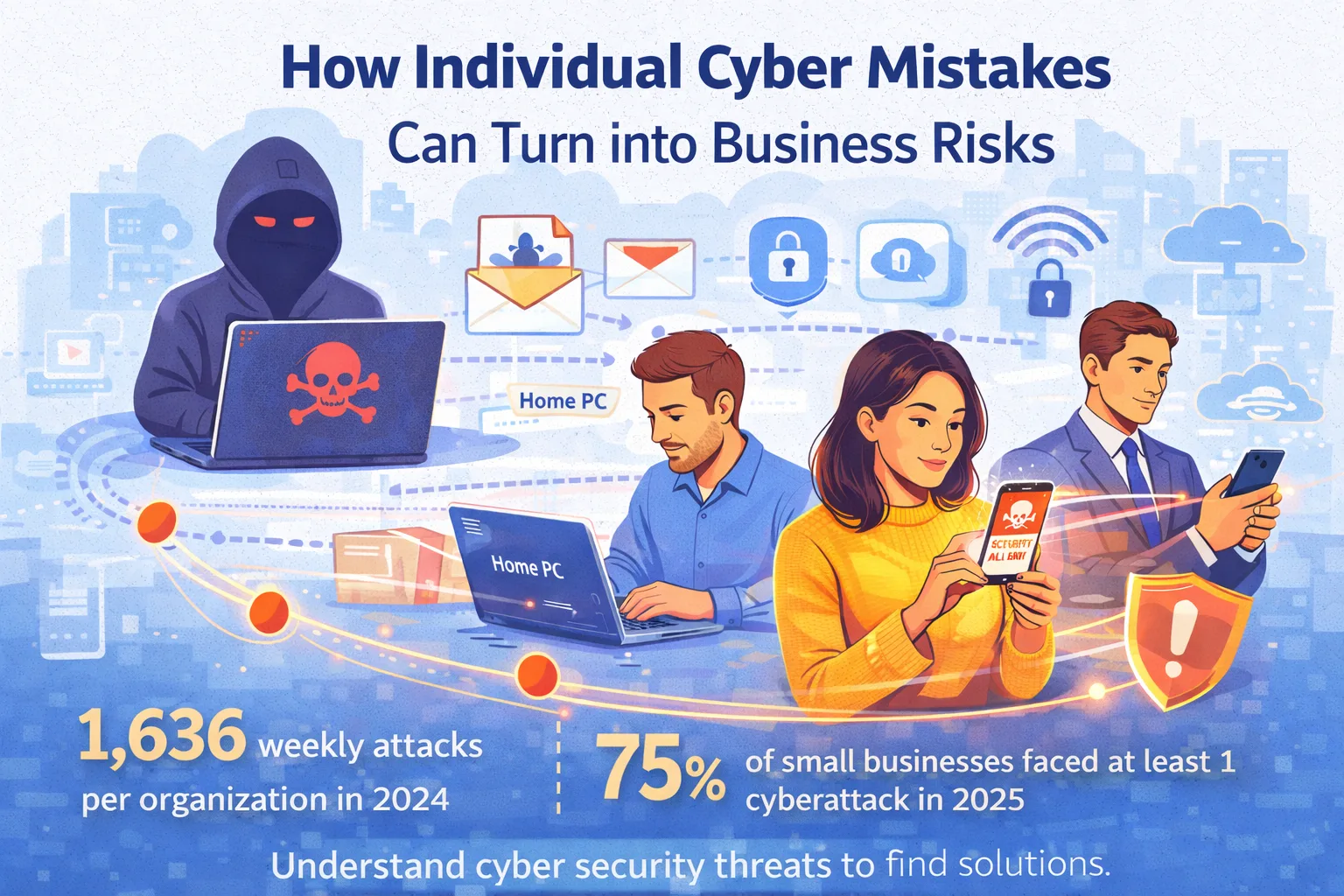
The data related to cyberattacks on businesses is simply eye-opening. In 2024, there were 1,636 weekly attacks per organization. In the case of small businesses, 75% of them experienced at least one cyberattack in 2025. A worrying trend that has come up is that individual cyber mistakes are contributing quite substantially to cyberattacks. The rise in remote and hybrid work, the use of personal PCs from home for office work, dependency on cloud platforms, etc., are some of the new reasons that have led to an increase in cyberattacks. It is therefore important to understand cyber security threats and analyze possible solutions.

1. Personal devices become corporate entry points

Because of changing work trends, businesses now allow employees to work remotely. In such cases, many of them use their personal devices. Due to this, their personal security habits have a direct impact on corporate security systems. Compromised personal devices lead to indirect access to business emails, shared drives, critical information files or internal dashboards. To prevent any data leaks and compliance violations, basic device security standards should be enforced for the employees across all levels.

2. Misunderstanding platform safety

Just because a platform is popular and used by billions of people does not make it automatically safe. This is where many employees make cyber mistakes, as they trust them to be safe in all regards.

Telegram is widely used as a messenger for quick conversations between office workers. But there have been times when questions around Telegram scams and is Telegram secure have highlighted how misplaced trust creates vulnerabilities. The typical symptoms to know if there’s a scam or not can prevent sensitive conversations and data from falling into the wrong hands. For this, businesses need to train and educate users on platform limits, whether it’s Telegram or Facebook or X or WhatsApp. This can be done through regular training sessions and awareness campaigns.

3. Weak authentication leading to account takeovers

Employees might be using weak passwords to log in to office email or work-specific collaboration tools and other SaaS products. They might have changed passwords and usernames but simple changes prove to be ineffective if passwords are not really strong or do not use 2FA. To prevent any chance of a cyber attack, train employees to set strong passwords that include a mix of numbers, letters, special characters and uppercase letters. They should also use 2FA or MFA to strengthen the defense further.

4. Missed or ignored updates create vulnerabilities

System and app updates should be done the moment they’re due. Any gap on this front leaves vulnerabilities exposed. Hackers find these gaps too easy to exploit because security gaps are already documented and unpatched. From financial frauds to making systems inoperable, the possibilities are many in case of a cyberattack. To protect the systems, make automatic updates mandatory.

5. Social media at work means high risk

Employees increasingly use social media and chat platforms for office discussions, file sharing and other work like sourcing candidates, vendors, background checks, etc. Basically, the use is widespread and in between, there’s use for personal reasons also.

From Telegram security to Instagram safety, lack of awareness can lead users to trust malicious links or impersonated contacts. This is where Instagram, Facebook, X and Telegram app scams take place. It includes various other apps like YouTube, Teams, etc., so nothing should be taken lightly. Set limits for social media platform use, and if possible, set a rule to prevent personal use and define which ones can be used in the office.

6. Small human errors turning into big risks

Cyber incidents often start with simple cyber mistakes, which mostly snowball into something big. It’s almost always about negligence and simple rushed actions like:

  •  Click – A rushed decision to click on a fake malicious link
  •  Share – Uploading files to an unsecured platform or sharing with an impersonator
  •  Trust – Believing a message without verification and ending up taking an unwanted action

Regular awareness training that focuses on real-world scenarios makes a big difference in developing the cyber sense of employees.

7. Built-in protections ignored

Devices like Macs come pre-loaded with firewalls, encryption and access controls and other key security features. To enhance them, companies like Apple and others regularly roll out updates that address vulnerabilities. The cyber mistakes happen when employees ignore these. It’s a matter of minutes to update the systems and software but it is the lack of cyber threat protection information that makes them do so. Businesses should standardize security settings across all work devices for all employees and audit the rollout adoption.

Conclusion

Cybercrime data clearly shows that hackers understand where humans are prone to make cyber mistakes when working on systems. They are smart and use the latest technologies to exploit these simple vulnerabilities and leave a business financially and reputationally damaged in no time. With these above ideas and increased focus on developing strong cybersecurity teams and audit models, businesses can minimize the cyberattacks.

More must-read stories from Enterprise League:

Your Online Reputation Is Not One Site, It Is the Whole Trail

Your Online Reputation Is Not One Site, It Is the Whole Trail

Learn how to connect your social profiles, old bios, news mentions, and reviews into one clear story so people trust your business faster.

Most founders think their reputation lives in one place, like a Google Business Profile, a LinkedIn page, or a single article. In reality, people rarely stop at just one result.

They click a few links, skim your About page, scan your reviews, and then build a quick “mental profile” of you and your business. If those touchpoints match, you look established. If they contradict each other, you look risky, even when you are not.

This guide explains how the trail works, where it usually breaks, and how to keep your story consistent without turning your life into a full-time cleanup project.

What is the “reputation trail”?

Your reputation trail is the collection of public signals that show up when someone searches your name, your company, or both. It includes owned assets (things you control) and third-party assets (things you do not control).

Most trails include:

  •  Your website and About page
  •  Social profiles (LinkedIn, X, Instagram, YouTube, TikTok, GitHub, Medium, etc.)
  •  Old bios on partner sites, podcasts, conference pages, and guest posts
  •  Reviews (Google, Yelp, G2, Trustpilot, industry directories)
  •  News mentions, press releases, and industry features
  •  Business listings and data broker profiles
  •  Images, snippets, and “People also ask” results

Key Takeaway: People do not judge you from one page. They judge you from patterns across multiple pages.

Why consistency matters more than “perfection”

A mismatched trail creates doubt. Doubt kills deals, partnerships, and hires.

Here is what “mismatch” looks like in the real world:

  •  Your LinkedIn says you are a founder, but your website shows you as a consultant
  •  An old conference bio lists a company you left years ago
  •  Your Google reviews mention a service you no longer offer
  •  A news article describes your company in a way that does not match your current positioning
  •  Your brand name appears in listings with the wrong phone number or address

Even small inconsistencies can feel like “something is off.” And because trust in business is not unlimited, you do not want to give people extra reasons to hesitate.

How the trail connects behind the scenes

Most founders underestimate how connected the web is. Here is why one old bio can keep showing up for years:

Search engines reward confirmation

When multiple sources repeat the same details (name, title, company, niche, location), Google gets more confident. That confidence can help those pages rank.

Scrapers copy everything

Directories, “profile” sites, and aggregator blogs often pull content from each other. One outdated page can get cloned into ten more.

Knowledge panels and snippets are built from many sources

Those little info boxes are not just “from Google.” They are built from sources Google trusts and can connect.

Did You Know? Review behavior trends show many consumers still check more than one site before deciding, which means your trail is often compared across platforms, not viewed in isolation.

What do reputation management efforts actually do?

If you want a consistent trail, you need a repeatable system. The goal is not to “control the internet.” The goal is to reduce confusion and strengthen credibility.

Here are the core activities that usually move the needle:

  •  Asset alignment: Make sure your website, social profiles, and listings match the same positioning, services, and proof points.
  •  Content hygiene: Update old bios, speaker pages, directory profiles, and any “about the founder” pages you control.
  •  Review visibility and response: Build a steady habit of earning, monitoring, and responding to reviews in a way that matches your brand voice.
  •  Search-result triage: Identify what ranks on page one and page two for brand and founder searches, then prioritize fixes.
  •  Suppression planning: If harmful or irrelevant results rank highly, build stronger, more relevant assets that can outrank them over time.

Benefits of managing your trail as one story

Treating your online presence as a connected system gives you practical benefits:

  •  Faster trust in sales calls because prospects see the same story everywhere
  •  Fewer awkward questions from partners and investors (“why does this bio say…?”)
  •  Less hiring friction when candidates research leadership
  •  Better conversion from branded search (people searching your company name)
  •  Reduced risk when something negative appears, because your page-one footprint is stronger

Key Takeaway: Consistency reduces “trust tax.” You spend less time proving you are real.

The most common trail problems founders run into

1) Old bios that outrank your current story

This happens when you spoke at an event, did a podcast, joined an accelerator, or got featured years ago. Those pages often have high authority and can rank for your name.

2) Too many “almost-right” profiles

Different usernames, different headshots, slightly different titles, different company descriptions. None of these are major issues on their own, but together they look messy.

3) Reviews that do not match your current business

Maybe you pivoted. Maybe you changed pricing. Maybe you shifted industries. People still use reviews as a quick proxy for what it is like to work with you.

4) Listings with wrong contact info

This can create real operational damage, not just reputation damage. Missed calls and misdirected leads add up.

5) One negative result that anchors the whole search

When page one contains a harsh forum thread, a complaint post, or a bad press mention, people may assume it is the “real story,” even if it is outdated or one-sided.

How much does it cost to keep the trail clean?

There is no single price because the work depends on how complex your footprint is. But most founders fall into one of these buckets:

  •  DIY maintenance (low cost): A monthly routine and a simple tracker. Best if you have a small footprint and no major negative results.
  •  Hybrid (moderate cost): You handle updates and reviews, but bring in help for removals, suppression strategy, or high-stakes issues.
  •  Full support (higher cost): Best if you have frequent press, a growing team, investor visibility, or recurring reputation attacks.

Cost drivers usually include:

  •  How many profiles and listings you need to update
  •  Whether negative content requires removal, deindexing requests, or suppression
  •  How many locations your business has
  •  How regulated your industry is (health, finance, legal, etc.)
  •  How fast you need results

Tip: Even if you hire help, keep a simple “source of truth” doc with your official bio, positioning statement, logo files, and brand description. That one doc prevents future drift.

How to keep your story consistent

Use this as a practical checklist. Most founders can do steps 1 to 3 in one afternoon, then turn it into a monthly habit.

1) Map your trail like a customer would

Search these variations in an incognito window:

  •  Your full name
  •  Your name + company
  •  Your company name
  •  Your company name + reviews
  •  Your company name + scam (yes, check it)
  •  Your company name + complaints

Create a short list of what shows up on page one and page two.

2) Choose your “story spine”

Your story spine is a short set of facts that should match everywhere:

  •  What you do
  •  Who you do it for
  •  What makes you different
  •  Proof points (results, clients, credentials, coverage)
  •  How to contact you

Write a 60 to 90 word version and a 150 to 200 word version. These become your standard bios.

3) Align your owned assets first

Start with what you control:

  •  Website homepage and About page
  •  Founder bio page (if you have one)
  •  LinkedIn headline and About section
  •  Pinned posts or featured sections
  •  Brand messaging on your top social platforms

If your owned assets are unclear, everything else will feel unclear too.

4) Update your “high authority” third-party pages

Look for pages that rank well and are easy to fix:

  •  Speaker profiles
  •  Podcast guest pages
  •  Accelerator or alumni pages
  •  Guest author bios
  •  Company directory listings you can claim

These often have strong domain authority and can shape search results quickly once updated.

5) Build a monthly maintenance habit

Put this on your calendar:

  •  Check brand search results once per month
  •  Respond to new reviews weekly or biweekly
  •  Add one new proof point per month (case study, short post, interview, customer story)

Tip: Take screenshots when you find a problem. It helps you track changes and creates a record if you need to request edits later.

When to bring in professional help

If your issue is time-sensitive, legally complex, or spreading fast, it is worth talking to specialists. In those cases, online reputation management support can help you coordinate removals, suppression, and monitoring as one plan instead of a set of random tasks.

How to find a trustworthy provider (and avoid red flags)

Some services are helpful. Others are risky. Here are warning signs to watch for:

  •  “Guaranteed” ranking promises: No one controls Google’s algorithm, and anyone claiming certainty is overselling.
  •  No process transparency: You should understand what tactics are used, where content will be published, and what you will own.
  •  Pressure to sign long contracts immediately: It is reasonable to have terms, but you should have clear milestones and exit clauses.
  •  Shady review tactics: Buying fake reviews or incentivizing dishonest reviews can backfire and violate platform policies.
  •  One-size-fits-all packages: Your footprint is specific, so the plan should be specific too.

Key Takeaway: Trustworthy providers explain options, limits, and tradeoffs in plain English.

Online reputation trail FAQs

How long does it take to see improvements?

Small fixes (bios, listings, profile alignment) can help within weeks, especially if those pages already rank. Bigger changes (suppression, content strategy, review volume growth) usually take months, not days.

Can I DIY this without tools?

Yes, if your footprint is small and the issue is mostly “messy,” not “harmful.” A spreadsheet tracker and a monthly check-in goes a long way. Tools help when you need monitoring, alerts, or consistent reporting.

What causes old content to keep resurfacing?

Scraping, reposting, and high-authority sites. Once an old bio is copied and republished, it can become a long-term search result unless you update the original or build stronger assets that outrank it.

What if the information is true but outdated?

That is common. Start by updating what you control, then request updates from site owners where possible. If you cannot change it, the next best option is to publish newer, more relevant content that becomes the “main story” in search.

Conclusion

Your online reputation is not a single profile or a single review site. It is the full trail people follow when they decide whether to trust you.

If you treat that trail like a system, you will spend less time reacting and more time building. Start with the basics: map what shows up, define your story spine, align your owned assets, and build a simple monthly routine.

Over time, consistency compounds. And when something negative happens, you will have a stronger page-one foundation that helps your real story win.

More must-read stories from Enterprise League:

What Are the Best-Value Cleaning Solutions for High-Volume Car Washes? 7 Options for Managers

What Are the Best-Value Cleaning Solutions for High-Volume Car Washes? 7 Options for Managers

Cleaning products are vital to a car wash’s efficiency, profitability and customer satisfaction. Therefore, industry professionals must be selective and identify the best brands for their operations.

While spotless finishes are essential, the cleaners should also control costs and streamline operations. What are the best-value cleaning solutions for high-volume car washes?

Top choices for high-volume car washes

The right brand can significantly impact daily operations and business growth. Car washes should pick their cleaning products for consistent results and minimized downtime. Here are the top seven brands for high-volume vehicle washing operations.

1. JBS Industries

JBS Industries has been a leader in vehicle wash supplies since 1979. For nearly five decades, the brand has grown to serve clients across the professional cleaning spectrum. Facility managers trust JBS Industries to produce top-performing solutions, including detergents and hyper concentrates. The brand also sells protectants, presoaks and specialty products for your operations.

The detergents stand out because they help professionals save money and please customers. JBS Industries utilizes a high dilution ratio in its chemical composition, allowing you to clean more cars. Managers can choose low and high-pH detergents to tackle dirt and mineral compositions.

Key features:

2. AP Formulators

AP Formulators specializes in high-quality, customizable cleaning chemicals. The brand started in a truck trailer before growing into a reputable industry leader. Professionals benefit from the company’s products, which are suitable for any environment. From conveyors to in-bay solutions, AP Formulators has cleaning solutions for all high-volume car washes.

The brand’s bestselling product is the Performance Wheel Cleaner. Its NPE-free formula enhances brightness and whitens whitewalls for powerful cleaning results. In-bay and self-serve facilities can utilize this specialty cleaner. You can also request formulas for your particular needs. AP Formulators offers numerous colors and scents to provide personalized solutions.

Key features:

3. Zep

Zep has consistently produced top-tier cleaning products since 1937. The Georgia-based brand takes pride in its research and development, featuring over 4,000 proprietary formulas and solutions. While the company makes degreasers and bathroom cleaners, it also manufactures products for commercial vehicle washing facilities. Professionals can select from truck and trailer washes, concentrates and powders.

One of the brand’s bestselling products is Zep-O-Shine, a premium-grade vehicle wash. This one-step product is best for handwashing at professional facilities, detailing shops and service stations. Each gallon contains synthetic detergents and wetting agents to clean vehicles effectively. The product’s surfactants are powerful enough to cut stubborn soil but are also biodegradable.

Key features:

4. Sonny’s

Sonny’s understands car washes and exclusively focuses on them. The Florida company is committed to equipment, technologies and supplies for your business. If you need the best-value cleaning solutions for high-volume operations, you can rely on Sonny’s brands. Solutions Direct ensures affordability and effective cleaning results for your business.

Professionals prefer Solutions Direct’s high-pressure detergents, such as Bay Soap Citrus. This high-foaming product cleans vehicle surfaces without leaving undesirable marks. You can purchase the product in a 5-gallon pail or a 15-gallon drum. Other popular products from the brand include Excite Triple Foam Conditioner and Bye Bye Bug Prep.

Key features:

5. Ecolab

Ecolab stands out because its cleaning solutions for high-volume car washes are environmentally friendly. The brand has become a global leader in sustainability by reducing water consumption and implementing science-based solutions. Data-driven insights enable in-house professionals to advance washing technologies for your operation. Each product delivers value and quality for your customers.

Ecolab’s cleaning solutions include prewash liquids, foaming shampoos and powders. From waxes to drying agents, the selection delivers economical and environmentally friendly solutions. Professionals should consider the Kenotek Pro line, which offers versatile products for textile and bodywork. Ecolab also specializes in active sensation foam, which is applicable for brush shampoos and hand shampoos.

Key features:

6. Mothers

Mothers is a brand for auto enthusiasts that promotes the best-value cleaning solutions for high-volume operations. The company started with aluminum polish and has positioned itself as an industry leader. Mothers’ line of polishes helps professionals tackle imperfections without leaving streaks. You can use these products to remove swirl marks and enhance the appearance of any vehicle.

The brand’s professional line includes an effective, water-based degreaser concentrate. Mothers sells a gallon-sized container of this highly versatile product to lift grease and baked-on grime. The powerful cleaner is safe and biodegradable, helping professional facilities reduce grease. Professionals can safely use it on paint and aluminum engine components.

Key features:

7. Simoniz

Simoniz has over 100 years of experience in the manufacturing sector. Its expertise benefits professionals with some of the best-value cleaning solutions for high-volume operations. The brand designs its products to last, whether in conveyors or in-bay automatic systems. Simoniz offers presoaks, body shampoos and other solutions for effective cleanings.

Simoniz stands out for its hot wax and shine solutions. The brand’s unique application gives professionals the tools for genuine carnauba waxes. Lava Shield delivers Simoniz’s longest-lasting shine for customers’ vehicles. Professionals can also procure Diamond Plate, a nano-ceramic polymer coating that adds protective layers.

Key features:

Methodology to determine the best-value cleaning solutions for high-volume car washes

Managers are expected to select the proper cleaning solutions for their businesses. They must consider factors beyond price, including the following criteria.

Driving success with the right cleaning solutions

Deciding on cleaning solutions involves more than price tags. Professionals must be strategic and meticulous by considering performance, efficiency and customer satisfaction. Simultaneously, managers must consider cost control and employee workflows. The changing industry means business owners should stay updated on the latest innovations and proven brands.

More must-read stories from Enterprise League:

Mentoring vs. Coaching: Key Differences and When to Use Each

Mentoring vs. Coaching: Key Differences and When to Use Each

Statistics show that mentored employees are happier at work, with 90% reporting job satisfaction. The numbers paint a stark contrast – 40% of employees without mentors have thoughts about quitting. The difference between coaching and mentoring plays a more vital role than most realize.

Many people use coaching and mentoring as interchangeable terms. Understanding their unique roles can significantly affect professional development. A coach works on targeted performance enhancement through time-bound processes.

Mentoring takes a broader view and focuses on long-term personal and professional growth. Research backs these methods’ effectiveness – 70% of coached individuals see better work results, and 86% of businesses recover their coaching investment.

Coaching and mentoring serve distinct purposes at various career stages. A coach drives performance toward specific goals, while a mentor provides broader wisdom and ongoing support.

Let’s examine these development methods’ unique characteristics and ideal applications.

What is the difference between mentoring and coaching?

Coaching and mentoring, while often used interchangeably, serve fundamentally different purposes in professional development. The difference between these approaches helps organizations match the right support to specific growth needs.

Definition of coaching: structured, goal-oriented, short-term

Coaching is a structured process that improves specific skills or performance within a defined timeframe. The International Coaching Federation states that coaching involves “partnering with clients in a thought-provoking and creative process that inspires them to maximize their personal and professional potential.”

At its core, coaching is:

  •  Goal-oriented – Coaches help individuals set and achieve measurable objectives
  •  Performance-driven – Focused on enhancing specific skills or addressing performance issues
  •  Time-bound – Typically lasting from a few weeks to several months
  •  Structured – Following clear frameworks with regular check-ins

A coach doesn’t need firsthand experience in what they’re coaching. They use targeted questions and feedback to guide individuals toward finding their own solutions. The relationship stays formal, with clear agendas and measurable outcomes.

To cite an instance, see coaching as precision training. The coach observes your technique, gives immediate feedback, and helps you adjust until you become skilled at the task. A leadership coach might work with new managers over 3-6 months to develop specific communication skills needed for their role.

Definition of mentoring: relationship-based, long-term, all-encompassing approach

Mentoring creates a nurturing relationship where an experienced person (mentor) guides someone less experienced (mentee) through their professional experience. Unlike coaching’s targeted approach, mentoring offers detailed guidance across multiple aspects of career and personal growth.

Key characteristics of mentoring include:

  •  Relationship-centered – Built on trust and personal connection
  •  Development-focused – Aimed at overall career and personal growth
  •  Long-term – Relationships often last a year or longer
  •  Experience-based – Mentors share wisdom gained from their own experiences

A mentor’s role extends beyond skill development to include emotional support, career guidance, and network expansion. The mentoring relationship becomes more relaxed, with meetings guided by the mentee’s needs rather than strict schedules.

Rafael Nadal and his mentor Toni Nadal provide a perfect example. Beyond technical training, Toni instilled values like humility and resilience that shaped Rafael’s whole approach to tennis and life. This comprehensive influence exemplifies true mentoring.

Coach vs mentor: key conceptual differences

The differences between coaching and mentoring affect how each approach delivers value:

  •  Driving force: The coach typically drives the relationship with structured sessions and goal-setting. The mentee leads mentoring relationships by determining priorities and requesting guidance.
  •  Knowledge transfer: A coach guides you to find your own answers through thoughtful questions. One expert explains, “A coach does not give answers to a coachee, but they ask questions to help the coachee find the answers. Mentors directly share knowledge, experiences, and solutions.
  •  Feedback approach: Coaching provides evaluative feedback aimed at performance improvement, often tied to specific metrics or KPIs. Mentoring offers more supportive guidance focused on overall development rather than immediate performance.
  •  Expertise requirements: Coaches typically have specialized training in coaching methodologies, while mentors rely primarily on their personal and professional experiences. You don’t need certification to be an effective mentor, though formal training exists for both roles.

Both approaches add tremendous value, especially when paired with tools like MentorCity that can match individuals with the right type of support based on their specific needs.

Note that organizations benefit from offering both coaching and mentoring, addressing different developmental needs at different career stages.

Core differences between coaching and mentoring

Coaching and mentoring are different in five essential ways. Organizations need to know these differences to pick the right approach that matches their development needs.

Timeframe: short-term vs long-term

The length of the relationship shows a clear difference between coaching and mentoring. A coaching relationship usually runs from a few months to about a year. The focus stays on reaching specific goals within set timelines.

Mentoring creates a lasting bond. These relationships last at least six months but often go on for many years. This longer timeline lets mentees grow steadily and build stronger bonds with their mentors.

“Mentoring relationships are long-term because they focus more holistically on career development. The extended period helps address broader career goals that need ongoing guidance.

Focus: performance vs development

The core goals of coaching and mentoring set them apart. Coaching targets performance and aims to improve specific skills or tackle particular challenges. Coaches help employees boost their current abilities or fix performance issues.

Mentoring looks at the bigger picture and focuses on overall growth beyond just performance. The priority lies in long-term personal and professional development through guidance and strategic advice. This growth-focused approach helps mentees direct their career paths and get ready for future roles.

Structure: formal vs informal

These relationships follow different formats. Coaching uses a well-laid-out process with clear, measurable goals and scheduled meetings. Each session follows specific agendas and timelines.

Mentoring works in a more relaxed and flexible way. Regular meetings help, but mentees can ask for guidance whenever needed. This flexibility opens up natural conversations and addresses new concerns.

Here’s a quick comparison:

  •  Coaching structure: Clear goals, scheduled sessions, formal evaluations
  •  Mentoring structure: Flexible timing, adaptable agendas, relationship-based talks

Relationship: coach-led vs mentee-led

Leadership style marks a key difference between these approaches. Coaches or supervisors usually set the agenda in coaching. Since coaching links to performance, coaches often pick the priorities and topics.

Mentoring works the opposite way. Mentees take “the driver’s seat” and set their goals and topics. This approach gives people the ability to own their development while learning from experienced professionals.

This affects accountability, too. Both coach and employee share responsibility in coaching. In mentoring, mentors guide and support, but mentees stay mainly accountable.

Feedback style: evaluative vs supportive

Feedback works differently in each approach. Coaching gives constructive, evaluative feedback aimed at specific improvements. This often ties to measurable performance metrics and company goals.

Mentoring takes a more supportive approach. Mentors suggest possible actions, but mentees choose how to use that advice. This creates a safe space to discuss challenges without worrying about formal assessment.

One expert puts it this way: “Mentoring is non-evaluative, while coaching is based on measuring performance change, whether through company performance reviews or coaching tests.

When exploring mentoring vs. coaching, key differences and when to use each, tools like MentorCity can help match participants and track progress based on your development goals.

Both methods bring great value when used correctly. Success comes from understanding these basic differences and choosing what fits best.

Real-world examples of coaching vs mentoring

Ground applications show how coaching and mentoring serve different developmental purposes. These examples highlight distinct approaches and their measurable effects on professional growth.

Coaching example: leadership development for new managers

Leadership coaching helps new managers transition from individual contributors to skilled team leaders. Financial services firms identify promising team members and pair them with executive coaches to build leadership presence, delegation skills, and conflict management abilities. This focused approach helps new managers handle people management’s emotional intelligence requirements.

A look at Salesforce shows how senior developers coach junior staff on AI integration, which speeds up project completion by 40%.

The process stays well-laid-out and focused on goals:

  •  Coaches observe specific leadership behaviors
  •  They give immediate, applicable feedback
  •  Sessions target measurable growth in defined competencies

“Coaching prepares emerging leaders for future roles and ensures effective succession planning within the organization,” notes one leadership development expert. The results are clear, AT&T’s coaching program builds confidence in frontline employees who grow into supervisory positions.

The relationship remains brief but effective. One executive worked with a leadership coach to improve communication and conflict resolution skills. Through focused sessions, the coach helped identify leadership style, strengthen interpersonal relations, and create effective team management strategies. This goal-focused approach brought clear performance gains.

Mentoring example: career guidance for junior employees

Unlike coaching’s targeted focus, mentoring gives complete career guidance to junior staff. Mastercard’s mentoring breaks down silos by connecting employees who share ambitions across departments. Their system creates mentor pairings based on capabilities rather than just seniority.

The University of North Carolina’s pharmacy school shows this through their Bill and Karen Campbell Faculty Mentoring Program. This 7-year-old program supports junior faculty in pharmacy research’s changing world. Junior faculty members grew academically while mentors opened valuable networking doors.

Mentoring relationships grow naturally through:

  •  Regular guidance and emotional support
  •  Trust-building over time
  •  Complete career development across multiple skills

Cooley Law Firm recognized that complex legal work needs quick onboarding for new attorneys. Their Cooley Academy Mentoring Program (CAMP) links new employees with experienced attorneys and creates support systems that speed up competency.

Mentoring programs support employees in developing their careers by providing guidance and skill enhancement. This leads to increased employee engagement and productivity, directly benefiting the organization’s return on investment,” according to industry research.

Reverse mentoring: younger employees mentoring senior staff

Reverse mentoring changes the traditional model, in which junior employees mentor senior leaders. Jack Welch started this approach at General Electric in 1999, where younger staff taught executives about digital trends.

This practice now shows remarkable results across industries. Labcorp’s younger employees from diverse backgrounds mentor executives on inclusion, and 50% of these diversity mentors earned promotions since 2020. Siemens created a program where junior engineers taught senior executives about AI automation tools, which boosted efficiency by 20% in certain processes.

Lilly created a reverse mentoring program that matched LGBTQ+ employees with senior leaders to promote inclusion. PwC’s program made an even bigger difference: junior employees from underrepresented backgrounds mentored senior leaders, revealed unconscious biases, and sparked policy changes that improved diverse talent retention.

“In reverse mentoring, younger employees are more likely to be earlier adopters of new technological practices. This continuous learning format enables senior employees to sharpen their skills,” explains one organizational development expert.

The right approach, coaching, mentoring, or reverse mentoring, depends on specific development needs.

Conclusion

The difference between coaching and mentoring is nowhere near just academic wordplay.

Our exploration shows how these two development approaches complement each other while serving different purposes in professional growth.

Coaching delivers targeted, performance-driven interventions with clear timelines and well-laid-out processes. Mentoring takes a different path with relationship-centered guidance that grows naturally over time.

These approaches deliver powerful results. Coaching leads to measurable performance gains, closes skill gaps, and prepares leaders to handle challenging transitions.

More must-read stories from Enterprise League:

How to Describe Your ICP for an AI Lead Finder: Examples and Best Practices

How to Describe Your ICP for an AI Lead Finder: Examples and Best Practices

The prompt is everything. When using an AI lead finder, the quality of your results depends entirely on how well you describe what you’re looking for. Get it right, and you’ll receive a list of precisely targeted prospects in seconds. Get it wrong, and you’ll waste time sifting through irrelevant results or missing ideal customers entirely.

AI lead finders work fundamentally differently from traditional database filters. Instead of selecting from predetermined categories, you describe your ideal customer profile in natural language. The AI interprets your description and finds companies that match. This flexibility is powerful, but it requires a different skill set than checkbox-based filtering.

The anatomy of an effective ICP prompt

Effective prompts share common characteristics. They’re specific enough to exclude irrelevant matches but not so restrictive that they eliminate good prospects. They focus on observable characteristics that the AI can actually evaluate. They describe what you want, not what you don’t want.

A strong ICP prompt typically includes several elements:

Company type or business model. What kind of business are you targeting? SaaS companies, agencies, manufacturers, retailers? This foundational element shapes the entire search.

Specialization or focus area. Beyond general business type, what specific area should they work in? E-commerce, fintech, healthcare technology, B2B services? The more precise your specialization description, the better your results.

Size indicators. Employee count remains a useful proxy for company stage and capacity. Ranges work better than exact numbers: “10-50 employees” rather than “exactly 25 employees.”

Geographic focus. Where are these companies located or where do they operate? “US-based” is different from “serving the US market.”

Additional qualifiers. Any other characteristics that matter to your targeting. Recent funding, specific technologies, target customer types, or growth indicators.

15 prompt examples across industries

Learning by example accelerates prompt writing skill. Here are effective prompts for various targeting scenarios:

Technology and SaaS

  •  “B2B SaaS companies in the US building HR or recruiting software with 20-100 employees”
  •  “Developer tools startups in Europe that have raised Series A funding in the last 18 months”
  •  “Cloud infrastructure companies targeting enterprise customers with engineering teams of 50+ people”

Agencies and Services

  •  “Digital marketing agencies in the UK specializing in e-commerce clients with fewer than 30 employees”
  •  “Web development agencies that build custom Shopify stores for fashion and lifestyle brands”
  •  “SEO agencies in North America focused on B2B SaaS clients”

E-commerce and Retail

  •  “Direct-to-consumer brands in the beauty and skincare space with active social media presence”
  •  “E-commerce companies selling sustainable or eco-friendly products in Europe”
  •  “Subscription box companies in the US with between 10 and 50 employees”

Healthcare and Life Sciences

  •  “Biotech startups working on gene therapy or CRISPR applications in the US”
  •  “Digital health companies building patient engagement or telemedicine platforms”
  •  “Medical device companies focused on diagnostic equipment with FDA clearance”

Financial Services

  •  “Fintech startups in Europe building payment processing or money transfer solutions”
  •  “Wealth management firms targeting high-net-worth individuals with AUM over $100M”
  •  “Insurtech companies using AI for claims processing or underwriting”

Each prompt is specific enough to return targeted results while remaining broad enough to capture the full range of relevant companies. Notice how they combine multiple characteristics without becoming overly restrictive.

With an AI lead finder using natural language like Findymail, you can enter prompts exactly like these and receive qualified leads matching your description.

What to include and what to avoid

Effective prompts focus on externally observable characteristics. The AI analyzes publicly available information: websites, company descriptions, job postings, press releases. It cannot access internal data.

Include:

  •  Industry or sector
  •  Business model (B2B, B2C, marketplace, etc.)
  •  Company size (employee count ranges)
  •  Geographic location or market focus
  •  Technology focus or specialization
  •  Target customer type
  •  Business stage (startup, growth, enterprise)

Avoid:

  •  Revenue figures (not publicly available for most companies)
  •  Specific tools or software they use internally
  •  Hiring plans or growth rates (unless evident from public job postings)
  •  Profitability metrics
  •  Internal organizational structure details

For example, “companies using Salesforce as their CRM” is a problematic prompt because CRM choice is internal information. Instead, try “B2B companies with sales teams of 10+ people” which describes the same target indirectly through observable characteristics.

Refining your results

Your first prompt rarely produces perfect results. Effective prompt writing is iterative.

Start broad, then narrow. Begin with a prompt covering your general target market. Review the results to see what’s included that shouldn’t be. Add qualifiers to exclude those unwanted matches.

Learn from unexpected results. If irrelevant companies appear, understand why the AI included them. Their presence reveals how the AI interpreted your prompt. Adjust wording to clarify your intent.

Use multiple searches. Rather than crafting one perfect prompt, try several variations. “E-commerce agencies” and “Shopify development firms” and “online retail consultancies” might each surface different but relevant companies.

Test edge cases. Try prompts at the boundaries of your ICP. This helps you understand where the AI draws lines and whether those boundaries match your actual requirements.

Intellimatch from Findymail uses semantic search to understand prompts beyond literal keyword matching. This means your descriptions are interpreted intelligently, matching companies based on meaning rather than exact terminology.

Common mistakes and how to fix them

Several patterns consistently produce poor results.

Too vague. “Tech companies” is essentially useless. There are millions of tech companies. Add specificity: “Tech companies building what specifically, of what size, where?”

Too specific. “SaaS companies in Austin, TX founded in 2019 by Stanford graduates building AI-powered CRM with exactly 37 employees” will return zero or nearly zero results. Relax constraints that aren’t essential to your targeting.

Negative framing. “Companies that are NOT in healthcare” doesn’t help the AI understand what you do want. Focus on positive characteristics.

Internal data requests. “Companies with revenue over $5M” or “businesses that use Slack” ask for information the AI cannot access. Describe the same target using external indicators.

Conflicting criteria. “Enterprise software companies with 10 employees” contains inherent tension. Enterprise focus typically requires more scale. Ensure your criteria work together coherently.

Advanced techniques

Once you’ve mastered basics, several advanced approaches can improve results:

Layered searches. Run your ICP through multiple complementary prompts. “B2B SaaS in fintech” plus “payment technology startups” plus “financial software companies” together capture more of your market than any single prompt.

Temporal qualifiers. When relevant, add time elements. “Startups that have raised funding in the last 12 months” or “companies that have recently expanded to European markets” add precision.

Comparative descriptions. “Companies similar to [well-known company]” can be surprisingly effective. The AI can identify characteristics of known companies and find similar ones.

Exclusion by inclusion. Instead of “not enterprise,” describe the size range you want: “with 10-100 employees.” This achieves exclusion while giving the AI positive direction.

Putting it into practice

The best way to improve prompt writing is practice. Start with your current ICP and translate it into a natural language description. Test it. Review results. Refine.

Most users find their prompt writing improves dramatically within their first five to ten searches. The patterns become intuitive quickly. What feels unfamiliar at first becomes natural.

The payoff is substantial. Well-crafted prompts return highly targeted prospect lists in seconds. Poor prompts waste time with irrelevant results or miss ideal customers entirely. The skill is worth developing.

You can try these prompts with a free trial to see how natural language targeting performs on your specific ICP. Experiment with different descriptions and compare results.

More must-read stories from Enterprise League:

What Are the Best Private Label Bread Suppliers for Grocery Stores? These Are the 6 Top Options

What Are the Best Private Label Bread Suppliers for Grocery Stores? These Are the 6 Top Options

Store brand bread programs have become a core growth lever for fresh goods stores that want stronger margins, tighter brand control and more flexibility in how products reach shelves. For business owners and operators, the supplier behind that program matters just as much as the branding on the bag.

Choosing the right partner affects everything, from product consistency and shelf life to delivery cadence, merchandising support and how quickly you can adjust orders. The best suppliers expand your business.

Consider this research-driven look at what are the best private label bread suppliers for grocery stores, based on operational strength, service models and long-term partnership potential.

The growing market for private label bakery services

Baked goods are popular in the U.S., with sales estimated at $78.96 billion in 2023 and projected to grow by 1.62% to $86.93 billion by 2029. While this figure includes branded, niche bakery and own-brand breads and baked goods, it indicates just how much consumer interest is rising, especially with novelty loaves, such as diet-specific types, becoming more popular.

For grocery stores, private brand bakery programs help to slice some of this growth. Grain-based products remain a high-velocity category with most consumers buying them weekly or even daily, making this a reliable driver of revenue and brand loyalty. Retailer-branded products allow retailers to compete on value without sacrificing quality, while maintaining control over assortment, packaging and pricing.

As consumer expectations rise around freshness, availability and consistency, suppliers must deliver more than product alone. Retailers want distribution reliability, service flexibility and merchandising support to stand out from the competition, and so they seek top-tier white-label bakeries to partner with.

Methodology for selecting the top suppliers

These suppliers consistently support retailers at scale while maintaining quality and operational flexibility. Each company met the following criteria:

  •  Sustainable product quality and assortment across core bread categories
  •  Private label program depth, including customization and packaging support
  •  Distribution capabilities, including direct store delivery (DSD), frozen solutions and hybrid models
  •  Retail support, such as sales teams, ordering systems and merchandising assistance
  •  Operational reliability, including consistency, scalability and long-term stability

The result is a balanced list of national and regional providers that serve different retail strategies without showing bias toward a single operating model. So you can find a partner that gives you much more than your store’s daily bread.

The 6 best private label bread suppliers for grocery stores

These suppliers represent a range of service models, distribution strategies and production strengths. Each option supports grocery stores in different ways, whether the goal is full-service delivery, expanded assortment or operational efficiency at scale.

1. Gold medal bakery: best for full-service grocery partnerships

Gold Medal Bakery brings over a century of experience to its retail-focused programs, operating as a fourth-generation, family-owned facility that specializes in bread and specific baked goods. The company focuses on B2B partnerships, including fresh food retailers, distributors and non-competing bakeries, making its business model tightly aligned with retail needs.

The provider is known for its “one-stop shop” approach, combining manufacturing, distribution and in-store support under a single banner. Rather than offering a one-size-fits-all solution, the company builds customized programs based on your store volume, location and delivery requirements. Retailers within its direct shipment geography benefit from DSD, while others can access frozen options or distributor-supported models.

A major differentiator is the company’s hands-on sales staff, who actively visit stores, review orders with bakery clerks and support merchandising decisions. This level of engagement helps reduce out-of-stocks and improve on-shelf performance.

Key Features:

  •  Massachusetts-based since 1912, serving retail outlets across the U.S.
  •  White label services include DSD capabilities, frozen deliveries and co-packing
  •  Unique offerings include a web-based order management tool, a 72-hour adjustment window and extensive in-store support

2. Klosterman baking company: best for large-scale production needs

Klosterman Baking Company operates as a high-capacity commercial facility with a strong presence across the Midwest and beyond. Its retail bakery programs are designed for store or franchise owners that require scale, consistency and a broad product portfolio for delivery to multiple locations.

The company invests heavily in research and development, allowing it to match national brand standards while supporting retailer-owned branding. The provider can customize recipes to your customers’ tastes. Fresh and frozen options are available, providing stores with flexibility based on their distribution models and in-store capabilities.

While Klosterman Baking Company’s size supports large-volume accounts, smaller retailers may find the experience less personalized than family-owned competitors. While it has a large-scale output, its delivery models are mostly focused on the Midwest.

Key Features:

  •  Ohio-based company, initially founded as French Baking in 1892 in Covington, KY
  •  In-store bakery services include fresh and frozen production
  •  Unique offerings, such as strong research and development for customized recipes and national-brand benchmarking

3. Flowers foods: best for nationwide distribution coverage

Flowers Foods is one of the largest baked goods producers in the U.S. It has extensive experience across branded and store-specific programs. Its size and infrastructure allow it to support grocery retailers with wide geographical coverage of their complex logistics needs.

The company offers DSD and warehouse delivery systems, providing retailers with options tailored to their store format and market coverage. Its deep category knowledge from managing major national brands ensures operational discipline with predictable supply chains.

The large scale may mean less flexibility for retailers seeking customized service or localized adjustments. If sustainable practices are high on your list, you may want to consider the brand, as it has a commitment to reduce emissions and water waste and divert all excess from landfills.

Key Features:

  •  Georgia-based, founded in 1919, operating nationwide
  •  Private label services include DSD and warehouse-supported solutions
  •  Unique offerings include extensive logistics infrastructure and category experience

4. CraftMark Bakery: best for frozen-focused bakery programs

CraftMark Bakery specializes in frozen solutions for retail and food service channels. Its custom-branded offerings are particularly well-suited for grocery stores with in-store bakery sections that rely on frozen, fully baked products.

The company emphasizes innovation and consistency, supported by modern production facilities. While its frozen-first approach works well for many retailers, you may prefer stores that use DSD or fresh delivery methods.

However, if your store experiences high sales fluctuations, a frozen-first approach may work in your favor, as you can bake goods as needed without waste. The company invests in continuing research and development, which serves innovative partnerships with a unique branded assortment that your customers will cherish.

Key Features:

  •  Indiana-based, founded in 2013, serving national retail accounts
  •  Private services focus on frozen capabilities
  •  Unique offerings include advanced freezing technology and bake consistency

5. Turano Baking Co: best for artisan-style bread assortments

Turano Baking Co. is a family-owned bakery renowned for its European-style artisan loaves and rolls. Its proprietary services appeal to grocery stores that want differentiated options for their bread aisle.

The company offers both fresh and frozen distribution options, although its delivery network is more regionally centered than that of national suppliers. For retailers within its service areas, the brand delivers high-quality, distinctive products that elevate white label perception.

What started with a family recipe for Italian grain staples soon expanded to Vienna and French loaves, though it also produces buns, rolls and sourdough baked goods.

Key Features:

  •  Illinois-based, founded in 1962, serving regional markets
  •  Private brand services include fresh or frozen artisan loaves
  •  Unique offerings include European-style recipes and a broad range of product choices

6. Rotella’s Italian Bakery: best for wide product variety

Rotella’s Italian Bakery offers one of the most extensive bread selections in the industry, with hundreds of varieties spanning classic and specialty styles, such as ciabatta, gluten-free, hoagies and traditional loaves. Its exclusive retail brand programs support grocery stores looking to broaden their assortment without juggling multiple suppliers.

The company’s strength lies in product diversity and tradition, though its regional distribution footprint may limit scalability for national chains. Its focus on old-world baking techniques, passed down for five generations, gives each slice or bun a unique taste that customers will never tire of.

Download the extensive product catalog and order samples to help you decide which is best for your customers, but be warned that with more than 400 varieties available, choosing can be daunting.

Key Features:

  •  Nebraska-based, founded in 1850 in Italy and from 1921 in the U.S., serves regional and national partners
  •  Private brand services include fresh and frozen solutions
  •  Unique offerings include an extensive product catalog

Comparison of top store brand bread suppliers

Consider providers across metrics such as distribution, product focus and retail support to find the option best suited to your needs.

Choose the right supplier for your store

Selecting the right supplier depends on your store’s operational model and growth goals. Start by evaluating just how bread moves through your business. Stores that rely on frequent replenishment may benefit from DSD programs, while others may prefer frozen inventory for greater control.

Consider the expected or necessary level of support. Dedicated sales teams, merchandising guidance and flexible ordering systems can reduce labor strain and improve sales. Multilocation operators that need consistency across widespread markets.

Finally, assess long-term alignment. The best private label bread suppliers for stores act as partners, helping you adapt to market trends, seasonal demand and operational shifts without disrupting the shelf.

A strong supplier does more than fill space in the bakery aisle. It supports profitability, brand trust and day-to-day operational efficiency across your grocery business.

Questions to ask your private label bread supplier

It can be quite daunting when reaching out to potential service providers, so having a detailed list of questions will give you actionable insights across each company you consider. These questions can help you work through multiple bakeries and find the best one.

FAQ

These frequently asked questions can help you unravel the mysteries of store branding and the baked goods industry.

Q: What is the difference between private labeling and co-packing?

A: Private labeling is when a bakery produces a product for a retailer to sell under its own brand name. The retailer controls the name, but the product is manufactured according to the supplier’s existing recipes and specifications. When co-packing, a retailer or brand owner provides their own unique recipe and packaging materials to a manufacturing partner, who then produces and packages the product on their behalf.

Q: How does a private label program increase a grocery store’s profitability?

A: Retail brand programs can boost profitability in several ways. They typically offer higher profit margins compared to national brands because production and marketing costs are lower. Furthermore, a successful own-brand line builds customer loyalty to your store, rather than to a national brand, encouraging repeat business and giving you control over pricing and promotions.

Q: What are the main distribution methods for private-label bread?

A: The two most common methods are direct store delivery (DSD) and warehouse distribution. With DSD, the supplier delivers fresh products directly to your retail locations, often managing the stock on the shelves. This is ideal for fresh bread. With warehouse distribution, products are typically frozen and sent to your central distribution center, which you then deliver to your individual stores. This method is common for products with a longer shelf life or for “bake-in-store” solutions.

Choose the best private label bread suppliers

White label baked goods programs succeed when the supplier relationship supports consistency, flexibility and dependable execution. While product quality sets the baseline, factors like delivery structure, order management and in-store support often determine how well a program performs over time.

The best fit depends on how your store operates today and where you plan to grow tomorrow. Align with a supplier that understands baked goods and grocery workflows to ensure they adapt to your needs, turning bread into an asset instead of a liability.

More must-read stories from Enterprise League: