
Getting Started with Cash Application Software: A Step-by-Step Guide

Getting Started with Cash Application Software: A Step-by-Step Guide

Accurate payment handling builds trust and strengthens financial control. Organizations that manage high transaction volumes require reliable methods to post receipts, match invoices, and maintain clean records. Manual entry may slow down processes and create delays, while structured automation supports faster reconciliation and smoother coordination between finance teams and customers.

Many finance leaders now turn to cash application software to streamline payment allocation and reduce administrative pressure. This approach helps teams process remittances quickly, track outstanding balances, and maintain consistency across records. A structured rollout also improves visibility into incoming funds and strengthens reporting accuracy. This guide explains how to begin, what to prepare, and how to implement a structured rollout for long-term success.

Why automated payment matching improves financial accuracy

A well-organized payment process supports faster reconciliation and improves financial clarity. When receipts arrive from multiple channels, finance teams must identify customers, confirm amounts, and match payments with open invoices. Manual workflows may slow these steps and increase complexity across records.

Cash application software transforms this workflow by organizing transaction data into a unified view. Finance professionals gain better visibility into incoming funds, which helps reduce posting delays and improve reporting accuracy. Clear records also strengthen customer relationships, since accounts reflect updated balances quickly.

The financial impact of manual processing extends beyond simple delays. When staff members spend hours matching payments by hand, they cannot focus on strategic financial analysis or customer service improvements. Errors in manual matching can lead to incorrect account balances, disputed invoices, and strained vendor relationships. Cash application software addresses these challenges by automating repetitive tasks while maintaining high accuracy standards.

Consider a company processing 500 payments daily across multiple bank accounts. Without automation, staff might spend entire workdays matching these transactions, often working overtime during month-end closing periods. With cash application software, the same volume can be processed in minutes, freeing finance teams to focus on exception handling and strategic initiatives.

Prepare your financial data before implementation

Preparation plays a critical role in a smooth rollout. Organizations should review their current payment workflows and identify areas that require improvement. A clear understanding of existing procedures helps teams define goals and measure performance after implementation.

Start by organizing invoice records, customer information, and payment methods. Clean and structured data improves matching accuracy and reduces manual adjustments. Finance teams should also review payment sources such as bank transfers, checks, and digital payments to ensure compatibility with automated workflows.

Data quality directly affects the success of cash application software implementation. Begin with a comprehensive audit of your customer master data, checking for duplicate entries, outdated contact information, and inconsistent naming conventions. Standardize customer names and account numbers across all systems to prevent matching errors. Review your invoice numbering system to ensure each invoice has a unique identifier that customers can reference when making payments.

Payment format standardization also requires attention. Document how different customers typically send remittance information, whether through email, EDI, or paper documents. Understanding these patterns helps configure the software to handle various formats effectively. Create a mapping document that links customer payment behaviors to specific processing rules, which will streamline the configuration phase.

Historical data analysis provides valuable insights for system configuration. Review past payment patterns to identify common exceptions and processing challenges. Calculate average days sales outstanding (DSO) and identify customers who consistently pay late or submit incomplete remittance information. This analysis helps establish baseline metrics for measuring improvement after implementing cash application software.

Essential capabilities to look for

Selecting the right features supports long-term efficiency and scalability. Organizations should evaluate capabilities that simplify reconciliation and improve visibility across financial records. The following features support successful adoption:

  •  Automated payment matching across multiple channels
  •  Intelligent remittance capture and structured data extraction
  •  Real-time visibility into outstanding balances
  •  Seamless integration with accounting systems
  •  Reporting tools for financial insights and performance tracking
  •  Configurable rules for different payment formats

These capabilities help finance teams maintain accuracy while handling growing transaction volumes. Beyond basic features, consider advanced functionality that addresses specific business needs. Machine learning algorithms can improve matching accuracy over time by learning from manual corrections. Exception management workflows help staff quickly resolve unmatched payments through intuitive interfaces.

Integration capabilities deserve special attention during evaluation. Cash application software should connect seamlessly with your existing ERP system, whether SAP, Oracle, or Microsoft Dynamics. API-based integrations enable real-time data synchronization, eliminating batch processing delays. Consider how the software handles bank statement imports, lockbox files, and electronic payment notifications from various financial institutions.

Step-by-step setup for a smooth launch

A structured setup process helps teams adopt new tools with confidence. Begin by configuring payment sources and connecting financial inputs to ensure transactions flow into the system efficiently. This step supports accurate tracking and faster reconciliation.

The initial configuration phase typically starts with establishing bank account connections. Work with your banking partners to set up automated file transfers for daily transaction reports. Configure the software to recognize different file formats, including BAI2, MT940, and custom CSV layouts. Test each connection thoroughly to ensure files transfer correctly and data appears accurately in the system.

Next, define matching rules based on invoice numbers, customer identifiers, or payment references. Clear rules improve accuracy and reduce manual review. Start with simple exact-match rules for invoice numbers and customer account codes. Then add fuzzy matching logic to handle minor variations in data entry, such as missing leading zeros or transposed digits. Configure tolerance thresholds for partial payments and overpayments, specifying when the system should auto-apply differences versus flagging them for review.

After configuration, conduct testing with sample transactions to confirm that matching performs correctly. Create test scenarios that represent your typical payment patterns, including full payments, partial payments, and payments covering multiple invoices. Include edge cases like duplicate payments, payments without remittance details, and foreign currency transactions. Document test results and refine matching rules based on outcomes.

The pilot phase offers valuable learning opportunities before full deployment. Select a subset of customers or business units for initial rollout. Monitor system performance closely during this period, tracking metrics like auto-match rates and processing times. Gather feedback from users about workflow efficiency and interface usability. Use these insights to optimize configurations before expanding to all payment streams.

Support teams and tracking performance

Employee readiness supports long-term success. Finance leaders should provide structured training sessions that explain workflows, reporting tools, and reconciliation procedures. When employees understand system functionality, productivity improves across departments.

Training should cover both technical skills and process changes. Begin with hands-on sessions where staff practice common tasks like reviewing exceptions, applying unapplied cash, and generating reports. Create role-specific training materials for different user groups, from accounts receivable clerks to financial analysts. Include troubleshooting guides that address common issues and their solutions.

Change management extends beyond initial training. Establish a network of super users who can provide ongoing support to their colleagues. Schedule regular refresher sessions to reinforce best practices and introduce new features. Create documentation repositories where staff can access quick reference guides, video tutorials, and process flowcharts.

Performance tracking also helps maintain efficiency. Finance managers can review posting times, reconciliation accuracy, and outstanding balances to measure improvements. Regular monitoring allows teams to refine workflows and adjust processes as transaction volumes grow.

Establish key performance indicators (KPIs) that align with business objectives. Track metrics like straight-through processing rates, average time to apply payments, and reduction in unapplied cash balances. Compare these metrics to baseline measurements taken before implementation. Set realistic improvement targets and celebrate achievements to maintain team motivation.

Monthly performance reviews help identify optimization opportunities. Analyze patterns in manual interventions to understand why certain payments require human review. Adjust matching rules to handle recurring exceptions automatically. Monitor customer payment behaviors and update processing rules when patterns change.

A structured payment process strengthens financial clarity and operational efficiency. Cash application software supports accurate reconciliation, improved visibility, and consistent financial records. With proper preparation, thoughtful implementation, and ongoing performance monitoring, organizations can build a reliable payment workflow that supports growth and strengthens financial confidence across the business.

More must-read stories from Enterprise League:

Leadership vs Management: What’s the Real Difference?

Leadership vs Management: What’s the Real Difference?

Many professionals step into their first manager position only to realize that overseeing a workflow is fundamentally different from guiding a team. Managers influence roughly 70% of team engagement scores, proving that the stakes of this distinction are incredibly high. For startup founders and operations leads, mastering both leadership and management is a baseline requirement for scaling a business without burning out the talent.

This guide was developed after an extensive review of authoritative reading lists and book summaries, including insights from popular publishing materials. By analyzing the core frameworks found in the collection, we have identified the essential resources that bridge the gap between these two disciplines. Whether you are refining your systems or inspiring your people, understanding the nuance of leadership vs management is the first step toward professional mastery.

Below is a curated selection and guide that breaks down the core differences between guiding teams and managing operations using practical frameworks and examples, supported by insights from business books!

What sets leadership apart from management

To understand management vs guiding teams, we have to look at their primary objectives at the Nibble platform and app that help to learn core ideas in a simple and engaging way, so this difference becomes clear. While they often overlap in a single person’s daily routine, they serve two distinct organizational needs:

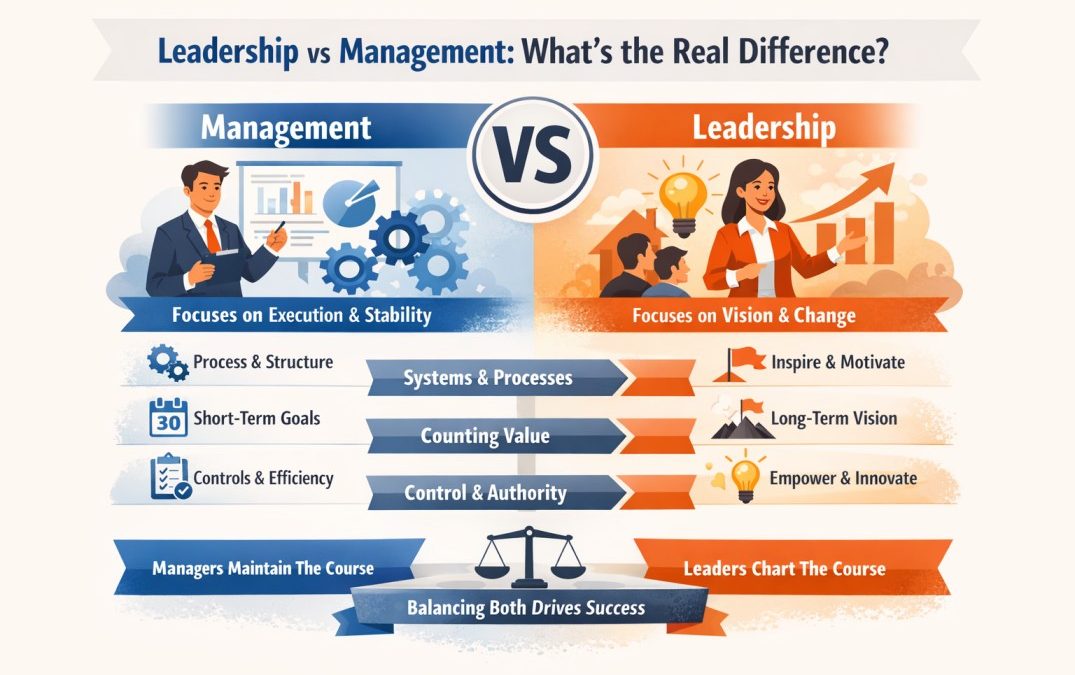
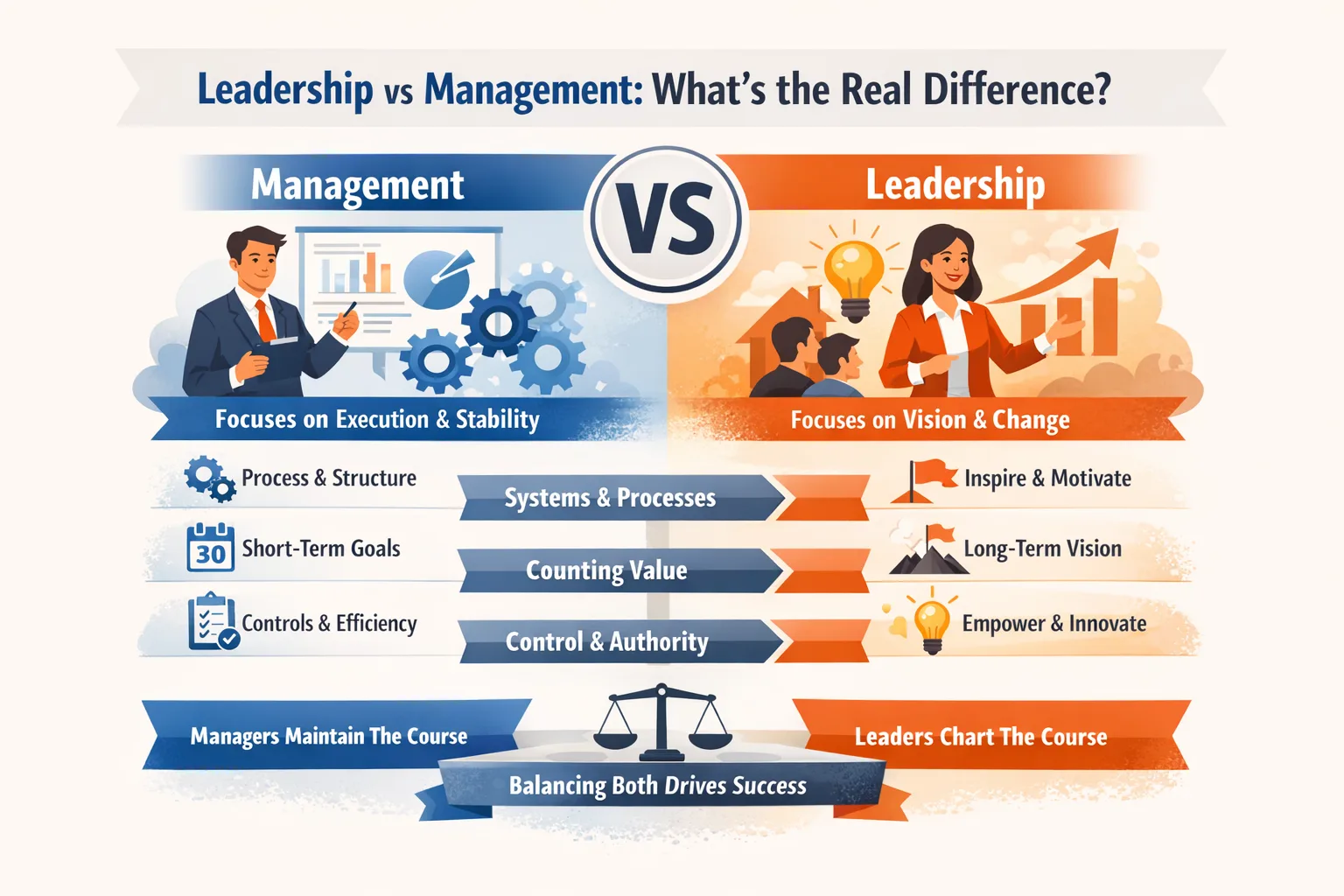
  •  Management is about complexity: It focuses on consistency and the systems required to produce predictable results.
  •  Leadership is about change: It focuses on vision, alignment, motivating people, and showing examples to move through uncertainty toward a better future.

Leadership vs management key differences

Crucial points of distinction

Moving past the definitions, based on the management books and leadership books, there are several truths that define how these roles function. And also, to truly master the dynamic, one must balance the following three pillars:

  •  Systems vs. People: A manager ensures the software is updated and the deadlines are met; a leader ensures the person behind the keyboard feels valued and empowered to solve problems.
  •  Counting Value vs. Creating Value: Management often defaults to measuring what has already happened (KPIs and metrics). Leading focuses on creating the conditions where future value can exist.
  •  Control vs. Trust: Management relies on control to maintain standards. Guiding teams relies on trust to foster autonomy, allowing team members to take ownership of their work.

Bridging the gap between these two disciplines requires a mix of tactical systems and psychological insight. Based on frameworks, we’ve curated the top tips and resources to help you level up.

1. Understanding team loyalty

“Leaders Eat Last’ by Simon Sinek, you will find the work that stands as a pillar for understanding the human element. While management often focuses on the what, leadership focuses on the who. Sinek, famous for his TED Talk with over 60 million views, argues that guiding others is a biological obligation to protect the tribe:

  •  The Concept: Sinek introduces the Circle of Safety. He posits that when leaders create an environment of trust, the team naturally pools its resources to fight external challenges rather than internal politics.
  •  Why it Matters: Many managers struggle with team commitment because they prioritize short-term metrics over long-term psychological safety. This book is an essential guide for those in high-pressure startups where burnout is a constant threat.

2. Managing team output

If Sinek represents the soul of guiding teams, ‘High Output Management’ by Andrew Grove represents the mechanics of management. As the former CEO of Intel, Grove defines management as the ability to create high-leverage results through structured systems. This is the definitive guide for management vs leadership practitioners who need to scale technical operations:

  •  The Concept: The Manager’s Output = Team Output model. Grove argues that a manager’s own work is irrelevant if it does not increase the productivity of their subordinates.
  •  The Method: The book provides detailed frameworks for meetings and performance measurement.
  •  Why it Matters: For engineering teams and startup founders, Grove’s disciplined approach to output provides the rigor necessary to move from a chaotic small team to a structured organization.

3. Fixing team trust

‘The Five Dysfunctions of a Team’ by Patrick Lencioni uses a narrative format to solve a common management headache: why talented individuals often fail to work as a cohesive unit. In the debate between guiding and managing, this book shows that a manager can organize a schedule, but a leader must fix the culture:

  •  The Framework: You will find the five dysfunctions, starting from Absence of Trust, Fear of Conflict, Lack of Commitment, Avoidance of Accountability to Inattention to Results.
  •  Why it Matters: Managers often address the symptoms (like missed deadlines) while ignoring the disease (lack of trust). This book is a staple in workshops worldwide because it offers a diagnostic tool for cross-departmental collaboration.

4. Studying company patterns

‘Good to Great’ by Jim Collins and his research team analyzed 1,435 companies over five years to find out why some stagnate while others soar. His findings revolutionized how we view management books by grounding theory in hard data:

  •  The Concept: Level 5 Leadership, where Collins discovered that the executives who took companies from good to great weren’t flashy or charismatic; they were paradoxically humble and professional.
  •  Key Insight: Great management involves getting the right people on the bus, but great guidance involves having the discipline and humility to point that bus in the right strategic direction.

5. Understanding motivation research

Why do traditional carrot and stick rewards often fail in modern workplaces? Daniel Pink’s ‘Drive’ explores the behavioral science of what actually moves people.

  •  The Concept: You will find the Autonomy, Mastery, and Purpose model. Pink argues that for 21st-century tasks, internal motivation is far more powerful than external pressure.
  •  Why it Matters: Managers who rely solely on bonuses or discipline are practicing outdated management. To truly lead, one must provide a sense of purpose and the freedom for employees to master their craft.

Additional top books and insights

To deepen your understanding of guiding teams, it’s useful to explore perspectives that focus on purpose and human connection. The following books highlight the mindset and behaviors:

  •  ‘Start with Why’ by Simon Sinek: The quintessential guide to finding the purpose that inspires action.
  •  ‘Dare to Lead’ by Brené Brown: A deep dive into the vulnerability and courage required to lead effectively.
  •  ‘The 21 Irrefutable Laws of Leadership’ by John C. Maxwell: A foundational look at how influence works.

Additional top management books

Management is built on structure and the ability to turn strategy into consistent results. These books focus on practical approaches that help managers run teams and operations:

  •  ‘High Output Management’ by Andrew Grove: Often called the Bible of management, focusing on the middle manager as the engine of a company.
  •  ‘The Making of a Manager’ by Julie Zhuo: A practical, modern guide for those transitioning into their first oversight role.
  •  ‘First, Break All the Rules’ by Marcus Buckingham: A data-driven look at what the world’s greatest managers do differently.]

Get practical lessons from leadership and management, and start testing insights to see the difference

The distinction between guiding teams vs management is best understood as two sides of the same coin. Management is the science of systems and the efficient allocation of resources to meet a specific goal. Leadership is the art of influence and the human psychology required to make people want to achieve that goal.

As the books and sources mentioned above demonstrate, the most effective professionals are those who can fluidly switch between these roles. You can pick one book or summary from this list today, whether it’s a deep dive into habits or a quick session on motivation, and apply one specific framework to your team tomorrow!

More must-read stories from Enterprise League:

Top-Rated Commercial Roofing Contractors in Pennsylvania

Top-Rated Commercial Roofing Contractors in Pennsylvania

The roof is your company’s first line of defense and a five-figure investment in your building’s security against the elements. When a commercial roof fails, you may face water damage, safety issues and ongoing business interruption. It pays to work with the top-rated commercial roofing contractors in Pennsylvania to ensure your investment is sound, maintained and inspected regularly, and quickly repaired before minor issues can escalate. Here are five of the best to consider.

1. DDP Roofing Services, Inc.

Commercial roof inspections cost between $200 and $600 on average, which is an investment in protecting your asset from the much higher costs of serious repairs or replacement. Choose a roofing contractor that is serious about preventive maintenance and inspections to extend your roof’s life span.

DDP Roofing Services, Inc. stands out as one such top-rated company, delivering comprehensive commercial roofing services throughout Pennsylvania, including flat and low-sloped roofs. Services include proactive preventive maintenance, repairs, inspections and complete roof replacements, all backed by thorough documentation and customer support.

The firm offers clear communication, a 24/7 emergency response and experience in minimizing operational disruption. Its roofing expertise ensures building protection, increases roof longevity and upholds safety standards for businesses across the state.

Key features

  •  24/7 emergency response
  •  Detailed pre- and post-repair documentation for accountability
  •  Focus on preventive maintenance for early problem detection
  •  Up to 30-year warranties on roof replacements

2. Manchester Roofing Systems

Manchester Roofing Systems specializes in cool roofing systems for low-slope or flat commercial roofs across the Tristate area. As a certified Duro-Last Master Contractor, it is known for providing sustainable, leakproof solutions that minimize energy usage and reduce life cycle costs.

The company also provides roofing inspections and preventive maintenance services. Installations take place with minimal business disruption, and extensive Duro-Last warranties are provided.

Key features

  •  Duro-Last Master Contractor certification
  •  Sustainable, energy-efficient roofing systems
  •  Broad regional reach
  •  Warranties that include consequential damages

3. DBS Roofing

DBS Roofing is one of central Pennsylvania’s largest commercial roofing companies. In business since 1948, it serves enterprises with millions of square feet of roofing annually. Its services include new installations, reroofing, repairs and maintenance.

DBS is widely awarded for quality and participates in prestigious contractor programs. Its deep experience ensures high standards, timely project completion, and operational efficiency for commercial property owners and facility managers.

Key features

  •  Over 10 million square feet of roofing installed annually
  •  Multiple award-winning firm
  •  Broad regional scope
  •  Specialized expertise in large-scale reroofing

4. Roofed Right America

Roofed Right America provides full-service commercial roofing throughout Pennsylvania, including installations, maintenance, inspections, repairs and solar roofing adaptations. It emphasizes energy performance, detailed inspections, and regular maintenance to extend roof life and reduce operational risk.

Licensed teams design solutions to counter Pennsylvania’s weather and legacy building stock challenges. The company also has expertise in green roofing for eco-conscious businesses.

Key features

  •  Energy-conscious roof systems designed for operational reliability
  •  Solar roofing and green solutions for sustainability-focused clients
  •  Emphasis on moisture control for legacy buildings
  •  Detailed quotes for full transparency

5. Penn State Roofing

Penn State Roofing is a family-owned, locally operated firm delivering full-spectrum roofing services. It focuses on quality, affordability and customer service, with decades of experience handling both repairs and new commercial installations.

Its team specializes in TPO roof systems and EPDM flat roofing, and provides tailored consultations with free, no-obligation estimates. Professional, friendly teams ensure minimum disruption during roofing work.

Key features

  •  Free consultations and estimates
  •  Experienced with a broad range of commercial roofing
  •  Focus on optimum value
  •  Strong reputation for customer service

How to select the best commercial roofing contractor in Pennsylvania

The right commercial roofing company will ideally become a long-term partner in ensuring your roof stays in good condition. To narrow down your options:

  •  Verify credentials: Ask to see current liability insurance, workers’ compensation and business licenses.
  •  Evaluate experience: Look for a contractor with a proven track record in your kind of commercial roof and your industry, such as retail or industrial roofing.
  •  Check reputation: Seek local commercial references and choose a firm in good standing with the Better Business Bureau.
  •  Review proposals: Request a full written proposal with scope of work, material specifications, start and end dates, and payment terms.
  •  Assess warranties and maintenance: Ensure the firm offers strong manufacturer warranties and workmanship warranties, along with long-term preventive maintenance services.

Avoid any contractor that approaches you directly following a weather event. Any reputable company will have more than enough work without resorting to storm-chasing tactics. Poor communication and suspiciously low bids are also red flags.

Protecting your building’s biggest asset

The top-rated commercial roofing contractors in Pennsylvania understand the wear and tear the local climate creates on retail, commercial and industrial roofs. With a focus on preventive maintenance and expert credentials, the best roofing firms can help keep your commercial roof in the best condition for as long as possible, minimizing costs and expensive business interruptions. Choose the right contractor for your needs and get peace of mind that your roof is in good hands.

More must-read stories from Enterprise League:

In-House vs. Outsourced IT: Scaling Financial Technology in 2026

In-House vs. Outsourced IT: Scaling Financial Technology in 2026

The debate over whether to build financial software internally or farm IT out to external vendors usually misses the point entirely. Most technical leaders treat this like a religious war. You are either a pure engineering culture that builds everything from scratch, or you are a business-first operation that delegates everything to third parties. Both extremes are massive liabilities in 2026. The financial technology sector is changing too quickly for rigid thinking.

Scaling a digital financial product today requires a completely different mindset. The old models of hiring armies of internal developers or tossing entire projects over a wall to an offshore agency are dead. Modern growth relies on finding a precise balance between protecting your intellectual property and using external speed. If you get this balance wrong, you will burn through your capital before you ever reach product-market fit.

The ego trap in engineering culture

Founders and technical leads often fall in love with their own code. There is a deep-seated belief that controlling every aspect of the technology stack creates a protective moat around the business. This was somewhat true ten years ago when off-the-shelf financial infrastructure was clunky and rigid. Today, building a proprietary payment gateway or a custom ledger from scratch is usually a poor allocation of capital.

IT takes months of careful planning and thousands of engineering hours to replicate what specialized vendors have already perfected. You burn through your runway paying premium salaries to solve problems that someone else solved five years ago. Furthermore, retaining top-tier engineering talent is increasingly difficult. When a senior internal developer leaves, their undocumented institutional knowledge often walks out the door with them, leaving the rest of the team scrambling to decipher legacy code.

Your engineering talent should focus entirely on what makes your product uniquely valuable to the user. Everything else is a distraction. Writing code for the sake of writing code is not a business strategy. IT is an ego trip that slows down product releases and bloats operational budgets.

The core versus context framework

To make smart decisions about scaling technology, you need to ruthlessly separate your operations into two buckets. Core operations are the specific features and algorithms that directly generate revenue and differentiate your product from competitors. Context operations are all the necessary backend systems that keep the lights on but do not win you any new customers.

If you are building an algorithmic trading platform, your pricing models and execution logic are core. Your user authentication flow, basic ledger maintenance, and generic API integrations are context. Scaling effectively means hoarding your best internal talent for those core operations. You hand off the context to external experts who can execute faster and cheaper. This requires a level of organizational discipline that many startups simply lack.

Founders struggle with this because letting go feels like losing control. But control is an illusion if your team is moving too slowly to capture market share. By applying the core versus context framework, you force your company to prioritize innovation over basic infrastructure maintenance.

Strategic delegation in practice

Moving context operations outside the building does not mean throwing requirements over a wall and hoping for the best. The modern approach is deeply collaborative. You integrate external developers into your daily workflows so they function as a seamless extension of your own team. They join your standup meetings, communicate in your Slack channels, and follow your internal coding standards.

This model gives you the flexibility to ramp up resources during heavy development phases and scale down when the product stabilizes. Smart leaders know exactly when to bring in outside help. If your internal team lacks specific experience with regulatory compliance or complex payment routing, you do not wait six months to hire and train someone. You look outside. For instance, partnering with a dedicated fintech software development company can significantly cut down time-to-market while reducing operational overhead.

This approach keeps your internal roadmap completely unblocked. Your core engineers never have to pause work on a critical revenue-generating feature just to patch a secondary database or update a compliance reporting module. The machine keeps moving forward on all fronts simultaneously.

Managing hidden vendor risks

Working with external partners carries its own set of dangers. If you do not structure the relationship correctly, you can end up with code that your internal team does not understand or cannot maintain. The handoff process must be documented with extreme clarity from day one. You also have to guard against vendor lock-in by keeping your architecture as modular as possible.

The most successful companies treat their external partners as temporary accelerators rather than permanent crutches. They set up clear service level agreements and demand transparent testing protocols. If an external team builds a feature, they must also provide the automated testing suite to support IT. This lets you use external speed without sacrificing long-term stability or security.

You must also carefully evaluate the long-term financial implications. Many organizations underestimate the long-term maintenance costs of in-house infrastructure, pushing them toward specialized external partnerships to maintain lean operations. When done correctly, this shifts heavy capital expenditures into predictable operational expenses.

Building a hybrid architecture

The winning playbook for 2026 is a hybrid architecture. Your internal team acts as the brain of the operation. They design the system architecture, write the core intellectual property, and manage the product vision. External teams act as the muscle. They execute the heavy lifting on third-party integrations, compliance reporting dashboards, and user interface development.

This separation of duties creates a highly resilient organization. When market conditions change quickly, you can pivot your internal strategy without getting bogged down in backend refactoring. Your external partners absorb the shock of sudden scaling requirements, letting your core team stay focused on the horizon.

This hybrid approach also changes how you hire. Instead of recruiting dozens of mid-level developers to churn out basic features, you hire a handful of elite senior architects. Their primary job becomes orchestrating the work of your external partners and reviewing pull requests to keep the code quality impeccably high.

Optimizing your build-or-partner matrix

There is no perfect formula for how much to build versus how much to buy. The ratios will shift constantly as your company matures and market dynamics change. What matters is building a culture that values speed and efficiency over engineering vanity. Every line of code you write internally is a liability you have to maintain forever. You want to keep those liabilities as low as possible.

Look at your current product roadmap and ask yourself hard questions about where your team is actually creating unique value. If you are spending weeks building tools that already exist in the market, you are moving too slowly. The companies that dominate the next phase of financial technology will be the ones that master the art of strategic delegation.

Stop trying to reinvent the wheel. Focus your capital on the engine, the steering, and the destination. Let specialized partners handle the rest. This is how you outpace competitors who are still trapped in the legacy mindset of owning every single line of code.

FAQ about in-house vs. outsourced IT: scaling financial technology in 2026

Why is building everything in-house no longer recommended for financial startups?

Building everything internally burns capital on non-differentiating features. IT forces companies to spend months replicating systems that specialized vendors have already solved, slowing down the time to market and wasting expensive engineering resources.

How do you determine what parts of a financial application to outsource?

You should outsource context features that do not directly generate revenue or differentiate your product from competitors. Keep your internal engineering talent focused strictly on the core logic and unique user value.

Does outsourcing technology increase security risks?

Not if handled correctly. External teams specializing in financial software often have deeper expertise in strict compliance protocols and data security standards than an early-stage internal team.

What is the biggest mistake companies make when working with external developers?

Many companies fail to integrate external teams into their daily workflows. Treating partners as a separate entity rather than an extension of the internal team leads to misaligned expectations and poor code quality.

How can a hybrid team structure improve scalability?

A hybrid structure allows internal teams to focus on strategy and proprietary features while external partners handle heavy technical execution. This allows the business to scale operations up or down quickly without complex hiring processes.


More must-read stories from Enterprise League:

Growing Cities Come with Growing Risks

Growing Cities Come with Growing Risks

Cities are constantly changing. Many USA residents are constantly moving in search of better employment and higher education so you’ll often see neighbours transforming and communities expanding.

Naturally, the higher the population, the more benefits for locals. That means more employment opportunities for locals, better business and overall better quality of life. However, alongside these benefits, it’s also important to address the downsides of such a high number of people.

With more people, it also means more room for hazards and risks and we’ll talk a bit more about that in the next paragraphs. When you have so many people sharing the same space, it means more people on the road and an increased likelihood of traffic jams, which just make everything more frustrating.

Undeniably so, urban growth creates excitement and progress, but it also comes with responsibility. City planners and local authorities all play a role in keeping everyone safe. Everyone needs to work together to create a safe and liveable environment for everyone. Residents also play a role in this and they also need to do their fair share of the work.

That’s why it’s always good to be aware of the most common risks. Let’s take a look at what the most common problems the expanding cities face and how to deal with them.

Understanding the risks in expanding cities

With expanding communities, the patterns of urban life change dramatically. That means more vehicles on the roads, new construction projects, and generally more movement around the city.

Unfortunately, this also means that accidents, both minor and severe, become more common.

According to the National Highway Traffic Safety Administration, pedestrian accidents alone accounted for over 7,000 deaths nationwide in 2023, highlighting the dangers in increasingly busy urban areas. Motor vehicle accidents also increase in frequency.

Expanding cities also face challenges like aging infrastructure and insufficient safety measures for pedestrians and cyclists. Most often, separate lanes for pedestrians and cyclists are not a priority and smaller cities rarely invest in proper infrastructure.

While growth brings more commerce and housing, it also requires careful planning to ensure that all residents remain safe.

The main risks that come with growing cities

So, as an expanding city, what types of issues might you come up against? That’s what we want to take a closer look at.

The list extends beyond what we’ve noted here but we’ve tried to put focus on the top 3 hazards that most expanding communities face.

1. Traffic accidents

Perhaps the most immediate and visible risk in a growing city is traffic accidents. More people on the road means more chances for collisions unfortunately. For instance, some cities such as Houston, Texas and Mesa, Arizona have seen rapid suburban expansion over the past decade.

A notable trend in these new neighborhoods and shopping areas shows that as more drivers share the same streets, the chances for collisions increase as those roads were not primarily built for such high volumes of traffic.

Pedestrian accidents are also a major concern. Unlike car accidents, pedestrian accidents are not talked about that often but they’re also an important topic to be addressed.

When sidewalks, crossings, and traffic signals aren’t fully adapted to the city’s growth, people on foot become highly vulnerable. Residents and visitors alike need to be careful when crossing the street, especially in busy downtown areas or near schools.

Local authorities also need to take responsibility and ensure proper lighting. Additionally, pedestrians should be encouraged to contact a pedestrian accident lawyer to assess the situation and take over the negotiations with the insurance company.

2. Construction-related incidents

Another problem expanding cities face is that construction sites become a familiar part of the urban environment. New apartment buildings keep popping up everywhere.

While new buildings and infrastructure projects do signal progress, they also create hazards. Falling debris, heavy machinery, and temporary traffic detours can all lead to accidents if precautions aren’t taken. Cities like Austin, Texas, or Phoenix, Arizona, have experienced what seemed like overnight construction booms that put both workers and residents at risk.

Construction zones can be confusing and dangerous, especially when drivers are unfamiliar with new traffic patterns. These areas need to be properly marked so that everyone is aware of the hazards ahead.

Pedestrians should try and avoid these areas if possible and move to the opposite side of the street. You never know when you might walk into a construction zone hazards so it’s best to avoid the area.

3. Public health and environmental hazards

A third risk in growing cities is related to public health and environmental hazards. More people in a concentrated area can increase the spread of infectious diseases, especially if sanitation or healthcare access does not keep pace with growth.

We all know how easily COVID spreads in large cities which regularly witness large crowds.

Air quality can also suffer as traffic increases and industrial activity grows, leading to respiratory problems for residents. Currently, you have California ranking as the most polluted state in the USA due to the large amount of vehicles and public transport.

The best thing you can do in these situations is to try and carpool when possible or use public transport to decrease air pollution. Also, getting an air purifier for at home use might be a good idea.

The bottom line

Growing cities are always a sign that there are positive changes happening in the community. It means more people come looking for better jobs and education opportunities. It also helps create more opportunities for locals as they are able to get more customers in their local businesses.

However, it’s also necessary to mention that it’s not all about the positives. There are always some downsides to every change. With more people, traffic increases and construction zones become more frequent across the city. Unfortunately, this creates more risks of traffic accidents and pedestrian-related incidents.

That’s why expanding cities need to have proper infrastructure in place and this is where local authorities need to step up and find the best approach to create a safe environment for all.

More must-read stories from Enterprise League: