
Understanding the Strategic Advantage of Partnering With a Metal Finishing Provider

Understanding the Strategic Advantage of Partnering With a Metal Finishing Provider

Original equipment manufacturers (OEMs) invest heavily in innovation, design, engineering and manufacturing to deliver a superior product. Finishing is an important step that helps protect it from corrosion, wear and daily use.

Partnering with a specialized metal finishing provider is a powerful strategic move that can drive results for your business. Discover the advantages and explore the criteria for choosing the right company.

The tangible business benefits of outsourcing your finishing needs

Here are the strategic advantages you can gain by partnering with an expert provider instead of attempting to manage it in-house.

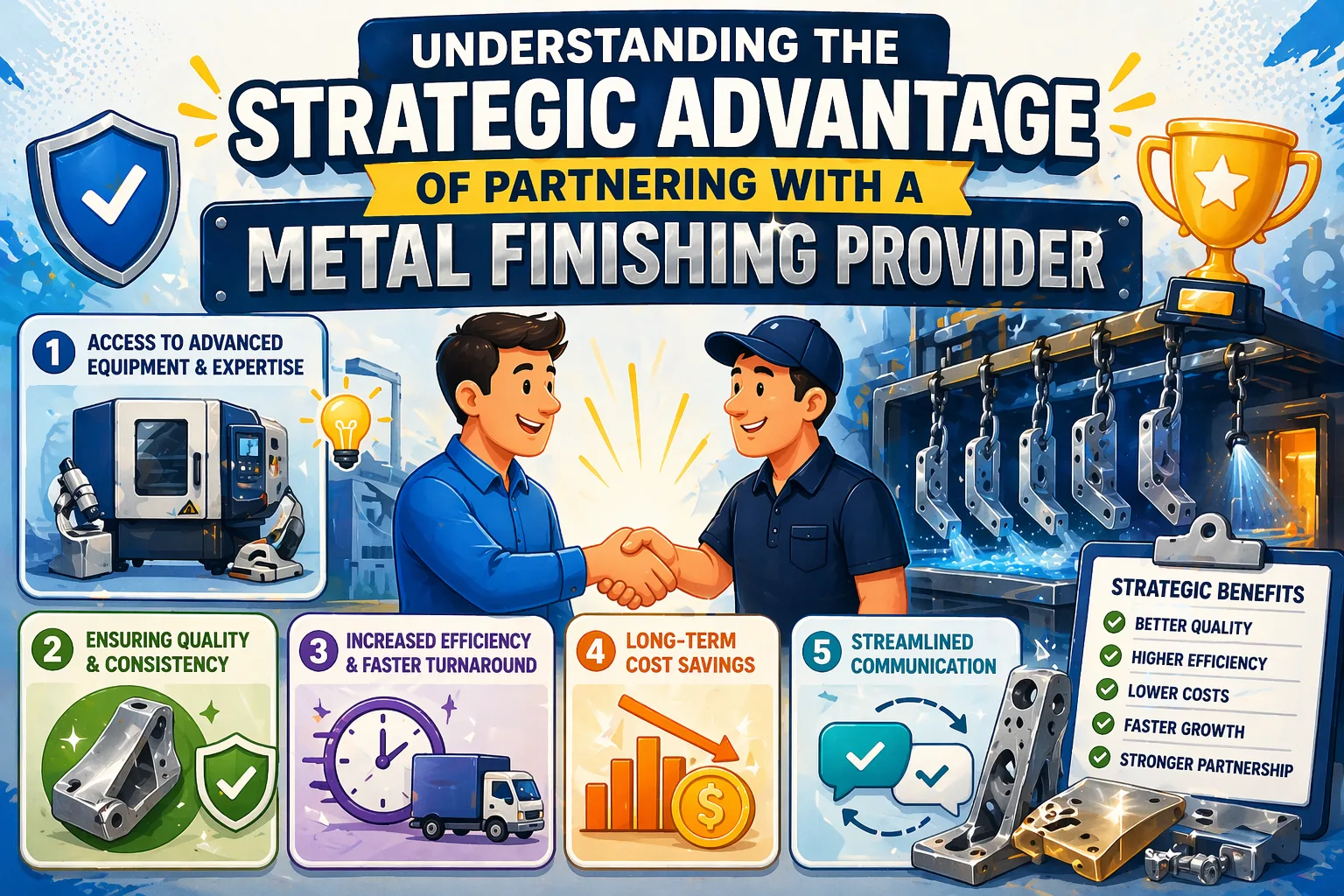
1. Access to advanced equipment and expertise

Metal finishing requires comprehensive physical and chemical processes. Providers have deep knowledge of different coating types and their specific applications. They can recommend the ideal pretreatment and finish for your project, depending on your budget and goals.

Their facilities are equipped with advanced equipment, such as automated lines, testing labs and curing ovens, which is often cost-prohibitive for nonspecialized companies.

2. Ensuring quality and consistency at scale

Finish quality is one of the first things customers notice and is often the most challenging to keep stable as demand increases. Delivering uniform quality ensures customers get the same quality every time, reducing defects and fostering a trustworthy brand image.

Inconsistencies can be spotted and corrected instantly in small runs, but at scale, they can accumulate. Achieving true consistency requires rigorous oversight at every stage of the production process.

3. Increased efficiency and faster turnaround

Outsourcing allows your team to focus on their core manufacturing competencies, such as building and designing. A specialized provider has a streamlined process for high-volume orders, helping you meet tight deadlines.

It can also handle small custom batches to reduce the risk of rework. This flexibility allows your business to maximize operations without worrying about bottlenecks in the production process.

4. Long-term cost savings

Outsourcing your metal finishing needs can help avoid the capital expenditure and operational costs of running an in-house finishing line. It can improve working capital management, particularly when the provider manages raw material inventory and invoices are settled upon shipment rather than in advance.

Moreover, the global cost of corrosion is over $2.5 trillion annually. Implementing proven corrosion control methods could save up to 35% of these costs.

5. Streamlined communication

Miscommunication can cost time and money. Streamlined communication with a partner offers financial and operational benefits. Instead of your project manager explaining technical finishing details to a general fabricator who then relays them to a subcontractor, you have a single point of contact.

There’s no chain of command to work through, allowing your company to be more adaptive in a fast-moving market.

6. Stronger long-term partnerships

A long-term partnership is an investment in your company’s stability, innovation and resilience. A metal finishing provider that works with you for years learns your challenges, goals and products. It stops being an order-taker and becomes a proactive consultant.

You can count on its quality and delivery times without constant oversight, helping reduce the management burden on your team.

Why partnership matters

While any supplier can provide you with a quote, a true partner invests in your success. Here’s why partnering with the right provider matters.

1. An extension of your research and development team

A finishing partner provides deep material science knowledge to your product development, offering advice on design modifications, coating adhesion and alternative materials. It acts as a free, specialized extension of your innovative efforts, which is valuable as you scale your company.

2. Greater supply chain agility

Your metal finishing partner is a significant part of your operational planning. It understands your production forecasts and collaborates to manage capacity. This collaborative planning prevents bottlenecks and ensures your products get to market on time.

In contrast, a transactional vendor simply processes purchase orders as they arrive, leaving your business vulnerable to logistical delays.

3. Focus on total cost of ownership

An effective partner enables you to move beyond a focus on per-piece price. It highlights the application of a precise, high-quality finish from the outset, significantly reducing the likelihood of field failures.

For example, when corrosion advances to the point of becoming penetrating rust, it can weaken a product’s frame and jeopardize its structural integrity. A commitment to quality lowers the total cost of ownership of your product, a more impactful metric than negligible savings on an initial invoice.

What to look for in a trusted metal finishing provider

Here are the essential criteria to use when evaluating a potential partner:

  •  Verifiable certifications and capabilities: A reliable provider should provide comprehensive services, including multistage pretreatment, abrasive blasting, a range of coating options and custom packaging. Ask about internationally recognized certifications, such as ISO 9001 or those from the Powder Coating Institute.
  •  Proactive quality assurance program: The right supplier emphasizes defect prevention. This involves having documented, repeatable processes from initial surface preparation to final inspection.
  •  Deep industry experience: Seek a company with a long history of serving businesses in your industry or related fields.
  •  Capacity to ensure business continuity: Your metal finishing partner must be able to support your business today and as you grow. Inquire about its capacity for high-volume orders and ability to scale production.

Keystone Koating as your trusted metal finishing provider

Keystone Koating is a trusted one-stop partner for OEMs looking to outsource their metal finishing projects. It is a powder coating contractor that provides value-adding services, such as masking, assembly, packaging and shipping.

A comprehensive, end-to-end process

The powder coating process involves several steps, each contributing to the finish’s durability.

  •  Blasting: Inorganic contaminants, such as welding smut, laser scale and rust, are removed using abrasives. This step ensures better powder coating adhesion.
  •  Pretreatment: Keystone Koating uses an eight-step proprietary process to ensure a clean substrate. This includes thorough rinses, iron phosphate application, reverse osmosis and a chrome-free zirconium sealer.
  •  Primer: The primer can help the finish on steel or aluminum products last up to four times longer than nonprimed items.
  •  Masking: This blocks off areas of the item that don’t require powder coating.
  •  Coating: The coating process requires an automatic system or a professional finisher to ensure consistent coverage on complex parts.
  •  Curing: Keystone Koating focuses on proper curing in accordance with project specifications.

A track record of innovation and reliability

Keystone Koating can handle high-volume projects with multiple automated lines, focusing on precision and fast turnaround times. Powder coating offerings include polyester, epoxy, fluoropolymer, urethane, silicone and hybrids. It has a quality assurance testing lab where experts employ tests and procedures to ensure the finishes hold up under various conditions.

The company complies with the standards of the American Architectural Manufacturers Association and the American Society for Testing and Materials. The company holds ISO 9001:2015 certification and is a member of Chemical Coaters Association International.

Frequently asked questions

Here are answers to common questions about partnering with a metal finishing provider.

Q: How do I know which type of coating is right for my product?

A: The ideal coating depends on the product’s end-use environment, exposure to UV light or chemicals, and required durability. For instance, polyester powder is ideal for outdoor decorations, while epoxy is limited to indoor use. A reliable partner like Keystone Koating can guide you through material selection.

Q: How durable is powder coating?

A: Durability is dependent on the application and preparation. When applied correctly, it offers excellent resistance to chipping, corrosion and scratching. Most powder coatings are weather-resistant and durable, providing years of high-traffic use.

Q: Forge a strong partnership with a finishing specialist

A: A true partnership ensures proactive problem-solving and shared accountability. Entrusting your metal finishing needs to a dedicated partner is an investment in your product’s integrity and brand’s reputation for quality. Choose the ideal supplier that demonstrates a genuine commitment to helping your business grow.

More must-read stories from Enterprise League:

How to Improve Business Efficiency with Simple Digital Tools

How to Improve Business Efficiency with Simple Digital Tools

Business moves fast today. The real question is not if you should improve efficiency, but how soon you can do it and how well it works. The good news is that better efficiency does not always mean rebuilding everything or buying expensive, complicated tech.

Many of the biggest wins come from adding a few simple (but very useful) digital tools to everyday work. These tools help businesses simplify workflows, lower costs, raise productivity, and do more with the same team, while staying flexible and competitive.

Digital tools can automate routine work, improve communication, and turn day-to-day information into clear insights. They also help people spend more time on planning, problem-solving, and customers instead of repeating admin tasks.

And since businesses now rely heavily on data, they also need strong ways to store and protect it. That is why reliable enterprise cloud storage is often a basic building block for smooth operations and security.

What is business efficiency and why does it matter?

Business efficiency means getting the best results using the least amount of resources. Resources can be time, money, tools, and people. An efficient business uses what it has wisely and keeps quality the same (or better). This is not about rushing or “cutting corners.” It is about using time and effort in the right places and improving the way work is done.

Efficiency matters a lot, especially in uncertain markets. Juan Perez, EVP and CIO of Salesforce, points to “protracted inflation, supply chain disruptions, market volatility, and recession fears.” In conditions like these, leaders are expected to deliver strong results with fewer mistakes and less waste.

Better efficiency often leads to stronger profits because costs go down and output goes up. It also affects employees. When people are stuck in broken processes, they burn out faster. When systems work well, workloads feel more manageable, job satisfaction improves, and teams can focus on better work.

How is business efficiency measured?

Efficiency is not measured only by profit. It is often measured by comparing output to input. Key Performance Indicators (KPIs) help you track progress and spot weak areas. If you want better customer service, for example, useful KPIs might be response time, customer satisfaction scores, and how many requests each support agent handles.

Other common metrics include employee output, project delivery time, cost per unit, and how well equipment or staff time is used. A good approach is to set clear goals, review current performance to create a starting point, and then compare results after you add a new tool or process.

Feedback also matters. Employee morale and customer comments can show whether changes are helping in real life, not just on paper.

What are simple digital tools for improving business efficiency?

Simple digital tools are apps and online platforms that help with common business tasks like organizing work, reducing repeated steps, improving communication, and reporting results. They usually do not need advanced IT skills or large budgets. Some may include AI features, but they are mainly built to solve everyday problems in a straightforward way. Think of them as practical helpers that let your team work smarter.

Many of these tools are cloud-based. That means you can use them anywhere with an internet connection, which helps remote work and teamwork across locations. Compared with paper processes or manual tracking, these tools are faster, more accurate, and keep information in one place.

Criteria for choosing effective digital tools

Picking the right tools matters. The goal is not to collect lots of apps. The goal is to choose tools that match your needs and make work easier. Here are key points to use when deciding:

  •  User-friendliness: The tool should be easy to learn and simple to use. If it feels confusing, people will avoid it.
  •  3rd-party Integration: Most companies already use several tools. New tools should connect well with systems like Google Docs, QuickBooks, or Mailchimp so information does not get stuck in separate places.
  •  Customization: Workflows vary by business. A good tool lets you adjust settings, dashboards, and access permissions to fit how your team works.
  •  Scalability: The tool should still work well as you add more staff, projects, and data. Look for plans that let you grow without switching platforms too soon.
  •  Data Security: Security is a must. Look for features like multi-factor authentication, encryption, and support for rules such as HIPAA or GDPR if they apply to your business.
  •  Customer Support: Good support and clear help guides save time when something goes wrong or when you want to use more features.

Comparing digital tools to traditional methods

Digital tools work very differently from older methods. For example, managing projects with whiteboards and spreadsheets can lead to missed updates, manual errors, and confusion, especially if people work from different locations. A project management tool keeps tasks, notes, files, and deadlines in one place, updates in real time, and sends reminders automatically.

Customer tracking is another example. In the past, customer details might be stored in paper files or scattered email threads. A CRM can track leads, store contact history, and prompt follow-ups automatically. Moving from traditional methods to digital tools is more than a small upgrade. It changes speed, accuracy, and how easily a business can adjust to new needs.

How do simple digital tools boost efficiency?

Digital tools are not just “nice to have.” They change how work happens by fixing common problems like slow processes, unclear communication, and missing information.

Reduces time on manual processes

One of the fastest benefits is saving time on manual work. Think of time spent on data entry, filing, and scheduling meetings with long email chains. Juan Perez from Salesforce notes that software can take over “repetitive and monotonous tasks.” This saves time and gives people more space for work that needs human judgment. For example, tools like Calendly can handle meeting scheduling automatically, so people can pick an available time without back-and-forth messages.

Improves team communication and collaboration

Good communication keeps teams moving. Digital tools make it easier to work together in real time, even if people are not in the same office. Tools like Slack or pascom’s cloud phone system bring chat, calling, file sharing, and video meetings into one place. This speeds up decisions, reduces confusion, and helps teams stay aligned on priorities.

Automates repetitive tasks

Automation is a big reason businesses adopt digital tools. Bill Gates said, “automation applied to an efficient operation will magnify the efficiency.” Many tools now use AI to handle repeated work, like setting reminders, sorting emails, updating task lists, or keeping inventory levels current. AI can also record and summarize meetings, create templates, and help with simple content editing. The result is faster operations and more time for growth-focused work.

Supports better decision making through data

Businesses collect lots of data, but it only helps if you can use it. Digital tools can turn raw information into insights that guide better decisions. AI tools can spot patterns, compare your results with similar businesses, and help flag risks early.

For example, tracking delivery delays or travel disruptions can help you adjust plans before problems hit. This kind of data-based approach helps businesses find trends, measure performance, and adjust plans faster.

Which business areas benefit most from simple digital tools?

Most parts of a business can benefit from digital tools, but some areas usually see the biggest improvements, especially where work is repeated often or where communication and data handling are heavy.

Project and task management

Projects can get messy fast without a clear system. Project management tools like ProofHub put tasks, files, time tracking, workflows, and team communication in one place. This reduces the need for multiple disconnected tools and helps teams stay organized. Clear ownership, deadlines, and progress views reduce delays and misunderstandings.

Customer relationship management

CRM software is one of the most useful upgrades for many businesses. Tools like HubSpot or Salesforce help track leads, manage customer conversations, and support sales and marketing work. Many CRMs also use AI to speed up routine tasks so sales and service teams can spend more time on conversations that need a human touch.

Accounting and financial operations

Financial work is often slow and easy to get wrong when done manually. Tools like QuickBooks help with invoicing, payroll, expense tracking, and reporting. Since many are cloud-based, teams can access records easily and keep things organized. Automation reduces manual errors and gives clearer reports for better decisions.

Internal and external communication

Communication is the base of smooth work. Tools like pascom offer cloud phone systems with VoIP, video meetings, messaging, and call handling. Loom can reduce meetings by letting people record quick screen videos to explain tasks or train others. For customer communication, AI can route calls to the right department or answer basic questions through chatbots, which can speed up support.

Marketing and social media management

Many businesses depend on online marketing. Mailchimp helps run targeted email campaigns using templates and tracking. Tools like Hootsuite let you schedule social posts ahead of time, saving hours each week. AI can also help draft blogs, job posts, product descriptions, and social content, and create variations for different platforms.

What are examples of simple digital tools for businesses?

There are many tools available, so it helps to focus on ones that solve real problems without adding too much complexity. Below are common categories and examples that often improve efficiency.

Task and project management tools

These tools help teams plan work, track deadlines, and see progress. ProofHub is a popular option because it combines task management, file sharing, time tracking, and flexible workflows. Other well-known tools include Asana, Trello, and Monday.com.

Customer relationship management (CRM) software

CRM tools keep customer data and sales activity organized. HubSpot offers an all-in-one setup for service, sales, and marketing. Salesforce and Zoho CRM are also strong options, with different levels of integration and customization. These tools help teams follow up on leads and personalize customer communication.

Cloud storage and file sharing platforms

More businesses are moving away from storing files only on local devices or office servers. Cloud storage lets teams store, access, and share files from anywhere. Common tools include Google Drive, Dropbox, and OneDrive. For larger setups, AWS, Microsoft Azure, and Google Cloud can support more complex systems and reduce the need for expensive on-site infrastructure.

Communication and video conferencing apps

These tools keep teams connected. pascom offers cloud calling and collaboration features. Slack is widely used for team chat, file sharing, and simple automations. Microsoft Teams, Google Meet, and Zoom are also common for remote meetings and day-to-day collaboration.

Basic automation tools (e.g., scheduling, email marketing)

Automation tools reduce repeated work. Calendly automates meeting scheduling. Mailchimp supports automated email campaigns. Zapier connects apps so actions in one tool can trigger actions in another. Hootsuite schedules social posts, and Leadformly helps handle more leads with less manual work.

Accounting and invoicing software

QuickBooks is a common choice for managing business finances. It supports invoicing, payroll, expense tracking, and reporting. It also works with many other tools, which can help keep your finance workflow smooth.

How to choose the right digital tools for your business needs

With so many tools available, choosing can feel overwhelming. The best approach is to match each tool to a real business problem and a clear goal. A tool that works well for one company may not fit another.

Key features to look for

Start with features that fix the issues you already see. Beyond the main function, prioritize ease of use so your team can adopt it quickly. Integration with your current tools matters so data flows smoothly.

Customization helps you match the tool to your workflows, such as setting role-based access. Strong security (multi-factor authentication, compliance options, and certifications) is also necessary to protect business and customer data.

How to assess costs versus benefits

Cost is more than the subscription price. It also includes training time, setup work, and any paid integrations. Benefits can include time saved, fewer errors, faster processing, better reporting, and happier employees. Many tools offer free trials or low-cost plans, which helps you test value before committing. If a tool saves your team hours every week, it can pay for itself quickly.

Fit with existing business processes

A new tool works best when it supports your current workflow instead of forcing a full redesign overnight. Salesforce calls this “business intimacy,” meaning tech leaders should know what each part of the company actually needs. Work with department leads, map how work is done today, and choose tools that fit those goals. This makes adoption smoother and reduces disruption.

Scalability and ease of use

Your tools should handle growth without slowing down. Choose options that let you add users, projects, and storage without performance issues. Ease of use matters just as much. Tools with ready-made features and low-code options can help more people build simple automations without waiting on IT, which speeds up improvements across the business.

What are the risks and limitations of digital tool adoption?

Digital tools can bring big gains, but they can also create problems if you roll them out without planning. Knowing the risks helps you avoid expensive mistakes.

Data security and privacy concerns

Cloud tools and AI systems can create security and privacy risks if data is handled poorly. For example, placing sensitive information into some AI systems may expose it to broader training data pools. Businesses should pick vendors with strong security and use protections like multi-factor authentication, encryption, backups, and compliance with rules such as HIPAA or GDPR where needed. Also watch for phishing, including messages written with AI that may look very convincing.

Potential for over-reliance and tool fatigue

It is possible to depend too much on tools. McKinsey reports that about 70% of digital transformation efforts do not hit their goals, often because people do not adopt the change. If teams use AI-generated content without review, messages can feel generic, harm trust, or get flagged as spam.

Human review should stay in place for customer-facing communication. Also, adding too many tools too quickly can overwhelm staff and reduce productivity instead of improving it.

Training and change management issues

People are often the hardest part of change. Many programs fail because employees do not adopt new ways of working. Some may worry that tools are too hard to use or will replace their roles. This is why training and change management matter.

Teams need hands-on help, clear communication, and visible support from leaders. When people understand how tools help them day to day, adoption improves.

How to successfully integrate digital tools into your business

Adding new tools is not only a tech task. It is an organization change. A good rollout plan focuses on people and process, not just software.

Step-by-step implementation process

Start with clear goals that you can measure. Then review how work is done today and identify where time is being wasted. Use that review to choose tools that solve specific problems. Include the people who will use the tools, since they understand the real workflow. Roll out tools in small phases, track results, and adjust based on what you learn. With AI tools, it often makes sense to start small and prove value before expanding.

Training employees and managing change

Automation helps by taking on work that people usually do not enjoy, which can reduce stress and burnout. But employees still need training and support to use new tools confidently. Training should cover how to use the tool and why it is being added. Explain how it saves time, reduces frustration, and lets people focus on more interesting work. Clear communication and ongoing support help teams feel included instead of pushed.

Measuring efficiency gains

After rollout, measure results consistently. Track[](https://www.qlik.com/us/kpi)KPIs tied to your goals, such as customer acquisition cost, average order value, or employee output. Compare results before and after the tool is added. For example, Vonage used automation to cut account/phone provisioning time from four days to minutes and reduced human error. Clear results like this help prove the value and guide what to improve next.

How to evaluate the impact and ROI of digital tools

To know if tools are worth it, you need a clear way to evaluate results. This helps confirm what is working and what should be changed.

What metrics should be tracked?

Track metrics linked to your goals. For operations, you might track cycle time, error rates, task completion rates, and resource usage. For customer service, track response times, CSAT scores, and how many tickets are solved through self-service or chatbots. For sales and marketing, track lead conversion rates, customer acquisition cost, average order value, and campaign ROI. Employee-focused measures, like time spent on admin work and staff survey results, also show whether tools are helping in practice.

Calculating time and cost savings

Time savings are often the easiest to convert into real numbers. Add up hours saved by automating tasks and multiply by labor cost. Also look for direct cost drops, like less paper, lower phone costs from VoIP, and fewer travel expenses due to video meetings. If you can do the same amount of work with fewer hours (or do more work with the same team), ROI usually improves.

Gathering feedback for continuous improvement

Data matters, but feedback fills in gaps. Ask employees and customers how the tools affect their experience. Use surveys, short interviews, or regular check-ins to collect ideas. This helps you fine-tune how tools are used and keeps people involved. When feedback is ongoing, your setup stays useful as business needs change over time.

Final thoughts: making business efficiency a sustainable priority

Efficiency is not something you finish once and forget. It is ongoing work. Digital tools help a lot, but long-term results also depend on company habits and attitude.

Encouraging a culture of continuous improvement

Business efficiency needs a mindset of steady improvement and learning. Build this into your culture by inviting teams to share ideas for removing repeated manual work and fixing bottlenecks. When employees help shape automation and process changes, they are more likely to support them. This also supports innovation because people look for better ways to work instead of waiting for management to tell them what to do.

Staying up-to-date with digital innovations

Digital tools keep changing, and new options appear often. You do not need to chase every new trend, but you should stay informed about bigger shifts like AI and cloud services. Review your current tools regularly, test new solutions when they match a real need, and stay willing to adjust as your business and market change. With smart choices and steady measurement, digital tools can help your business stay flexible, efficient, and ready for long-term growth.

More must-read stories from Enterprise League:

The 3 Most Cost-Effective and High-Quality Car Wash Chemicals for Maximizing Profits

The 3 Most Cost-Effective and High-Quality Car Wash Chemicals for Maximizing Profits

The car wash industry has been significantly growing in recent years. Business owners and entrepreneurs are facing a massive opportunity, as long as they can stand out from the competition.

One overlooked aspect of a successful car wash business is the chemical solution used for every wash. An effective cleaning agent produces clean and shiny cars, building customer loyalty.

Here are the most cost-effective and high-quality car wash chemicals for maximizing profits.

1. C.O.M.P.A.S.S hyper concentrates®

JBS Industries offers one of the most cost-effective and high-quality cleaning solutions for maximizing profits. Its C.O.M.P.A.S.S® line is specifically designed for operators who treat them as a key component of their business’s financial strategy, given their low cost-per-car.

The solution is hyper-concentrated, with products for every stage of the wash cycle. A single drum of product can wash significantly more cars than the industry average, lowering chemical costs. Additionally, since the business needs fewer drums of chemicals, freight costs can be reduced.

The company offers a scalable distributor program with growth incentives based on sales volume. Its partnerships start with a thorough consultation regarding the business’s current costs and pain points. With a thorough on-site field training, the system becomes calibrated based on the car wash’s specific equipment and water consumption. Employees learn how to set up products and use them, ensuring optimal performance from day one.

Key features

  •  Hyper-concentrated solution for less product per wash
  •  High-quality finish
  •  Distributor signup process for partnership

2. Ver-tech Labs

Ver-tech Labs offers car wash chemicals for maximizing profits. They are the choice for enterprises that want certified quality control and environmentally friendly products. Its ISO 9001:2015 certification guarantees that each batch of cleaning products undergoes the same rigorous process for consistent and predictable performance.

The car-washing process is smoother with reliable products that work every time. Additionally, the company’s products are reclaim-compatible. Formulations are specifically designed to work effectively and safely with water recycling systems. This prevents issues such as foaming and excessive water consumption. Filtration media are also protected as a result.

Ver-tech Labs is family-owned and has provided high-quality products for decades. It provides tailored solutions and support for businesses of all sizes and types. It has a nationwide network of experts and distributors and specializes in the large vehicle wash industry.

Key features

  •  ISO 9001:2015 certified manufacturing
  •  Reclaim-compatible chemicals
  •  Nationwide distribution

3. Turtle Wax Pro

Turtle Wax Pro is one of the most powerful and trusted brand names in the world of car care. It is a good choice for business owners who want to use the well-known name to attract customers and command premium prices. In fact, as many as 97% of North American consumers are aware of this company.

Merely advertising the use of Turtle Wax Pro can communicate a high level of service for the business. With this setup, more people might consider choosing top-tier wash packages. Its parent company Transchem Group provides comprehensive marketing materials and support. Operators can integrate Turtle Wax Pro easily into the car wash facility’s signage, menus and promotions.

This business offers a variety of high-performing products, including presoaks and detergents, as well as finishing and specialty products. Its system helps reduce water consumption, allowing businesses to lower their environmental impact and increase profits. It has also been operating in the industry for more than 75 years.

Key features

  •  Globally recognized brand
  •  Robust marketing support
  •  Online learning platform for staff

Selection methodology

The most cost-effective and high-quality car wash chemicals for maximizing profits were chosen based on a rigorous selection process based on these criteria:

  •  Cost-per-car, not cost-per-drum: Car wash chemicals for maximizing profits have extreme dilution ratios that require less chemical per car washed
  •  Performance and throughput: High-quality and efficient chemicals that break down road dirt without manual scrubbing and drying agents that offer a spot-free finish during the first round, reducing water and energy consumption
  •  Customer loyalty and revenue: Highly visual wash results that encourage people to be repeat customers
  •  Equipment protection: Use of chemicals that actively protects car and water recycling system components, especially brushes, nozzles and surfaces
  •  Supplier partnership: Offer of on-site training, expert consultation, premium packages and troubleshooting

Comparative summary table

Here is a quick, scannable chart to aid in the decision-making process among the most cost-effective and high-quality cleaning solutions for maximizing profits.

Frequently asked questions (FAQs)

Making a return on your investment is one of the most important parts of keeping your company afloat. Here are the most commonly asked questions about car wash chemicals for maximizing profits.

Q: How do I accurately calculate my chemical cost-per-car?

A: In order to calculate the chemical cost-per-car, make sure to know the chemical drum price, the drum volume and the recommended final dilution ratio by the supplier. Divide the drum price by the volume in ounces, then multiply that by the number of ounces used in a single car wash. Remember to include the cost of each chemical in a complete wash, from the presoak and soap to the wax and drying agent.

Q: What is reclaim compatibility, and why does it matter for profitability?

A: Reclaim compatibility means a chemical is specifically formulated to work within a water recycling system. Incompatible chemicals produce excessive foam that fouls pumps, contain waxes and oils that clog filter membranes, or fail to separate from water. These all lead to dirty water being used in the next washes.

Using a reclaim-compatible product prevents costly equipment damage and reduces the need for maintenance. The business can save on water and sewer costs.

Q: Are eco-friendly or green car wash chemicals as effective as traditional ones?

A: Yes. Cost-effective and high-quality car wash chemicals for maximizing profits need to be effective. Modern chemical engineering has enabled the production of green chemicals that yield powerful, biodegradable surfactants and effectively compete with traditional formulations. These chemicals are specifically designed to be reclaim-compatible.

Q: How often should I re-evaluate my chemical supplier and products?

A: Review chemical suppliers annually to ensure the business is getting the best-performing chemicals on the market. Consider immediate re-evaluation when there are considerable off signs, such as an increase in cost-per-car prices, customer complaints or lack of supplier support.

Your chemicals are a revenue driver, not just a cost

Successful car wash entrepreneurs understand that the chemicals they use are an investment in customer satisfaction and equipment longevity rather than an operating expense. The most cost-effective and high-quality cleaning solutions for maximizing profits are the ones that offer low cost-per-car, have consistent high performance, protect the equipment, and produce customer loyalty due to quality cleaning and finish.

Additionally, the right chemical partner will provide ample training and support that will help grow the business. These factors all add up to create an efficient operation that will ensure repeat customers. Start with the options on this list to find the best solution for your operation.

More must-read stories from Enterprise League:

Top Providers for Gas Line Repair: 3 Options in Oswego

Top Providers for Gas Line Repair: 3 Options in Oswego

Gas lines are critical for many commercial establishments, as they can power industrial equipment, heat buildings and more. However, they can wear out and cause various problems for business owners.

Most will fear gas leaks because of the potential fire hazard and carbon monoxide poisoning they pose, but it’s important to be wary of other issues, such as corroded lines and low gas pressure. To maintain operational efficiency and facility safety, it’s imperative to find qualified gas line repair services.

In Oswego, several companies can provide the assistance and repairs you need. Here are the top options.

1. Mr. Rooter Plumbing of Oswego

Mr. Rooter Plumbing of Oswego is committed to listening to and servicing both homes and businesses. Mr. Rooter Plumbing has hundreds of locations across the United States and Canada, including Oswego. It has built ties with its community thanks to its excellent work quality and great customer service.

What services does Mr. Rooter Plumbing offer?

Mr. Rooter Plumbing provides a variety of commercial services, including gas line replacement and installation. You can count on this licensed plumber, certified by Onondaga County, for plumbing leak detection and any related project.

It can handle risks such as carbon monoxide poisoning, gas leaks and aging pipes. Depending on the findings from its advanced diagnostics, damaged line sections will either be repaired or replaced. System safety is tested before officially restoring service.

Benefits of choosing Mr. Rooter Plumbing

Mr. Rooter Plumbing understands that finding a plumber for your business can be challenging. However, it provides reassurance that its team stands behind its work and gets the job done the first time, preventing immediate repairs in the near future.

According to its website, “At Mr. Rooter Plumbing®, we have the skills to make sure we fix the issue correctly and effectively. We strive to provide you with choices to resolve your plumbing issue and perform professional workmanship on the option you choose. By calling on our team of skilled service professionals and qualified plumbers, you can be sure it will be Done Right.”

Key features

  •  Provides same-day services to commercial establishments
  •  Accepts online bookings through its website
  •  Offers up-front, flat-rate pricing for transparency

2. CNY Plumbing Solutions

CNY Plumbing Solutions is a locally-owned and operated company that serves construction and commercial plumbing needs, including gas line services. Its team of licensed professional technicians has handled thousands of projects, from restaurants to multifamily units to industrial projects and more.

What services does CNY Plumbing Solutions offer?

CNY Plumbing Solutions offers a variety of services that can fit everything from commercial plumbing to new construction projects. It has worked on large properties in the past, which can give them insight into handling lengthier gas lines.

Its installation and maintenance services are imperative for health and safety. It can also provide emergency gas line repair in the event of a leak. That way, you can still perform simple tasks like getting hot water and controlling the temperature with ease.

Benefits of choosing CNY Plumbing Solutions

CNY Plumbing Solutions and its team go the extra mile by being available around the clock and delivering assistance during urgent gas line problems and other emergencies. Regular maintenance is also provided to prevent future hazards.

“From minor leaks to septic issues and unforeseen plumbing crises, we have the expertise to tackle them all,” it states. “Count on us for lasting solutions, backed by our commitment to guaranteed workmanship and quality parts, providing you with peace of mind every step of the way.”

Key features

  •  Available for quotes and free estimates
  •  Uses current technologies and industrial systems for its solutions
  •  Familiar with local needs

3. Do It Right Plumbing

Do It Right Plumbing is a one-stop shop that aims to handle all your plumbing needs, praised by the local community for its service. Its master plumbers have undergone rigorous training and examinations to service your gas lines and other property components. Each professional holds the necessary licenses to ensure regulatory compliance and quality work.

What services does Do It Right Plumbing offer?

Do It Right Plumbing provides a variety of services, including water and sewer work, as well as new construction and remodeling projects. It has helped both residential and commercial properties with accessing repairs, maintenance or installations.

While it’s best known for pipe repair and drain cleaning, it can also help with gas line services and leak detection. Do It Right Plumbing can handle a variety of repair situations.

Benefits of choosing Do It Right Plumbing

Do It Right Plumbing is prepared to start long-term client relationships by providing quality professional services. Competitive pricing is available for commercial establishments with a variety of plumbing needs.

“At Do It Right Plumbing, we want you to know just how dedicated we are to all your plumbing needs,” the company shares. “Whether it’s a busted pipe or a simple toilet clog, we will get the job done right the first time around! Get in touch with us when you need a reliable and experienced plumber!”

Key features

  •  Accepts some homeowners insurance programs
  •  Performs routine plumbing inspections as scheduled
  •  Conducts its own digging

Methodology for finding who provides gas line repair in Oswego

Finding a provider for gas line repair in Oswego can feel challenging at first, but many businesses can help you with your plans. Here are the key elements that can help with narrowing down the list.

1. Scope of services offered

Gas line repair is the main service you want from an Oswego company. It’s also important to check the kinds of problems it’s willing to work on and whether it offers emergency services. It can also be helpful to know which providers offer gas line replacements and installations if you want an upgrade.

2. Transparent pricing

Getting repairs or replacement for your gas lines can be a large expense, and some smaller businesses may not be prepared to foot the bill. Look for service providers that offer up-front and honest pricing so you know exactly what you’re paying for. Ideally, they will also offer flexible financing to ease the financial burden of paying a lump sum right away.

3. Customer satisfaction

Business owners understand the importance of meeting customer needs when delivering their own products and services. When you’re hiring a service for gas line issues, you also want to reach a reasonable level of satisfaction and get your lines fixed properly. Check the reviews of your provider’s past clientele to see how quickly and how well its work is.

Comparative table of companies for gas line repair in Oswego

Here’s a comparison overview of providers for gas line repair in Oswego.

Frequently asked questions

Here are frequently asked questions about gas line repair in Oswego.

Q: What are the signs of a gas leak?

A: Like with most leaks, you may hear hissing noises as the gas escapes from your line. There’s also a possible rotten smell or dead vegetation near the line.

Q: What should you do if you suspect a gas leak?

A: Business owners should prioritize evacuating the building. Advise everyone to avoid operating any electronics, including light switches. Shut off the gas valves if possible, and call a repair service from a safe distance.

Q: How much does it cost to cut a gas line?

A: The average fee for capping a gas line is $125 across the U.S., but it can vary depending on its length and how accessible the endpoint is.

Q: How often should gas line inspections occur?

A: A professional should inspect commercial gas lines at least once a year to ensure safety and compliance. Businesses that rely heavily on gas appliances or see a high volume of customers should consider more frequent checks.

Get the gas line repair you need

Resolving gas leaks and other issues should be a business’s main priority to avoid potential dangers and operational disruptions. It’s important to find a company that provides exceptional service and specializes in gas lines so you can quickly and safely get back up and running.

More must-read stories from Enterprise League:

Ranking the 6 Top Truck Dealerships on the West Coast

Ranking the 6 Top Truck Dealerships on the West Coast

Reliable transportation is essential for businesses operating on the West Coast, and a dependable dealer for transporting goods is critical to operational success. The right partner ensures maximum efficiency and uptime, minimizing the risk of costly repairs and logistical delays.

Discover the top truck dealerships on the West Coast and identify the optimal partner for your business requirements.

  1. Inland Kenworth

Inland Kenworth is one of the top truck dealerships on the West Coast, serving Southern California, Arizona and New Mexico. As the authorized dealer for Kenworth trucks, it offers unparalleled expertise and a comprehensive one-stop shop experience for new and used sales, parts and services. The trucks are built to meet stringent industry standards and engineered to endure the harshest operational conditions. They can be outfitted with PACCAR engines, seamlessly blending state-of-the-art performance with durability.

Examples of Kenworth trucks for sale include on-highway trucks like the T680 Next Gen and electric ones like the T680E. You can browse the inventory at the branch nearest you. The company is committed to supporting all needs, saying, “From high-quality trucks and expert maintenance to flexible financing options, Inland delivers a full range of services designed to support your business and ensure your success.”

Key features

  •  Long-standing history of over 70 years in the industry
  •  Wide variety of used trucks from leading manufacturers, including Peterbilt, Mack, Freightliner and Volvo
  •  Medium- and heavy-duty trucks that can travel any distance and haul any load


  1. TEC Equipment

TEC Equipment is a family-owned truck dealership business based in Portland, Oregon. It has over 30 locations in Washington, Oregon, California, Arizona, Nevada and some Midwest states. The company is dedicated to serving you with the “strength of an unparalleled network that offers under one roof,” including new and used trucks and trailers, parts, services, leasing and rental, insurance, and financing.

The catalog features medium- and heavy-duty trucks from renowned manufacturers, such as Mack, Volvo, Hino and Isuzu. You can also find trailers from Stoughton Trailers, Mac Trailer, BWS and more. You can filter the search results by condition, truck type, brand, mileage, price range and location.

Key features

  •  Extensive regional presence with over 30 locations in several states
  •  Trusted and authorized dealership for new Volvo and Mack trucks
  •  Flexible leasing and rental options through the TEC Leasing company


  1. Rush Truck Centers

Rush Truck Centers is one of the most trusted truck dealerships on the West Coast, offering comprehensive trucking solutions. It is a solid choice for businesses looking for a one point of contact for all their trucking needs. Products and services include new and used trucks, parts, service, collision repair, alternative fuel systems, leasing and rental, and advanced vehicle technologies.

According to the website, Rush Truck Centers has an “expansive inventory of new, used and certified preowned Class 7 and 8 on-highway and vocational trucks.” Find vehicles from premium brands, such as Ford, Peterbilt, International, Hino and Isuzu. Electric options are also available for eco-conscious businesses.

Key features

  •  One of the most extensive dealership networks on the continent
  •  Strong focus on servicing and supplying parts for any commercial truck brand
  •  Complete portfolio of support services, including 24/7 call center support


  1. Velocity Truck Centers

Velocity Truck Centers offers truck sales, financing, grant advice and service to truckers, owner operators and companies nationwide. It “runs on the three pillars of Speed, Value and Trust.” The company is dedicated to delivering parts as quickly as possible, providing competitive prices and guiding you to make the right decision for your business.

Velocity Truck Centers is a powerhouse for new Freightliner and Western Star trucks, with a wide network of locations in California, Arizona and Nevada. Other brands include Autocar, Rizon Truck, Kalmar Ottawa and Battle Motors. It offers new, used and for-rent trucks, parts, collision centers, trailer repair services and commercial electric vehicles.

Key features

  •  One of the leading authorized dealers for two of the most popular truck brands
  •  Strong focus on the highest standards of service, consistent communication and rapid diagnosis
  •  New and used bus sales and support


  1. Kingsburg truck sales

Kingsburg Truck Sales is a truck dealership dedicated to providing delivery vehicles that function well for any job. Its knowledgeable staff “works closely with buyers to choose a truck configuration that optimizes your trucks’ productivity,” making it a solid choice if you want to build a close relationship with your dealer.

Kingsburg Truck Sales sells lightly used work trucks with low mileage and various body types, including cab chassis, cargo vans, box, dump bodies and more. The catalog features trucks from various brands, including Freightliner, Ram, Chevrolet, Ford and Workhorse.

Key features

  •  Strong focus on providing a curated inventory of preowned trucks
  •  Inventory tailored to the needs of businesses in California’s agricultural and logistics hub
  •  Convenient on-site financing solutions for a seamless purchasing process

Methodology for ranking the leading truck dealerships

The following companies were evaluated based on the factors that are most critical to fleet managers and business owners.

  •  Inventory: Variety and volume of trucks, including the reputation of the brands offered
  •  Service network and expertise: Size and geographic coverage of the dealership’s service centers and the level of technical expertise
  •  Customer support: Reputation, history and commitment to long-term customer service
  •  Brand specialization: Dealership’s status as an authorized dealer for leading manufacturers and the ability to provide specialized knowledge

Summary of the top truck dealerships on the west coast

Here’s a breakdown of the leading companies that offer truck dealerships.

Frequently asked questions

Here are some answers to commonly asked questions.

Q: what defines the best truck dealerships?

A: The best truck dealerships offer a combination of a customer-centric approach, transparent pricing and a reliable service department. They avoid hidden fees, prioritize a smooth buying experience and maintain a diverse inventory of high-quality trucks.

Keep an eye out for red flags, such as high-pressure sales tactics, undisclosed markups and lack of transparency regarding final costs.

Q: is it better to buy a new or used commercial truck?

A: The right choice depends on your company’s budget, business stability and risk tolerance. Used trucks are more affordable and require lower insurance. They are ideal if you’re a new owner-operator with a limited budget and want to avoid rapid depreciation. However, they may require more maintenance than new models initially to prevent breakdowns.

New trucks offer top-tier fuel efficiency, warrant protection and higher reliability, which may lower maintenance costs. These fleets are ideal if reliability is a priority and fuel efficiency matters. However, it entails high initial cost, insurance cost, and tax and registration fees.

Finding a reliable truck dealership on the west coast

The most suitable dealership for your company depends on your unique needs, whether that involves access to a nationwide network or expertise in a specific brand. Look for a company with decades of experience, a complete ecosystem of support and a genuine commitment to helping you thrive in the industry. The top-rated dealerships on this list serve as an excellent starting point for finding a partner that meets these standards.

More must-read stories from Enterprise League: