Every brand's story needs a digital home. A web address goes beyond mere technical need. It acts as the digital front door where customers, partners, and investors form their very first impression. Consider the well-known global brand names that you personally trust...
How Can SME e-Commerce Sites Compete with Household Names?
Small companies can often come across barriers when the products they sell are dominated in the search engines by the retail giants. New or established, it’s a daunting prospect to get your stock above your competitors if they’re bigger than you are, have more money to invest in SEO, or simply just have better brand awareness.
While a glance at the SERPs can look as if it’s only dominated by household names, all is far from lost. There are a number of steps that smaller companies can do to have their e-commerce site appear on page one and increase traffic. It’s all about getting creative.
1 – Be realistic
First things first, you need to manage the expectations of key stakeholders in your business. Your boss will be understandably excited about their products, and can often be thinking through rose-tinted-glasses that everyone wants to buy their products.
If your e-commerce site has low authority or your brand awareness isn’t as strong as big-name competitors (yet), make sure they know that most actions will be part of a long-term plan, not overnight world domination.
2 – Long-tail keywords
When faced with the challenge of rising against the big brand machines, targeted keywords are of utmost importance. But rather than purely pursuing the high-volume, competitive keywords which bigger brands will be targeting, look at more specific topics which relate to your products. This can be the difference between your e-commerce site getting traffic and sticking at the back of the queue, hoping someone clicks on page 27 of Google.
To build your chances of more immediate results, consider long-tail keywords which describe your offering with more niche specificities which are being searched. Long-tail keywords will get less search traffic, but often get a higher conversion rate due to their specific nature. Searches such as ‘Vintage men’s corduroy jacket’ are far more targeted and defined than purely ‘men’s jackets’. This is also more likely to cater to a specific audience, leading to more chance of conversion.
3 – Blog content
In addition to long-tail commercial terms, blog content can significantly level up smaller e-commerce brands as they compete against bigger competitors.
E-commerce giants can get lazy and not pay as much attention to the importance of great on-site content. Take, for instance, the term ‘greenhouse’. It’s high volume, and a very competitive term, having well-established and authoritative brands ranking for it. If one smaller gardening equipment site sells greenhouses, one way to increase traffic can be through helpful blog content. Answer common questions around greenhouses, such as topics like:
- How to use a greenhouse
- What to grow in a greenhouse
- What to do with a greenhouse in winter
Your ultimate goal is to keep your brand front of mind, so a reader will remember you. Informational content can build authority and encourage readers to dig further into your site and buy your offering or come back in the future.
4 – Prove the value
Of course, it’s important to prove the value of having a blog on your e-commerce site and you can also do this.
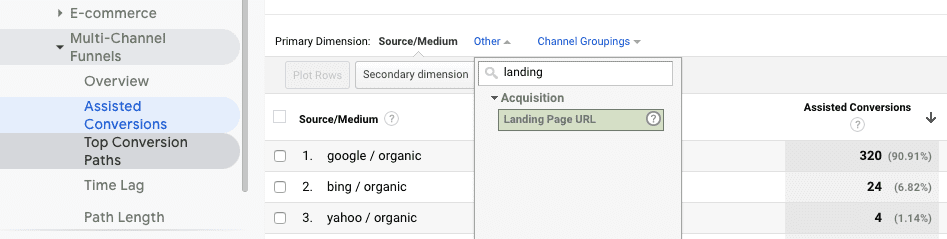
Head to Google Analytics, followed by:
1.Conversions
2.Multi-Channel Funnels
3.Assisted Conversions
You will be able to see all of the conversions where a channel (i.e. organic) is in the conversion path, but not the final conversion interaction. Instead, you can then select Organic Search as the Channel Grouping. By changing the primary dimension to landing Page URL, you can then see how organic users landing on your blog posts contribute to your e-commerce sales.
5 – Optimise your images
They say ‘A picture is worth a thousand words’, and it’s no different for SEO. Making sure your images are optimised can not only help you get discovered, but it can also speed up your page speed. Large high-quality images can look fantastic but can reduce the load time of your site. And with there being studies which show that the probability of a user bouncing off your page increases with every second it takes to load, it’s a crucial metric for achieving that all-important revenue. Site speed is also a confirmed ranking factor. Keep the file size as small as you can, while maintaining quality by using a tool such as Compress JPEG.
It’s also possible for images to rank where regular search results don’t.
Check to see which images are being indexed, by heading to Google’s Image Search and typing in site:www.yourdomain.co.uk. Google will show all of the images from your site in this index. Give your image a keyword-rich file name, which many brands can forget to do. Use an image format which Google indexes – with JPEG, GIF or PNG as the best for optimisation.
Use ALT tags for images on your site to tell Google what your image is about, containing key phrases which you’re optimising your page for. You can find out more about optimising your images here.
When the SERPs for products you’re selling are dominated by the usual suspects, don’t give up. SEO best practice and creative content can help you gain visibility quickly, and in the long-term with a solid strategy.
By Stanley Dunthorne,
SEO Specialist at Hallam
More must-read stories from Enterprise League:
- The golden rules you need to build a steady buyer-seller relationship.
- 10 pieces of advice so bad that they need to be forbidden by law.
- Read about the biggest mistakes entrepreneurs make and how you can avoid them.
- These are the must-have apps you’re going to need in 2020 if you’re an entrepreneur.
- How morning meditation can increase productivity during business meetings
Related Articles
Why Are Domains Indispensable for Brands?
read more

Need to Hire Professionals for a Store Remodel Project? These Are Your 7 Best Options
Finding the right team to hire for your store remodel makes all the difference between a smooth rollout and a costly delay. From fixture installation to full-scale resets, these experts will shape how your space performs for years to come. Here are seven of the best...

What’s the Best Value Synthetic Paper for Outdoor Signage? These Are the 5 Top Options
Introduction Your outdoor signage needs to be durable and weather-resistant for it to last long and be effective for outdoor advertising. The right synthetic paper can deliver returns on your investment by significantly enhancing the visibility and longevity of the...
Organic Marketing vs Paid Advertising: Which Should You Choose?
When you're looking to build a business, you may have at least once asked yourself this question: Should I go with ORGANIC marketing or PAID marketing? Sometimes, this is not always an easy question to answer. Both of these can work for you to drive customers, build...
Why Are Domains Indispensable for Brands?
Every brand's story needs a digital home. A web address goes beyond mere technical need. It acts as the digital front door where customers, partners, and investors form their very first impression. Consider the well-known global brand names that you personally trust...