
10 business tips for beginners to help you build a healthy brand

10 business tips for beginners to help you build a healthy brand

10 business tips for beginners to help you build a healthy brand

January 02, 2025

Business tips for building a healthy brand

Starting a business is exciting. Your mind will be brimming with ideas and feelings of eagerness to get started. Knowing where to start might not seem important, but it can save you a lot of money in the long term, and be pivotal to your brand’s success.

We learned the hard way, having launched Xite just after we left university, we’ve rebranded about three times and made mistakes along the way. The good news is that all our hard work has paid off and we have a growing customer base of fans who genuinely love the product.

So here is what we wish we knew before we started out, and would have helped us to reach where we are now, a lot quicker.

Treat your brand like it’s a human

It should have its own personality, goals, name, values, voice, opinions and its own network of friends, and even a few enemies (competitors). Crafting this step first will uniform all of your communications to your audience. It will ultimately mean you retain a highly engaged audience as a result.

Any brand with a loyal following, and good engagement has spent time on this. 

At XITE Energy, our values are around fun, excitement, motivation and health. This is something we amplify across our communications channels, social media, and is echoed by every member of our team. The less ‘business sounding’, but more human your brand is, the more engaging you are.

It really helps to bring your brand alive and makes you authentic. People interact with brands because they mirror similar values to their own and embody personalities that they like. If your goals are to get lots of followers, likes and comments on your social media, this is how to do it.

Plan first

It seems obvious, but you wouldn’t believe how often this gets skipped. Planning will save you time, allow you to be more strategic with your marketing, and essentially get you the best ROI.

A good place to start is planning your annual marketing calendar divided up by quarters (Q1, Q2, Q3, Q4), and tying this in with sales promotions, key dates in your MACRO environment, and when you intend to launch new products. 

This means, ahead of time, you know what resources you need to plan for, how to tease the best social campaigns. Having this down visually means you can plan your budgets, and yearly spend wisely, and sharing this with the whole team means your internal comms will be a force to be reckoned with.

Change is inevitable

The important element to consider here is being aware of which changes you can control, and those you cannot.

Changes you can control are your monthly spend, your team recruits, or anything to do with your planning and decision making.

As for changes you can’t control… I think Covid-19 has done a pretty good job of showing the world what that means.

Being aware of these changes with a PESTLE analysis versus internal forces you can control, will mean you are prepared to be reactive to serious changes in the external environment. You might not be able to control them, but you can be well equipped with a contingency plan and mitigate any worst-case scenarios.

Focus on performance

There are a lot of exciting, big ideas that you may be keen to spend money on. In the beginning, your outgoings will be more than your incoming. So it’s time to manage your own expectations that you probably won’t be making any money anytime soon.

What you can do, is focus on conversions. Plan and do everything with your end-goal in mind, the sale. Base your marketing strategy on performance marketing tactics, for example, SEM and SEO with a measurable goal of driving traffic to your optimised website. Do your due diligence on researching those.

Network and contacts are your currency

As the old saying goes – “it’s not what you know, it’s who you know”. You might already be privileged to have grown up with a network of great contacts through family or friends. However, for most of us, it’s a case of on-going networking, building a base of strategic contacts – LinkedIn and Enterprise League are huge tools for this. A good network can mean you get in front of the right audiences, and the best part is that it’s free.

(Cliché incoming) Don’t run before you can walk

Again, this sounds obvious, but many have learned this the hard way. By going after too much too soon, you can run out of money, and end up bankrupt before you’ve even made it through your first year as a business owner. It’s the harsh truth, but you’re better off planning, testing, and learning what works for you progressively.

Be logical, be systematic

There are logical steps to brand building. That starts with “why”, your USP, brand name, mission statement, core values, target audience, market data, what your goals are, and how you want to be perceived. When this is nailed, this should then inform every. Decision. You. Make.

Know what you’re trying to achieve. Is it reach? Or engagement? In a campaign are you focusing on brand awareness? Or conversions? You can’t focus on both. Needless to say it defeats the object of having a “focus” altogether.

Knowing your objectives will enable you be able to take logical, and systematic steps to get there.

Make trade-offs essential to your decision making

Weigh everything up. Knowing the value of money will be pivotal to your success. Ask yourself questions every day with whether £1k might be best spent up on influencers, or is it best spent on Google ads. Maybe it’s a 60-40% split, or ratio. Work out the estimated ROI before you make your decision. 

Even more important, is knowing the financial value of your time. “Time is money” couldn’t be more true, especially when your outgoings are team wages, and your own wages. Am I making the best use of my time driving to drop this delivery to a customer myself? Or is it more time and money efficient to just spend £4.99 on postage? A good way to rationalise this is through basing your time on around £10 an hour – if it costs less than £10 to post it, post it. You could be spending that hour on making a huge deal.

When building your brand, start from the “why”

Simon Sinek says “It’s all too easy to fall into the trap of marketing your products based on the core product, its attributes, its features.” In our case, this was talking about the naturally sourced caffeine from green coffee beans, the active nootropics for cognitive health and function, and the health benefits with our specially selected B vitamins, supported by empirical research we spent months on during our NPD.

Start with your brand purpose and its reason to exist. Simon Sinek calls this the “why”. Maybe yours is to reduce climate change, to disrupt the status quo, to connect people together, or in our case; to motivate people to achieve their ambitions, or “do what Xite’s you”.

It’s also worth having a think about what brand archetype you want to fall under and get your tone of voice nailed early on.

What works for other brands won’t necessarily work for you

By all means, learn from case studies and examples around you. But it’s a rookie error to assume that because a strategy works for another brand, that it will work for you. Don’t try to mirror exactly what another brand does, because it won’t work. Be unique. And if you’re not unique, what value are you bringing with a new business? If you don’t have a USP, you might as well not waste your time and money on asking people to buy into something they’ve seen before a thousand times.

Conclusion

These tips aren’t magic solutions, but they’re proven “tactics” that have helped countless businesses grow from scratch into healthy brands. Remember, every successful company you admire today started somewhere, probably making the same rookie mistakes you might worry about.

More must-read stories from Enterprise League:

Related Articles

Which HACCP Certification Bodies Are Credible? 8 Top Options

Which HACCP Certification Bodies Are Credible? 8 Top Options

Food businesses face increasing pressure to demonstrate that their products are produced under effective food safety management systems. Whether supplying retailers, restaurants or international markets, many organizations pursue Hazard Analysis and Critical Control...

read more

Related Articles

SEO writing: Five foolproof tips to secure you the first page

SEO writing: Five foolproof tips to secure you the first page

SEO writing: Five foolproof tips to secure you the first page

January 02, 2025

Five foolproof tips for SEO writing

Everyone wants to create content that ranks for a specific keyword perfectly. SEO writing is the only way that can help you produce content that people search for on Google. 

But when it comes to SEO writing, things become harder to accomplish. 

In this guide, you will get all the necessary information on SEO writing along with a few actionable tips to succeed. 

Let’s start!

The essence of SEO writing

As you know, nobody enters on the second page of Google search. Each of us reviews the first ten results of the SERP only. Moreover, we tend to click on the links from the top five positions. But what happens to the rest of the content? This content falls at the edge of the earth and it will never get an opportunity to be read by your target audience. Oppositely, writing SEO optimized content will help you boost your traffic and get more potential leads to your website. To be able to create such well-optimized content, you might need a powerful team of professional writers. You can build your personal in-house content writers department or hire a freelancer who would satisfy your content objectives. For instance, here is the progress of Visme blog for the past few years. We have grown our blog from ~800 to ~488K monthly visits.
To create SEO content you must understand what people are searching for on Google. Consequently, you must align your content per your audience’s needs. You might wonder how to write content with SEO in mind? To help you out, review the following three steps that you should consider before starting the process of writing.

Explore keywords with traffic potential

You should start by reading the content that people write within your business niche. It will help you identify the main (seed) keyword people type on Google. Yes, choosing the right keywords is important but it doesn’t mean you must read content from your competitors to identify them. You can think by yourself what would your target audience type on Google to find your service. Let’s say, you write a piece of content for a website that sells sports nutrition. Your seed keywords would be “sports nutrition” and “sport supplement.” The next step is to identify keyword phrases and questions that would be based on your seed keywords. You can use Keywords Explorer tool and review a few reports. The first report is “Questions” which suggests to you all possible questions that contain seed keywords.
Ahrefs keyword research example using 'Questions' option
The same analysis you do with your seed keywords using “Phrase match” report. This report lists the queries that are sorted by the monthly search volume.

Identify search intent

Google chooses what content to show people according to their search intent. Search intent is what the person wants to find behind a query. In other words, you must understand all possible “why” and “what” that your content must cover to satisfy a user’s needs.

To make sure your content goes in line with the search intent of your target audience, you should fulfill the next three conditions:

  • Choose the correct content type

The most straightforward way to understand what type of content you should put money on is by exploring the top positions on Google. It will tell you what type of content ranks well and you should take it into account.

For example, if your target keyword is mainly used across interrogative queries like “what is the difference between organic and paid search“, you will get such content types as blog posts, articles, or videos.

{screen}

However, if your target keywords don’t have informational intent, you won’t rank for blog posts. You will rank for video content or attract your target audience to your product pages.

manual keyword research
  • Think about content format

It won’t be hard to understand what content format you’re willing to create. There are a few standard formats to choose from – listicle, how-to guides, expert roundups, etc.

  • Work on exploring content angle

Content angle reflects the purpose of your content. To put it simply, you must understand what message you want to send. To give you a clear idea of what it means, let’s analyze this very post per these three aspects.

1) Content type is “blog post”

2) Content format is “guide”

3) Content angle is providing concrete actionable tips on SEO writing for the beginners

Keep in mind these nuances and move forward with implementing the next tips.

Proceed with the determination of subtopics

You already have your target keyword. You know what type of content you’re going to write. You know in what format content will be created. Plus, you decided what angle content will take. 

What is the next step?

The next step is to figure out subtopics for your future writings. Three ways will help you here. Let’s review them:

  • Analyze your competitors’ content

Must admit that this is a cool idea to analyze content created by the competitors. Just type your top priority query on Google and review the top pages it suggests. Afterwards, review the outline for each post paying attention to headings. For instance, this post on explainer video covers different subtopics that you could cover in your content as a separate topic.

  • Review “People also ask” section

“People also ask” section can provide you with more topic ideas. These are the variations of what people might also be looking for on Google based on your primary keyword. 

  • Explore what your competitors might rank for

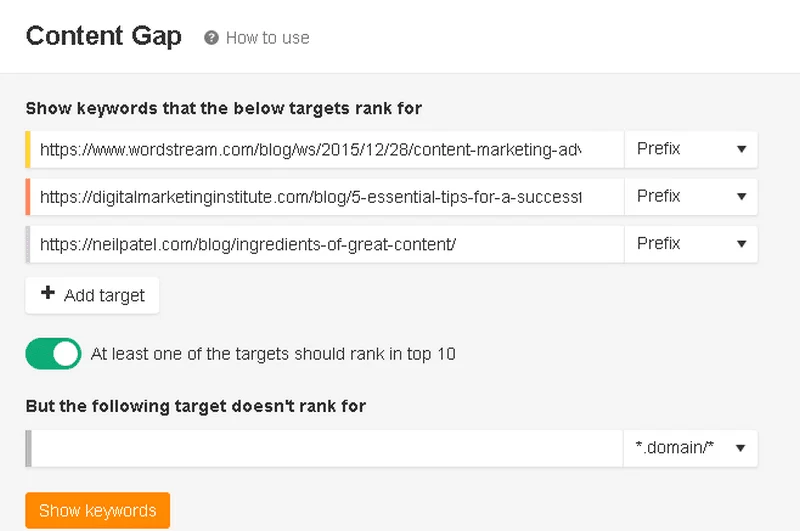
If you want to be ahead of your competitors, you must explore other possible keyword ideas and topics they rank for. One of the best ways to do this is by using Content Gap tool. Just paste your competitors’ URLs and hit the “Show keywords” button.

Review the results and compare them with each other. Focus on those keywords that are used by all the competitors you’re analyzing. 

Once all the preparations are done, you can start writing the post. Nevertheless, continue to read and you will find out five SEO writing tips.

SEO writing tips

It won’t be hard to guess that SEO writing aims to create content that would rank high on Google and attract traffic to your website. Consequently, without knowing some SEO tips you won’t be able to write optimized content right off the bait. 

Here are five tips that will help you drastically.

Create a perfect title

Without a proper title tag, you won’t get neither traffic nor CTR from your target audience. Hence, review the titles of the pages from your competitors and think about how you could write the better one. 

You must use a target keyword in the title tag + keep in mind search intent you have identified at the beginning stage. Try to make every title tag unique that would make people never bounce back from the page.

Short URL

If you want to create SEO-friendly content, you should start with the URL of the post first. Basically, any URL must be simple and easy-to-read. It must include a primary keyword and you should keep it short.

Work on featured snippets optimization

Being featured in “featured snippets” is a wonderful opportunity for your content to be easily noticeable by a target audience. To be able to optimize your primary keyword snippet, you must understand the exact format that would meet the requirements of a future featured snippet. Afterwards, create content accordingly.

Internal links

Internal links are one of the on-page SEO elements you should never ignore. Plus, these links are good for user experience. Remember, you can’t cover everything in one topic. All additional subtopics related to the main topic can be covered in separate posts on your blog. Internal links help your target audience to navigate on your blog reading information from other articles thereby. 

Add images

Images make your content more engaging for your audience. It helps people to absorb information visually. Just imagine if you read this very guide without images and screenshots. I bet you would leave it without compunction.

Conclusion

Summing up everything mentioned in this post, SEO writing is not about using the right keywords, ranking, and traffic. These elements are just a part of the game. The main course of the process is creating readable content that would help the audience to solve the problems.

As a bonus for your efforts, you get traffic to your website and ranking positions.

More must-read stories from Enterprise League:

Related Articles

How to onboard a new employee: Tips for quick integration

How to onboard a new employee: Tips for quick integration

How to onboard a new employee: Tips for quick integration

January 02, 2025

How to onboard a new employee

Onboarding a new employee is a method of integrating a new staff member with the firm and its culture. It is also a means of getting a new staff to hire the information and tools needed to become an effective and productive member of the company. 

When it comes to onboarding a new employee, it should be a strategic process and should last at least a year.  Experts claimed that the way employers manage the first few weeks or months of a new staff’s experience is critical to warranting high retention. 

Everything you need to know about how to onboard a new employee

To ensure a successful onboarding of newly hired employees, there must be an optimistic mindset in the workplace and detailed planning. Additionally, whether you have a small, average, or large company, you need to know how to onboard a new employee and make them feel valuable from the get go. Here are some possible steps that will assist you in the onboarding procedures:

Utilize checklists

Checklists during the onboarding process will assist you in systemizing your company. Through this, you will improve a specific scheme that can be awe-inspiring to some personnel. Having an onboarding new employee checklist also focuses on the significant hiring steps.

Onboarding new employee checklists include procurement of new hire devices or equipment, setting accounts, scheduling new hire orientation, performing a company tour, preparing new hire paperwork, and many more.

Curate an onboarding guide

Companies manage an internship that begins with a five or six-month stint. To manage this internship program, it is best to curate all the most effective reading materials on the field, the external content, and the company’s internal process into bite-sized pieces in an all-inclusive guide.

Through curating an onboarding guide, newly hired staff will be guided on what to do and how they are expected to function in the company.

Work directly with the new hires

Having a new employee at the office needs direct supervision, especially during one or two weeks. As an employer, it is best to shadow new employees for a couple of days. Through this, newly hired staff will know that there is someone who is willing to assist them. They can freely ask some questions needed to complete their tasks and know how the company works.

This scheme is also a perfect avenue to know more about your staff. Moreover, you will analyze their skills and level of understanding during the orientation process. You can also use this to check whether that newly hired employee needs more training or can directly work on their own after a week or month.

Provide a mentor

Having a new staff at the office is quite a challenging task. You have to orient that person and need to ensure that they are aware of their functions and tasks. To ensure that they will meet your expectations, it is a must to provide a mentor. A mentor will serve as their ultimate guide in completing the things that they need to accomplish.

However, there is always a limitation when mentoring a staff. It is best to let them work on their own after a series of training and orientation. An empowered employee should practice minimal supervision.

Advocate a repeatable procedure

If your company is growing fast, it is a must to enforce a repeatable and scalable process. It means that you will put your new hires through a structured, organized onboarding procedure. The main purpose of this is to ensure not only getting everything they need to be productive but also to ensure that each staff begins the same way. This prevents new employees from being branded into their units from the beginning.

Let them meet the customers

This is one of the best ways for a newly hired staff to understand your offered products and services better. By placing them in customer service, they can know what your company is offering to the target clientele. This is also a perfect way to learn basic operations in your business.

Above all, they can easily become more empathetic to the needs of the most valued customers. Placing them in customer service also makes them better equipped for their hired tasks.

Expose them to your business

An ideal way to integrate a new staff is to expose them to your company right away. Say, for instance, you can get a staff on a team that will serve as the middleman in the project. Then, let the newly hired staff show off their skills by putting them as a member of the team. 

To ensure that you will have a competent staff that is not procrastinating at work due to lack of knowledge, it is best to set up your new hire to engage at a high level of business exposure.

Monitoring and feedback

Every new employee has the right to know whether they are doing their tasks or not. A week after the orientation and supervision, you need to set up a one-on-one talk with your staff. You need to tell them the strengths and weaknesses that you have observed. You may also provide some tips and proper intervention to improve their work if needed. 

Talking to your staff is also a perfect way of building a more human connection. You will know them deeply and understand their behaviors as well. Other ways to onboard a new employee include proper communication and allowing them to be part of multiple teams.  

Bear in mind that onboarding a new employee can be a stressful and overwhelming process. It would be a case scenario if the newly hired will feel the same way during the process. So, maximize the benefits of mentoring programs to ensure that you will have a successful onboarding.

Conclusion

If a company is not effective in onboarding new employees, it can lead to reduced confidence, low employee morale, a decline in the level of employee engagement, and many more. All of these results can lead to missing revenue targets and company milestones. Having a concrete step by step approach on how to onboard a new employee will allow the new hire to integrate with the core team faster and without any drama.

More must-read stories from Enterprise League:

Related Articles

6 tips on how to delegate work so it actually gets done

6 tips on how to delegate work so it actually gets done

6 tips on how to delegate work so it actually gets done

December 30, 2024

How to delegate work efficiently

Delegation should not be confused with work allocation. Delegation is you transferring some of your workload which probably means it comes with additional responsibilities and accountability, whereas work allocation is just handing out tasks. That’s why it is crucial to understand how to delegate work efficiently.

As it is your own workload you are delegating out you are obviously going to want to make sure it gets done and it is done right. That’s why it is crucial to understand how to delegate work efficiently. There are various factors to consider when delegating your work.

Know when to delegate work

For me, I think this is the crucial one as there are some things that you shouldn’t delegate. Not because they wouldn’t get done but wouldn’t be done right. Dependant on your company structure this would vary but things such as disciplinaries, recruitment decisions, difficult conversations, business objectives/goals or anything that may affect the business (if you are the business owner). 

Don’t delegate things that you feel uncomfortable doing because chances are who you delegate to will also feel this way and have no one to ask for support. You also don’t want to be known for delegating rubbish because eventually you will end up doing it all yourself.

How to delegate work so it actually gets done

There are various factors to consider when delegating work.

Know when to delegate work

For me, I think this is the crucial one as there are some things that you shouldn’t delegate. Not because they wouldn’t get done but wouldn’t be done right. Depending on your company structure this would vary but things such as disciplinaries, recruitment decisions, difficult conversations, marketing KPIs, or anything that may affect the business (if you are the business owner). 

Don’t delegate things that you feel uncomfortable doing because chances are who you delegate to will also feel this way and have no one to ask for support. You also don’t want to be known for delegating rubbish because eventually, you will end up doing it all yourself.

Know your team

You need to make sure the work is delegated to the right person and this is where knowing your team or colleagues comes in. It’s not just about whether they can do it which we cover next.  Firstly, it’s understanding if they have the capacity to complete the work. For the eager beavers who are willing to take on any additional responsibility, can they really manage the extra workload or is something going to be sacrificed? For the skilled person to do it, does it motivate them and make them want to do a good job or will it just be another mediocre job? Or even a job completed at all.

Play to strengths

This again comes down to knowing your team, but this is knowing their skills and strengths and maybe more importantly what fires them up. From their daily tasks or work, they have done for you in the past what puts the fire in their belly, and the type of work they love to do? It’s human nature that if you enjoy doing something you will put more effort in and make sure it is done to a high level/of quality and within the deadline. Delegation can be seen as an opportunity if they are taking on additional responsibilities so make sure this is what they want.

Clear information

When delegating work, you need to make sure that all of the relevant information is provided including the problem, any expectations or specific criteria, any budget implications, and the deadline. Checking that your colleague understands is always good to do by asking if they have any questions or how they are going to resolve/complete the work. Be careful when doing this though as you may come across as controlling and micromanaging.

Recognition

When delegating, don’t pass over the information and hope that it gets completed or even micromanage. Make it clear that you are available to provide any support and guidance and available as a sounding board. You will be appreciated more for this and more likely to delegate work again confidently and quickly. Others will also see that if they take some work from you that the support is there.

Provide support

Everyone loves praise even if they don’t admit it, deep down they are smiling which is why thanking people or recognizing the work carried out is such a great motivator for people to do a great job again and on time. It also shows what a great leader you are, and that people will be happy to take work from you.

Conclusion

It is important to delegate if you want to take your business/team forward as always being a doer will not give you that time to focus on goals and objectives. Learning how to delegate work the right way will help you avoid delegating to the same people every time especially if it is project work or something that comes with high kudos. This may start to cause negativity within the workplace and not the workplace culture you want to achieve, be sure to take into account the points above.

More must-read stories from Enterprise League:

Related Articles

25 support small business quotes to inspire you (2026)

25 support small business quotes to inspire you (2026)

25 support small business quotes to inspire you (2026)

November 13, 2024

Small business quotes to inspire you

Small businesses are the backbone of local economies and communities. When you shop small, more money stays in your community to support jobs and neighborhood vitality. Small business owners also often provide specialized products and services tailored to community needs.

And if it takes a list of quotes about supporting small businesses quotes to inspire you to buy a book from the independent bookstore around the corner, and not from Amazon; or to wear handmade knitwear from your neighbour’s modest store, instead from Zara; or shop for fresh veggies and fruits at the local market, as opposed to the giant chain supermarkets – then we’re hope quotes will inspire you to support small businesses.

30 quotes about supporting small businesses

Most of these supporting small business quotes are from anonymous sources and that brings them even more value. Because it means these support small business quotes came from ordinary people like us – people who understand our daily lives – and not billionaires who’ve lost contact with the real world and preach from their glassy towers.

1. A small business is an amazing way to serve and leave an impact on the world you live in. – Nicole Snow

2. A big business starts small. – Richard Branson

3. When you support a small business, you support a dream. – Anonymus

4. “When you support small business, you’re empowering local dreams, not corporate giants.” – Unknown

4. When you support handmade you are not just supporting a person, small business, family, our economy; you are purchasing a small part of an artist’s heart. – Anonymus

5. Supporting another person’s success won’t ever damper yours. – Anonymus

6. When you buy from a small business, an actual person does a little happy dance. – Anonymus

7. If each of us spent $100 a year more on supporting local businesses instead of chain stores, it would put an extra $3 million a year into our economy, not only that but it would create thousands more jobs. – Anonymus

8. When you buy from a small business you’re not helping a CEO buy a third vacation home. You are helping a little girl get dance lessons, a little boy his team jersey, a mom put food on the table, a dad pay a mortgage or a student pay for college. – Anonymus

9.  Every small purchase makes a big difference. – Anonymus

10. Support your friend’s business and progression like you support the celebrities that you actually don’t know. – Anonymus

11. You can’t buy happiness, but you can buy local and that’s kind of the same. – Anonymus

12. When you support a small business, you support a dream. – Anonymus

13. Support your friends. Don’t ask for free stuff, pay for it. Go to their shows, be the first to buy their products and promote their ideas. – Anonymus

14. Every time you spend money you’re casting a vote for the kind of world you want. – Anna Lappe

15. When you buy something made by a person, there is something special there, and you feel it. The consciousness with which a thing is made is often more important than the thing itself. – J. Donald Walters

16. Today we celebrate side hustles that became main hustles, dreamers that became doers, maxed out credit cards that became thriving businesses, big fails that became big wins, and individuals with ideas that became teams with visions. – Anonymus

17. “A small purchase can create a ripple effect of positive change in someone’s life.” – Unknown

17. Giving a gift from a small business is giving a gift twice. – Anonymus

18. The best compliment you can give is a referral. – Anonymus

19. If we want to have these amazing small businesses, we need to actively seek out and support those who put their necks on the line to chase down a dream. Sometimes it may be a bit faster to zip through the drive-through line, but I can almost guarantee that the personal service and higher quality product will be worth the extra minute it may take. It could be a lasting relationship that holds more value in the long run. – Branch Street Coffee Roasters

20. We need to keep our small businesses healthy in order to keep our economy strong.  – Keith Haynes

21. Celebrity makes $80+ million a year, you will never meet them. You pay them full price or extra for what they sell. A small business owner makes $25K – $100K a year, they live next door, and you want a discount. – Anonymus

22. Small businesses provide the feeling that a real person is behind it all, someone who cares more about giving us a quality product or service, over just taking our hard-earned dollars. – Annia Bukhman

23. “Every purchase from a small business fuels a family, strengthens a community, and builds a brighter future.” – Unknown

Conclusion

When you get right down to it, small businesses are a huge part of what makes our communities special. They’re our neighbors, friends, and local partners in making our communities thrive. However, all the efforts would be pointless if the customers don’t see the importance of shopping at small, independent stores. So if you’re a customer, we hope these support small business quotes awakened something noble in you.

More must-read stories from Enterprise League:

Related Articles

10 essential tips to manage a small law firm

10 essential tips to manage a small law firm

10 essential tips to manage a small law firm

October 04, 2024

Essential tips to manage a small law firm<br />

Running a small law firm is a balancing act that requires a unique blend of efficiency, adaptability, and effective management. Unlike their larger counterparts, small firms must juggle multiple responsibilities, from staffing and technology to client relations. To thrive in this industry, small law firm owners need practical strategies that optimize operations and foster sustainable growth. This guide will explore essential areas that small law firm leaders should prioritize to ensure their firm’s success.

Set clear goals and metrics for success

Running a small law firm without defined goals is like traveling without a map—you won’t know if you’re headed in the right direction. Establishing clear, measurable objectives provides focus and benchmarks to evaluate your firm’s performance.

Long-term vision

Start by thinking big. Do you want to be the go-to firm in a specific legal practice area? Do you want to expand your staff or open new locations? These long-term ambitions shape your firm’s future. Once the vision is clear, it becomes easier to break it into manageable steps.

Measurable short-term goals

Turn your long-term vision into achievable goals. For example, if your aim is to increase revenue by 20% in the next year, set measurable quarterly benchmarks. This could include increasing consultations by 10% or improving case conversion rates. Achieving small milestones keeps progress on track.

Performance tracking

Regularly monitor the following key metrics:

  • Revenue growth: Is your firm’s revenue increasing as projected?
  • Client acquisition rates: How many new clients are signing on each month?
  • Case outcomes: What’s your success rate in different types of cases?
  • Billable hours: Are you maximizing billable hours compared to non-billable administrative work?

These performance indicators help you spot trends early and course-correct when needed.

Prioritize efficient time and task management

Time management is vital in small law firms where attorneys and staff juggle multiple responsibilities. Efficient use of time ensures your firm runs smoothly without overwhelming your team.

Tip: Use legal practice management software like Clio or MyCase to track how much time is spent on different tasks—both billable and non-billable. This provides insight into where time is being lost and where improvements can be made.

Delegation

Small firm owners often fall into the trap of doing everything themselves. Avoid burnout by delegating tasks. Use digital tools to assign tasks, track progress, and ensure accountability. Freeing yourself from non-billable tasks allows you to focus on what matters most—client work and strategy.

Prioritize high-value work

Focus on high-value, billable work, and let administrative staff handle time-consuming processes like organizing case files or handling client intake forms. Your time is better spent delivering legal services that generate revenue.

Invest in legal technology

For small law firms, legal technology is essential to streamline operations and minimize errors, as investing in the right tools can help scale without significantly increasing overhead costs. Several key technologies to consider include practice management software like PracticePanther or Clio Manage, which bring everything into one platform—billing, document management, scheduling, and client communication. 

Cloud-based systems are critical for remote or hybrid work environments, allowing teams to access case files from anywhere, though surprisingly, many small law firms have yet to adopt this technology. Additionally, automating repetitive tasks like document drafting or follow-up emails allows focus on more complex legal work without getting bogged down in administrative duties. Ultimately, leveraging legal technology enables small law firms to compete with larger firms by being more efficient and responsive to clients.

Focus on client relations and communication

Small law firms have a significant advantage over larger competitors due to their ability to offer personalized service, which fosters strong client relationships through clear and consistent communication. Freeman Law Firm, Inc in Washington State exemplifies this approach with its client-centered philosophy, as highlighted on its website: “We believe that every client deserves personalized attention, empathy, and understanding throughout their journey.” This commitment to client care contributes to long-term success, as demonstrated by their positive client reviews. Key strategies for building strong client relationships include:

  • Setting expectations early: Ensure clients understand the timeline, fees, and steps of their case to prevent misunderstandings and build trust.
  • Frequent updates: Provide regular updates to clients, even with minimal progress, to reassure them that their case is being actively managed. Using client portals can enhance communication and reduce unnecessary phone calls.
  • Client management tools: Implement Client Intake and CRM systems to track leads and client interactions, set reminders, and maintain timely communication, ensuring that no client falls through the cracks.

Build a strong team culture

In a small law firm, where every individual’s contribution is highly visible, fostering a strong team culture is paramount. Creating an environment where staff feel valued significantly improves morale, productivity, and overall firm success. Key strategies for cultivating a positive team culture include:

  • Open communication and transparency: Regular team meetings and open communication channels ensure everyone is aligned with the firm’s goals and understands how their role contributes to its success.
  • Investment in professional development: Providing opportunities for continuing legal education (CLE) courses, workshops, or certifications keeps the team sharp, engaged, and motivated.
  • Recognizing and celebrating achievements: Acknowledging individual and team accomplishments reinforces a sense of value and belonging, fostering loyalty and a positive work environment.

Manage finances wisely

Financial management is a key component of running a successful small law firm. With tighter budgets, it’s essential to keep a close eye on cash flow and expenses.

  • Step 1: Create a detailed budget Every expense matters. From office rent to software subscriptions, make sure everything is accounted for. Also, include hidden costs like filing fees or travel expenses that may arise unexpectedly.
  • Step 2: Track billable hours efficiently Using legal billing software like QuickBooks for Lawyers helps track hours and sends invoices promptly. This ensures you maintain a healthy cash flow and avoid missed billing opportunities.
  • Step 3: Proactively manage collections Late payments or unpaid invoices can significantly disrupt your cash flow. Have a clear process in place for following up on overdue payments, such as automated reminders or personal outreach to clients.

Market your law firm effectively

Marketing plays an essential role in growing your client base. For small law firms, it’s not just about having a presence, it’s about reaching the right people through strategic and cost-effective methods.

Search engine optimization (SEO)

SEO is one of the most powerful tools for generating leads. Ensure your website uses relevant keywords based on your location and practice area, like “Houston real estate lawyer” or “Los Angeles family law attorney.” Optimizing your content for local search terms can drive organic traffic to your site.

Social media and content marketing

Social media platforms like LinkedIn and Facebook allow you to share legal tips, blog posts, and case studies. Regularly posting valuable content not only positions your firm as an authority but also keeps your services visible to potential clients.
To operationalise these channels, map a 90‑day plan that aligns SEO, PPC, content, social, and email into measurable campaigns tied to intake goals. For a step‑by‑step law firm marketing playbook covering 2025 strategies, keywords, local SEO, ad budgeting, editorial calendars, and conversion tracking, use it as a template for your firm.

Client reviews

After successfully completing a case, ask clients for a review. Positive online reviews improve your firm’s reputation and make it easier for new clients to trust you.

Stay compliant with legal ethics and regulations

Maintaining compliance with legal ethics and regulations is critical to protect your firm’s reputation and avoid legal complications. Smaller firms may have fewer resources, but that doesn’t diminish the importance of compliance.

Confidentiality and data security

Confidentiality is non-negotiable. Ensure you’re using encrypted platforms for client communications and secure storage for all sensitive information, whether stored locally or in the cloud.

Trust account management

Mismanagement of client funds is one of the most serious ethical breaches. Be diligent with trust accounts, keeping them separate from operating accounts. Consider using legal-specific software to help track and manage client funds.

Continuing legal education (CLE)

Staying compliant also means keeping up with state-specific legal requirements. Attending regular CLE courses ensures you stay up-to-date with changing laws and regulations.

Use data to make informed decisions

Effective decision-making requires data, not just gut feelings. Data-driven decisions help you optimize operations and allocate resources effectively. What you ned to track is:

  • Client conversion rates: How many consultations turn into paying clients? If the rate is low, review your intake process or client communication.
  • Billable hours vs. non-billable hours: Are you spending too much time on tasks that don’t generate revenue? Adjust your time allocation to maximize billable work.
  • Revenue per case: Which types of cases bring in the most profit? Use this insight to focus on the most profitable practice areas.
  • Data-driven adjustments: Regularly reviewing these metrics enables you to make informed decisions, from marketing investments to staffing changes.

Be adaptable and open to change

The legal industry is always changing, and small firms must be agile enough to keep up with new technologies, regulations, and client expectations. That’s why you need to embrace innovation and not be afraid to adopt new tools, whether it’s a more efficient case management system or automated client intake software. The same goes for staying ahead of trends and by that, we mean keeping up with industry changes by subscribing to legal journals, attending conferences, and networking with other attorneys. 

Staying ahead of trends allows your firm to adapt quickly, ensuring that you remain competitive in an evolving market. Last but not least, don’t forget to involve your team. Keep in mind that your staff can provide valuable feedback on how things are running. Regularly seek their input, and don’t hesitate to implement their ideas for improving internal processes.

Conclusion

Managing a small law firm is no small feat, but by setting clear goals, leveraging technology, focusing on client relations, and staying financially disciplined, your firm can thrive. Success requires strategic planning, adaptability, and ongoing refinement of your processes. When you prioritize efficiency, compliance, and positive work culture, you lay the foundation for a sustainable and profitable firm that provides excellent client service.

More must-read stories from Enterprise League:

Related Articles